Why?
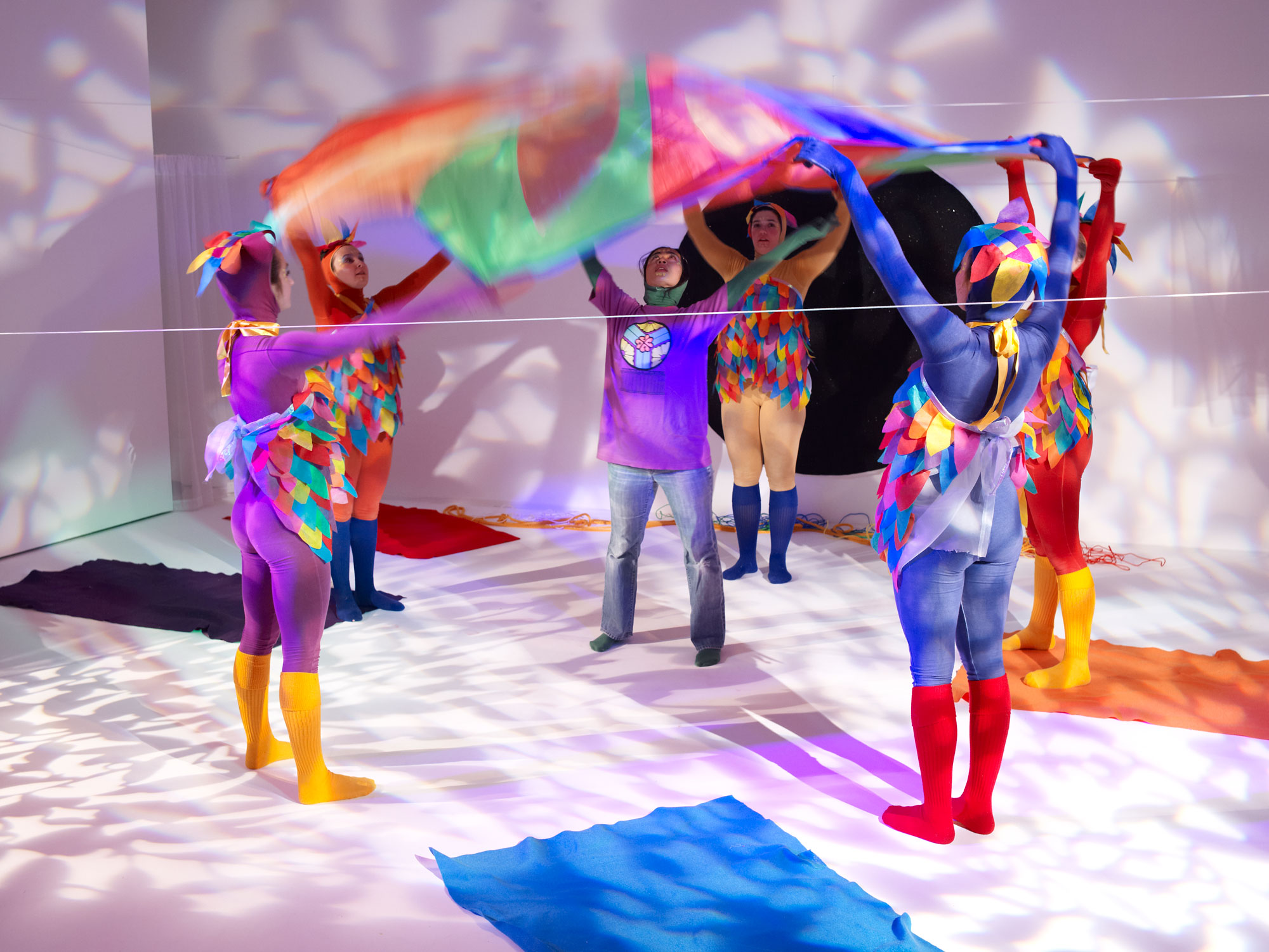
Performance art is one of the primary time-based genres—rooted in experimental theater, dance, and musical performances. Performance is centered on the human body, but is not relegated to just the artist’s body. Experiencing performance as an artist/performer, audience member, and participant is important to understand and appreciate the genre.
Brief
Your performance project will consist of two parts:
- The live, real-time performance:
- The live performance should be three to five minutes and will be conducted in front of the class in the BFA common space in the JKB. Keep that space in mind. If you need a different space or set up, such as conducting the performance outdoors, consult with the instructor well in advance. If the concept for your performance dictates that the action should take longer than three to five minutes, you may consider the in-class performance to be an excerpt and should be treated as such. Your performance may be collaborative, participatory, and/or directed. If participatory or directed, the instructions and instruction period should be part of the three to five minutes given in class.
- A document of a performance:
- You should have also conducted the performance prior to class and documented it in some way. This could be through video, photography, and/or some material or object that recorded the performance’s actions. Think carefully about the mode of documentation and how that informs the performance. If the document is time-based, it should be three to ten minutes in total, even if the actual performance is longer. If the document is object-based, it should also be documented through photo/video to be submitted via Learning Suite or it should be submitted in class to the instructor. Be mindful of equipment and set-up you might need in order to appropriately document the performance so that the document is not merely an afterthought or hastily assembled.
Your project should be conceptually grounded, with that central concept informing how the performance is executed. Try to consider the work you are already do and dedicating yourself to. See if there is a way to formulate a performance that is in line with your existing practice so that it might become part of a larger body of work and portfolio. If you want this to be a true experiment and move away from your current body of work, that is also fine and is entirely your choice.
- Submission Checklist
- Tips and Considerations
- Equipment
- Late Policy
Grading
Assignment grades will be based on the following:
- Conceptual Concerns (40%)
Student demonstrates evidence that they understand and inventively integrate conceptual concerns. The student’s research is evident and ample given the allotted time.
- Excellent: Student demonstrates conversational familiarity with the material—making interesting connections between material.
- Average: Student is able to relate material, but not do much interesting with it.
- Below Average: Student struggles to demonstrate a grasp of the material and shows no facility in connecting ideas or new thinking.
- Execution (40%)
-
When selecting a thesis or POV, the student is able to succinctly and plainly build a case using good storytelling techniques.
This includes proper spelling, punctuation, sentence structure, grammar and formatting for written assignments; and annunciation, confidence and focused arguments for oral assignments.
- Excellent: Student understands modes of writing and presentation including style guides and is able to nimbly employ these tools in their writing and speaking.
- Average: Student makes some stylistic and formatting mistakes by ignoring provided guidance.
- Below Average: Student repeatedly makes the same mistakes and ignores instructor input and suggestions.
- Assessment/Critique (10%)
-
The student will produce a self-evaluation for each art project including the strengths and weaknesses of a given work and plans for future improvement. This will also include an accounting of time taken. The student will also be present for and participate in group critiques of projects.
- Excellent: The student thoughtfully and honestly engages in the self-reflective process of critiquing their own work and efforts. The student enthusiastically engages with group critiques, seeking ways to offer constructive feedback to other students.
- Average: The student performs a cursory and surface-level assessment of their work and efforts. They make neutral comments during the group critiques and do not fully engage.
- Below Average: The student demonstrates an inability to honestly engage with their work as it exists in the world, and does not adequately participate in group critiques, or is absent/tardy.
- Following Instructions (10%)
-
The student adheres to the guidelines provided for the course and the assignment. If the paper has a particular framework, the student adheres to that framework. If an assignment is to be submitted as a Word doc on Learning Suite, the student does not email the instructor a PDF.
- Excellent: A detail-oriented student who takes instruction and fastidiously executes it within their work.
- Average: A student who misses some details because they didn't read instructions thoroughly or take proper notes when instructions were given.
- Below Average: Student ignores basic instructions and guidance given for assignments.
Learning Outcomes Addressed
- Digital Art History and Practices
-
Students will develop a working knowledge of digital art practices, including an understanding of the theoretical implications of art in a digital age.
- Skills
-
Students will develop the skills and resources necessary to realize a wide variety of digitally-based projects.
- Project
-
Students will produce a body of work demonstrating a comprehension and engagement with the themes and concepts explored in class.
- Development
-
Students will develop the skills and resources necessary to realize a wide variety of digitally-based projects.
- General Practices
-
Students will develop a working knowledge of digital art practices, including an understanding of the theoretical implications of art in a digital age.
- Production
-
Students will produce a body of work demonstrating a comprehension and engagement with the themes and concepts explored in class.