Why?
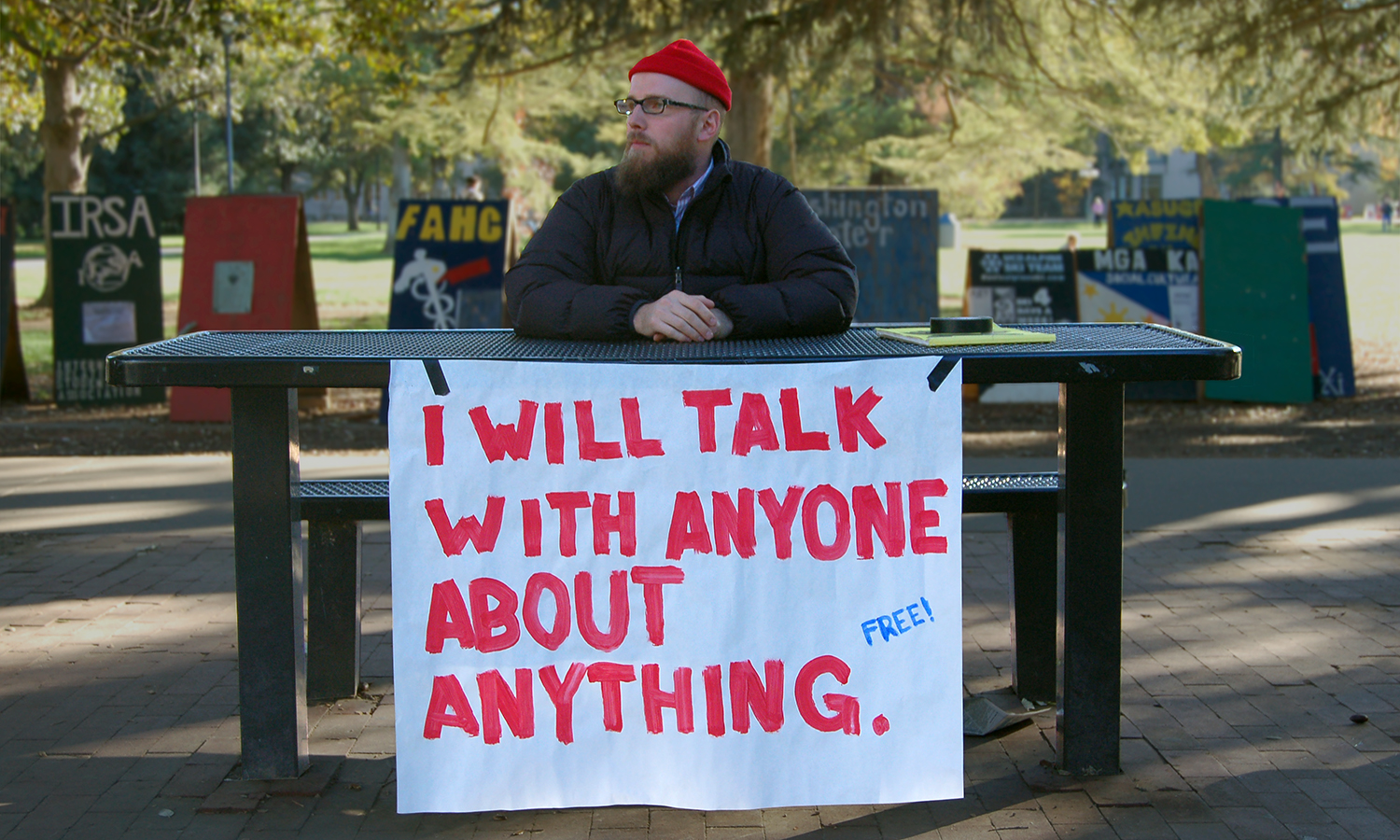
Social Practice has become a popular branch of performance art, with some universities offering it as a discipline. It moves beyond theatricality to direct social engagement and involvement. This methodology can move beyond time-based practices to encourage thinking about work that is about a thing vs. work that is a thing. For example, a painting can address a societal or political topic, while not directly effecting change, whereas a social practice project may directly engage the public in making a change.
Brief
Your social practice project should involve people as the medium or material of the work, whether that’s their debate, collaboration, participation, or social interaction. People’s participation should fall under directed, creative, or collaborative. Preference should be given to engaging a public you don’t know, but if social anxiety keeps you from working with strangers, you may work with people you know.
You will conduct your project outside of class and visually document it. You will then submit via Learning Suite and present in class (three to five minutes) a video document of your project that you have already conducted. This video should include text and/or a voice over that explains the project’s concept and execution, so it is clear what the extent of your work is.
You are also required to submit a self-evaluation along with your assignment, so leave enough time to complete the assignment and ruminate on your experience. 10% of your grade is based on your Assessment/Critique—this includes your self-assessment and participating fully in the group critique.
- Submission Checklist
- Tips and Considerations
- Equipment
- Late Policy
Grading
Assignment grades will be based on the following:
- Conceptual Concerns (40%)
Student demonstrates evidence that they understand and inventively integrate conceptual concerns. The student’s research is evident and ample given the allotted time.
- Excellent: Student demonstrates conversational familiarity with the material—making interesting connections between material.
- Average: Student is able to relate material, but not do much interesting with it.
- Below Average: Student struggles to demonstrate a grasp of the material and shows no facility in connecting ideas or new thinking.
- Execution (40%)
-
When selecting a thesis or POV, the student is able to succinctly and plainly build a case using good storytelling techniques.
This includes proper spelling, punctuation, sentence structure, grammar and formatting for written assignments; and annunciation, confidence and focused arguments for oral assignments.
- Excellent: Student understands modes of writing and presentation including style guides and is able to nimbly employ these tools in their writing and speaking.
- Average: Student makes some stylistic and formatting mistakes by ignoring provided guidance.
- Below Average: Student repeatedly makes the same mistakes and ignores instructor input and suggestions.
- Assessment/Critique (10%)
-
The student will produce a self-evaluation for each art project including the strengths and weaknesses of a given work and plans for future improvement. This will also include an accounting of time taken. The student will also be present for and participate in group critiques of projects.
- Excellent: The student thoughtfully and honestly engages in the self-reflective process of critiquing their own work and efforts. The student enthusiastically engages with group critiques, seeking ways to offer constructive feedback to other students.
- Average: The student performs a cursory and surface-level assessment of their work and efforts. They make neutral comments during the group critiques and do not fully engage.
- Below Average: The student demonstrates an inability to honestly engage with their work as it exists in the world, and does not adequately participate in group critiques, or is absent/tardy.
- Following Instructions (10%)
-
The student adheres to the guidelines provided for the course and the assignment. If the paper has a particular framework, the student adheres to that framework. If an assignment is to be submitted as a Word doc on Learning Suite, the student does not email the instructor a PDF.
- Excellent: A detail-oriented student who takes instruction and fastidiously executes it within their work.
- Average: A student who misses some details because they didn't read instructions thoroughly or take proper notes when instructions were given.
- Below Average: Student ignores basic instructions and guidance given for assignments.
Learning Outcomes Addressed
- Digital Art History and Practices
-
Students will develop a working knowledge of digital art practices, including an understanding of the theoretical implications of art in a digital age.
- Skills
-
Students will develop the skills and resources necessary to realize a wide variety of digitally-based projects.
- Project
-
Students will produce a body of work demonstrating a comprehension and engagement with the themes and concepts explored in class.
- Development
-
Students will develop the skills and resources necessary to realize a wide variety of digitally-based projects.
- General Practices
-
Students will develop a working knowledge of digital art practices, including an understanding of the theoretical implications of art in a digital age.
- Production
-
Students will produce a body of work demonstrating a comprehension and engagement with the themes and concepts explored in class.