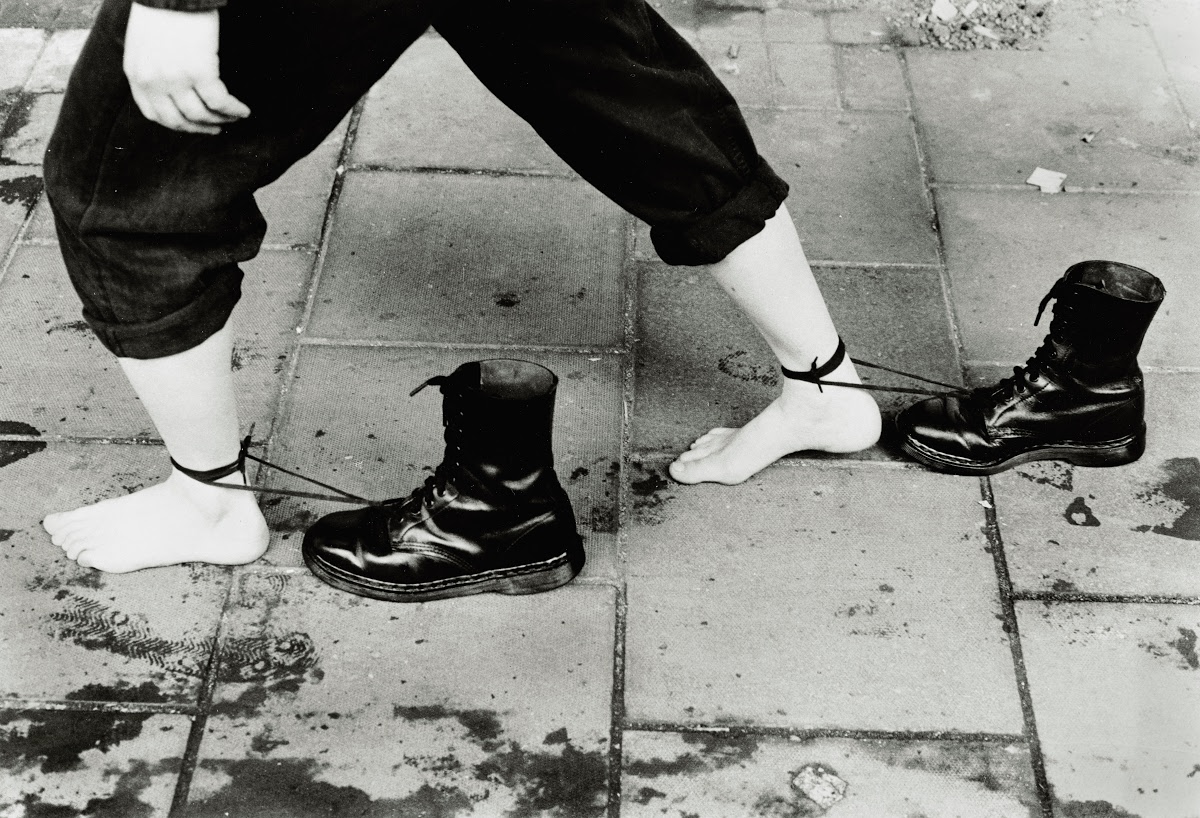
Mona Hatoum (1952–)
Performance Still from Roadworks, 1985
Black and white photograph mounted on aluminium
30 1/8 x 42 1/2 in. (76.5 x 108 cm)
Why?
To understand performance art, you actually have to see performance art. Since finding active, live performance art in Provo is unlikely, our fallback option is to watch videos of seminal performance art pieces. To really experience the performance art, you need to give yourself to it. It can be difficult since some of it is slow and difficult. Do not fast forward. Do not get distracted. Glue yourself to the screen and focus on what is happening, the gestures, the framing/angles, the artists’ choices, the pacing, all of it.
Note: Due to the nature of performance art being an exploration of the body, some material below may be inappropriate for sensitive individuals. If you have concerns, please contact the instructor and they can guide you to material that will be suitable for you.
Required
Semiotics of the Kitchen
“Semiotics of the Kitchen adopts the form of a parodic cooking demonstration in which, Rosler states, ‘An anti-Julia Child replaces the domesticated “meaning” of tools with a lexicon of rage and frustration.’ In this performance-based work, a static camera is focused on a woman in a kitchen. On a counter before her are a variety of utensils, each of which she picks up, names and proceeds to demonstrate, but with gestures that depart from the normal uses of the tool. In an ironic grammatology of sound and gesture, the woman and her implements enter and transgress the familiar system of everyday kitchen meanings—the securely understood signs of domestic industry and food production erupt into anger and violence. In this alphabet of kitchen implements, states Rosler, ‘when the woman speaks, she names her own oppression.’”
Selected Works
Includes the following documented performances:
- Fall 1, 1970 (Los Angeles)
- Fall II, 1970 (Amsterdam)
- I'm Too Sad To Tell You, 1971
- Broken Fall, 1971 (Geometric) (West Kapelle, Holland)
- Broken Fall, 1971 (Organic) (Amsterdamse Bos, Holland)
- Nightfall, 1971
Roadworks (clip)
“A lively street scene in the London borough of Brixton in the mid-1980s: people hurry along the busy streets carrying full shopping bags as they pass shabby shops and stalls. Amid all this is a young woman dressed in black walks barefoot along the dingy sidewalk. Tied to her ankles is a pair of black Dr. Martens boots, which she drags behind her, step by step. Very few people notice the young woman; some stop in amazement, shaking their heads or making fun of her display. The action, in fact, is a performance by Mona Hatoum, which the artist staged as part of an exhibition project at the Brixton Art Gallery and which she documented on video. A working-class, residential area in south London, Brixton is characterized by its multicultural population. In the 1980s, there was racist police violence against its Black residents, which led to a riot. In her performance, Mona Hatoum refers to these political events: the Dr. Martens, which she dragged through the neighborhood’s streets, were traditionally worn by the British police. Like a dark shadow, the boots seem to follow the barefoot artist, who seems naked and vulnerable. The black, lace-up Dr. Martens boots were not only part of police officers’ uniforms but were also worn by punks and skinheads. In the context of this performance, the shoes embody a system of control, violence, and oppression against which the individual is defenseless. In her video film Roadworks, Hatoum has condensed the 30-minute plus eponymous performance into a 6’45” cinematic collage that primarily focuses on the audience’s reaction.”
Joseph Beuys – English Subtitles – How to Explain Pictures to a Dead Hare 1/2
Joseph Beuys discusses his seminal work How to Explain Pictures to a Dead Hare on the German TV program “Club 2” am on January 27, 1983. Make sure you turn on English subtitles. Part 1.
Joseph Beuys – English Subtitles – How to Explain Pictures to a Dead Hare 2/2
Joseph Beuys discusses his seminal work How to Explain Pictures to a Dead Hare on the German TV program “Club 2” am on January 27, 1983. Make sure you turn on English subtitles. Part 2.
Paradox of Praxis 1: Sometimes Making Something Leads to Nothing
Mexico City, Mexico, 1997
Supplementary Readings: Performance Artworks
- Performance Art and Documentation
-
The Performativity of Performance Documentation, PAJ: A Journal of Performance and Art
“As a point of departure for my analysis here, I propose that performance documentation has been understood to encompass two categories, which I shall call the documentary and the theatrical. The documentary category represents the traditional way in which the relationship between performance art and its documentation is conceived. It is assumed that the documentation of the performance event provides both a record of it through which it can be reconstructed (though, as Kathy O'Dell points out, the reconstruction is bound to be fragmentary and incomplete') and evidence that it actually occurred. The connection between performance and document is thus thought to be ontological, with the event preceding and authorizing its documentation. Burden's performance documentation, as well as most of the documentation of classic performance and body art from the 1960s and 1970s, belongs to this category.”
Documentation Tool: Map of Interactions, Tate Research Publication
This is part of a series published by Tate about collecting and documenting performance art. “The Map of Interactions is a document that aims to provide an understanding of the networks that exist both internally and externally to Tate. These networks are critical in supporting the institution’s ability to activate performance artworks in the collection and have been developed in practice to create a tool that maps a range of interactions.”
Documentation Tool: Activation Report, Tate Research Publication
This is part of a series published by Tate about collecting and documenting performance art. “The activation report has been developed for documenting the material conditions of the activation of a performance artwork within the institution, both at Tate and beyond. This written document reflects the specific conditions of each activation of any given artwork. The activation report, the format of which is similar to the performance specification, captures new information in each instance that the artwork is brought from its dormant state through to its activated state, and seeks to capture institutional and artistic justification for consequent changes that arise from this activation.”
Documentation Tool: Performance Specification, Tate Research Publication
This is part of a series published by Tate about collecting and documenting performance art. “Developed as part of the Documentation and Conservation of Performance project, the Performance Specification is a document designed to capture written information about a performance-based artwork. The Performance Specification consists of a single central written document that captures written information about performance-based artwork. It contains seven overall category headings: ‘Artwork Requirements’, ‘Space’, ‘Time’, ‘Audience/Viewers’, ‘Performer’, ‘Physical Components’, ‘Logistics’, with two further categories: ‘Material Histories’ being captured in a separate document and ‘Activations after Acquisition’ being documented in individual folders for each instantiation of the work, saved in our artwork folder structure under ‘Display History’.”
Documentation Tool: Material History, Tate Research Publication
This is part of a series published by Tate about collecting and documenting performance art. “This tool has been developed for with the intent of mapping the material histories of the performance-based artworks in Tate’s collection. When mapping the material history of artworks, we hope to identify the material conditions of their various activations. This includes understanding, for example, what equipment and materials were used and for what, who has been involved in curating, producing, directing, or performing the work, where the activations have taken place, and the interactions between the social context and the materiality of the work. In other words, writing a material history consists of understanding how artworks evolve, how and why they change, and how those changes are traces of decision-making processes that are both material and social.”
Strategy and Glossary of Terms for the Documentation and Conservation of Performance, Tate Research Publication
This is part of a series published by Tate about collecting and documenting performance art. “Performance has been collected at Tate since 2005, with Good Feelings, Good Times 2003 by Roman Ondak being the first performance work to be acquired. These artworks fall within the remit of the time-based media conservation team, who have worked to document and conserve them. The approach to the conservation of performance was developed in the years following this first acquisition by applying existing conservation practice, working to understand each artwork and considering the short- to long-term needs of each work. At this early stage, existing documentation strategies and templates used for time-based media artworks were adapted.The approach to the documentation and conservation of performance works in the collection was revisited in early 2016, prompted by an increase in the number of performances works being collected and their increasing complexity.”
- Documented Performance Art
-
The Collector
In collaboration with Julien Devaux and Octavio Iturbe
Artist Forbids Any Reproduction of His Artworks | LIVE ART # 6 – Tino Sehgal, Palais de Tokyo, wocomoCulture
“What is a living sculpture? Can time be represented? What should be the lifespan of a work of art? Who can say do not touch the works? Can stealing an idea be justified? The LIVE ART documentary collection attempts to answer these questions by focusing on works referred to as ‘ephemeral.’ These presentations and performances exist only for the duration of an exhibition then disappear, to be - perhaps - recreated in another location. From New York to Istanbul, from the São Paulo Biennial to the Palais de Tokyo in Paris, this documentary series makes us question the place of art in our lives and the significance of the staging, the venue and the role of the visitor for an exhibition.”
Zapatos magnéticos (Magnetic Shoes)
Havana, Cuba, 1994
Cuentos patrióticos
Mexico City, Mexico, 1997
Duett
Venice, Italy, 1999. In collaboration with Honoré d’O.
“(moderato) A & B arrive at opposite ends of Venezia. A is carrying the upper part of a tuba helicon, B is carrying the lower part, (andante) A& B wander through the city looking for each other, (crescendo) Upon meeting, A will help B to reassemble the tuba, (vibrato) With one breath B will play a note for as long as he can. A will clap for as long as he can hold his breath.”
Painting (Retoque)
Ex-Panama Canal Zone, Panama, 2008
The Green Line
Jerusalem, Israel, 2004; 17:41 min. In collaboration with Philippe Bellaiche, Rachel Leah Jones, and Julien Devaux
“Sometimes doing something poetic can become political and sometimes doing something political can become poetic In the summer of 1995 I performed a walk with a leaking can of blue paint in the city of São Paulo. The walk was then read as a poetic gesture of sorts. In June 2004, I re-enacted that same performance with a leaking can of green paint by tracing a line following the portion of the ‘Green Line’ that runs through the municipality of Jerusalem. 58 liters of green paint were used to trace 24 km. Shortly after, a filmed documentation of the walk was presented to a number of people whom I invited to react spontaneously to the action and the circumstances within which it was performed.”
The Great White Way: 22 Miles, 5 Years, Part 1
“The Great White Way is Pope.L’s masterwork-in-progress. For this piece, he plans to traverse Broadway’s 22 miles via painstakingly slow and rigorous crawling over the course of five years. This appropriately began at the Statue of Liberty, from which he took a ferry to the Financial District. From there, the inching up Broadway (which is uphill for a while) began. You can take your pick of the symbols relevant to Pope.L’s Broadway. Within the Financial District, one of the first that seems relevant is a large sculpture of a staggering bull, prominently located on a small island in the middle of the street. The reminder here, in the context of Pope.L’s crawl, is multifarious.”
- Performance for Documentation
-
Free, White and 21
“In Free, White And 21, Howardena Pindell recounts bias incidents she has experienced as an African American woman in educational institutions, employment offices, and in various social settings. As a student, Pindell was prevented from overstepping black/ white boundaries. For example, she was discouraged from being ‘accelerated’ at the expense of a white student and her name was taken off a student body officer ballot because officials considered it inappropriate. Out of school, as a potential employee, she was turned away from jobs that were then offered to white candidates. As a member of a wedding party in Kennebunkport, Maine, Pindell experienced a different type of racism as guests selectively shook hands with everyone but her and later stared at her as she ate her food, thus turning basic human functions into spectacle. As Pindell tells these stories she wraps her head in white gauze bandages, an image that serves as a metaphor for being ‘white-faced’ and white, out in society. Pindell also portrays a white woman with blonde wig, a stocking over her head, and dark glasses who appears between story segments to reprimand black Howardena for being paranoid and ungrateful. "But then," says white Howardena, ‘you're not free, white and twenty one.’”
John Baldessari Sings Sol Lewitt
“One of Baldessari's most ambitious and risky efforts. Seated and holding a sheaf of papers, he proceeds to sing each of Sol LeWitt's 35 conceptual statements to a different pop tune, after the model of Ella Fitzgerald Sings Cole Porter. What initially presents itself as humorous gradually becomes a struggle to convey Lewitt's statements through this arbitrary means.” – Helene Winer, "Scenarios/Documents/Images," Art in America 61 (March 1973)
Teaching a Plant the Alphabet
“Teaching a Plant the Alphabet is an exercise in futility, an absurdist lesson in cognition and recognition. The scenario is elementary: A small potted plant sits atop a stool. In the role of teacher, Baldessari holds up a series of children's alphabet cards in sequence, repeating each letter to the plant until he has completed the alphabet. The plant, of course, does not respond. Eliciting deadpan humor from the incongruous juxtaposition of the rote instruction and the uncomprehending pupil, Baldessari creates illogic from a logical construct, making nonsense from sense. An elaboration of working notes in which Baldessari wrote, ‘Is it worth it to teach ants the alphabet?’ this piece also responds to Joseph Beuys' 1965 performance How to Explain Pictures to a Dead Hare.” -- EAI
Dance or Walk on the Perimeter of a Square
“For this film, Nauman made a square of masking tape on the studio floor, with each side marked at its halfway point. To the sound of a metronome and beginning at one corner, he methodically moves around the perimeter of the square, sometimes facing into its interior, sometimes out. Each pace is the equivalent of half the length of a side of the taped square. He uses the hip-swaying walk in Walk with Contrapposto.” - EAI
Fountain
“Fountain is a video that originated from a live performance of drinking water from a mirror. The image of confronting one’s own image recalls Narcissus, the Greek god that fell in love with his own image without recognizing it as his own, in some way being a splitting of the interior and exterior selves. In Fountain the image attempts to become whole again by drinking in the image of itself.”
- Collaborative Performance
-
Oliver Herring: “Task”, Art21
“Episode #209: This episode of ART21 ‘Exclusive’ follows artist Oliver Herring around Madison Square Park as he organizes his largest TASK Party to date. TASK parties encourage people to take creative risks and to break down social barriers through a simple, ‘self-perpetuating’ cycle: Each participant writes down a task and places it into a box and, in exchange, retrieves a task from the box. Participants work together to realize their tasks through provided materials such as paint, paper, tape, plastic wrap, and foil. ‘These tasks can be interpreted however you want,’ says Herring. ‘The tools are your imagination and your imagination is limitless.’ Since 2002, Herring has organized TASK events around the world, at military bases, museums, churches, schools, and other venues. Among Oliver Herring’s earliest works were his woven sculptures and performance pieces in which he knitted Mylar, a transparent and reflective material, into human figures, clothing and furniture. Since 1998, Herring has created stop-motion videos, photo-collaged sculptures, and impromptu participatory performances with ‘off-the-street’ strangers, embracing chance and chance-encounters in his work.”
18 Happenings in 6 Parts
18 Happenings in 6 Parts
New York City
April, 1988
Reinvented as part of
Precedings
at
The University of Texas at Arlington Center for Research on Contemporary Art organized by Jeff Kelley - Francis Alÿs
-
The Collector
In collaboration with Julien Devaux and Octavio Iturbe
Zapatos magnéticos (Magnetic Shoes)
Havana, Cuba, 1994
Cuentos patrióticos
Mexico City, Mexico, 1997
Duett
Venice, Italy, 1999. In collaboration with Honoré d’O.
“(moderato) A & B arrive at opposite ends of Venezia. A is carrying the upper part of a tuba helicon, B is carrying the lower part, (andante) A& B wander through the city looking for each other, (crescendo) Upon meeting, A will help B to reassemble the tuba, (vibrato) With one breath B will play a note for as long as he can. A will clap for as long as he can hold his breath.”
Painting (Retoque)
Ex-Panama Canal Zone, Panama, 2008
The Green Line
Jerusalem, Israel, 2004; 17:41 min. In collaboration with Philippe Bellaiche, Rachel Leah Jones, and Julien Devaux
“Sometimes doing something poetic can become political and sometimes doing something political can become poetic In the summer of 1995 I performed a walk with a leaking can of blue paint in the city of São Paulo. The walk was then read as a poetic gesture of sorts. In June 2004, I re-enacted that same performance with a leaking can of green paint by tracing a line following the portion of the ‘Green Line’ that runs through the municipality of Jerusalem. 58 liters of green paint were used to trace 24 km. Shortly after, a filmed documentation of the walk was presented to a number of people whom I invited to react spontaneously to the action and the circumstances within which it was performed.”
- Joseph Beuys
-
Beuys: The Life and Work of a Innovative Artist Joseph Beuys
“Thirty years after his death, Joseph Beuys still feels like a visionary and is widely considered one of the most influential artists of his generation. Known for his contributions to the Fluxus movement and his work across diverse media—from happening and performance to sculpture, installation, and graphic art—Beuys’ expanded concept of the role of the artist places him in the middle of socially relevant discourses on media, community, and capitalism. Using previously untapped visual and audio sources, director Andres Veiel has created a one-of-a-kind chronicle: BEUYS is not a portrait in the traditional sense, but an intimate and in-depth look at a human being, his art and ideas, and the way they have impacted the world.”
Note: Kanopy videos are mercurial—sometimes they are available, and sometimes they are not. If this video is unavailable on Kanopy, just find it elsewhere, or find a different "reading."
Filz TV (Felt TV), Identifications
“Joseph Beuys «Felt TV: Shown in TV broadcast 'Identifications'» As a contribution to Gerry Schum's 'Identifications', Beuys adapted for television the 'Felt TV' action previously staged for a live audience at a Happening festival in Copenhagen in 1966. It was the only Beuys action executed specifically for the camera. It opens with Beuys seated in front of a TV set showing a programme which is invisible because the screen is covered by felt. The boxing-gloves used later in the action lie at the ready beneath his chair. Beuys turns up the bottom left corner of the felt, revealing a glimpse of the faulty TV picture. The voice of a TV reporter, who is talking about current milk and meat prices, is still audible. Beuys declares he has 'undertaken a gradual elimination' by 'filtering away' the picture first while leaving the sound, 'but when the picture has gone, the sound becomes absurd.'”
- Chris Burden
-
Shot in the Name of Art | Op-Docs | The New York Times, The New York Times
“This short documentary celebrates the late conceptual artist Chris Burden’s landmark work ‘Shoot,’ in which a friend shot him in the arm.”
Burden
“An unprecedented look into the life of conceptual artist and sculptor Chris Burden. Whether he shot himself, squeezed into a 2-foot-square locker for 5 days, or mounted iconic sculptures, Burden rocked the art world.”
- Allan Kaprow and Happenings
-
An Interview with Allan Kaprow
“The following interview was videotaped at the Dallas Public Library Cable Access Studio in 1988 while Mr. Kaprow was attending, ‘Proceedings,’ a sympiosium in his honor held at the University of Texas at Arligngton. It was subsequently broadcast on Dallas Cable Access TV.”
The Legacy of Jackson Pollock
“Young artists of today need no longer say, ‘I am a painter’ or ‘a poet’ or ‘a dancer.’ They are simply ‘artists.’ All of life will be open to them. They will discover out of ordinary things the meaning of ordinariness. They will not try to make them extraordinary but will only state their real meaning. But out of nothing they will devise the extraordinary and then maybe nothingness as well. People will be horrified, critics will be confused or amused, but these, I am certain, will be the alchemies of the 1960s.”
How to Make a Happening: Side 1
Note: This has been edited for content. “Allan Kaprow’s How to Make a Happening was released as a LP album in 1966 by Mass Art Inc. It features Kaprow delivering 11 rules on how, and how not, to make a Happening—a movement begun by Kaprow in the late fifties that is known for its unpredictability, open scores, and constantly-evolving form.” You may read the unedited transcript here if you like.
How to Make a Happening: Side 2
Note: This has been edited for content. “On the second track, which is constructed like the first, Kaprow reads the program and notes of three recent Happenings (Soap, Calling, and Raining), which serve as loose instruction, as they involve improvisation and forces beyond human control, such as acts of nature and other uncontrolled environmental forces. These elucidations further provide a clear, if somewhat circumstantial, distinction of what does and does not constitute a Happening.” You may read the unedited transcript here if you like.
18 Happenings in 6 Parts
18 Happenings in 6 Parts
New York City
April, 1988
Reinvented as part of
Precedings
at
The University of Texas at Arlington Center for Research on Contemporary Art organized by Jeff Kelley - Fluxus and Performance
-
George: The Story of George Maciunas and Fluxus: Story of an Avant-Garde Artist
Note: It gets a bit kinky 01:44:30–01:54:10.
“A feature documentary as mercurial as its subject, George Maciunas, impresario of the international avant-garde art movement Fluxus (1962–78). Fascinatingly contradictory interviews with artists, including Yoko Ono, Jonas Mekas, and Nam June Paik, and inventive sound and screen design, shape this rich portrait of a visionary artist. Dedicated to cooperative methods and expanded processes, everything could be Fluxus: kits, shops, festivals, islands, weddings, food, or Flux Lofts—the first network of artist-owned lofts in SoHo, New York. The iconoclastic Maciunas and the spirit of Fluxus provoke questions still critical to artists working today.”Note: Kanopy videos are mercurial—sometimes they are available, and sometimes they are not. If this video is unavailable on Kanopy, just find it elsewhere, or find a different "reading."
Filz TV (Felt TV), Identifications
“Joseph Beuys «Felt TV: Shown in TV broadcast 'Identifications'» As a contribution to Gerry Schum's 'Identifications', Beuys adapted for television the 'Felt TV' action previously staged for a live audience at a Happening festival in Copenhagen in 1966. It was the only Beuys action executed specifically for the camera. It opens with Beuys seated in front of a TV set showing a programme which is invisible because the screen is covered by felt. The boxing-gloves used later in the action lie at the ready beneath his chair. Beuys turns up the bottom left corner of the felt, revealing a glimpse of the faulty TV picture. The voice of a TV reporter, who is talking about current milk and meat prices, is still audible. Beuys declares he has 'undertaken a gradual elimination' by 'filtering away' the picture first while leaving the sound, 'but when the picture has gone, the sound becomes absurd.'”
- Yoko Ono
-
Yoko Ono: A Kind of Meeting Point, Getty: Recording Artists
“This episode focuses on Yoko Ono (b. 1933). Joining host Helen Molesworth are artists Catherine Lord and Sanford Biggers. In an interview from 1990, Ono reflects on her influences, her years on the international avant-garde scene, and the impact of her marriage on the reception of her work.”
- Howardena Pindell
-
Free, White and 21
“In Free, White And 21, Howardena Pindell recounts bias incidents she has experienced as an African American woman in educational institutions, employment offices, and in various social settings. As a student, Pindell was prevented from overstepping black/ white boundaries. For example, she was discouraged from being ‘accelerated’ at the expense of a white student and her name was taken off a student body officer ballot because officials considered it inappropriate. Out of school, as a potential employee, she was turned away from jobs that were then offered to white candidates. As a member of a wedding party in Kennebunkport, Maine, Pindell experienced a different type of racism as guests selectively shook hands with everyone but her and later stared at her as she ate her food, thus turning basic human functions into spectacle. As Pindell tells these stories she wraps her head in white gauze bandages, an image that serves as a metaphor for being ‘white-faced’ and white, out in society. Pindell also portrays a white woman with blonde wig, a stocking over her head, and dark glasses who appears between story segments to reprimand black Howardena for being paranoid and ungrateful. "But then," says white Howardena, ‘you're not free, white and twenty one.’”
- Martha Wilson
-
Martha Wilson: An Interview, Video Data Bank On Art & Artists: Performance
“Feminist performance artist, Martha Wilson, is director and founder of the alternative New York art space, Franklin Furnace Gallery, in operation since 1976. In this interview, Wilson discusses her Quaker upbringing, the impetus for her move from Nova Scotia to New York, and the founding of Franklin Furnace, as well as her involvement in the feminist punk band collective Disband. She also discusses her collaboration with the Guerrilla Girls, a group established in the mid 1980s to confront the art world's sexism and racism. In the interview, Wilson describes the ‘sculpting of personality’ that mobilized her early investment in art and continued to sustain her later satirical performances parodying the personas of Nancy Reagan, Barbara Bush, and Tipper Gore.”
Note: Kanopy videos are mercurial—sometimes they are available, and sometimes they are not. If this video is unavailable on Kanopy, just find it elsewhere, or find a different "reading."
Response Question
Remember to cite specific instances from the “readings” to support your views.
- What stood out to you as exciting in the performance art examples?
- What might you take from the performance art examples to apply in your own practice and why?
- How might the performance art examples impact your thinking about documenting your performance art?