13.2: Final Inspiration

Read by Thu Nov 27, 8am
Reading Response due Thu Nov 27, 8am

Allison Schulnik (1978–)
Mound, 2011
Video (still)

Why?

The intention here is to expose you to even more time-based art and artists to expand your thinking and challenge you to think more ambitiously about your final projects.

Note: Due to the nature of time-based art, some material below may be inappropriate for sensitive individuals. If you have concerns, please contact the instructor and they can guide you to material that will be suitable for you.

Required

Select at least sixty minutes of material from the options below to inspire you and your final project. Not everything has to relate directly to your work. You can be inspired by someone’s ambition, methodology, words, approach, subject matter, or anything else.

Video Art
Guitar Drag, Christian Marclay (1999)

“This video depicts a pickup truck dragging an amplified, electric guitar tied by a rope across a Texas roadway to its aggressive destruction. The many-layered video work references the practice of smashing guitars during rock concerts and demonstrates Marclay’s interest in inventing new types of sound. The piece was also created in response to the 1998 murder of 49-year-old James Byrd, Jr. of Jasper, Texas by three white supremacists and the tragedy’s widespread repercussions. Guitar Drag not only resonates with our aural and visual senses, but also simultaneously investigates multiple layers of history, race, geography, and timely social issues. Since 2000, Guitar Drag has been shown 24 times in museums and galleries, both nationally and internationally, including the Hayward Gallery in London, Gallery Koyanagi in Tokyo, Museum of Contemporary Art, Chicago, ZKM Center for Art and Media in Karlsruhe, Germany, and the Smithsonian Institution in Washington, DC. Sixteen years after its initial making, Artpace proudly presents the completed version of Marclay’s Guitar Drag for its Texas premiere.”

John Baldessari Sings Sol Lewitt

“One of Baldessari's most ambitious and risky efforts. Seated and holding a sheaf of papers, he proceeds to sing each of Sol LeWitt's 35 conceptual statements to a different pop tune, after the model of Ella Fitzgerald Sings Cole Porter. What initially presents itself as humorous gradually becomes a struggle to convey Lewitt's statements through this arbitrary means.” – Helene Winer, "Scenarios/Documents/Images," Art in America 61 (March 1973)

Acoustic Investigation into the Syrian Regime Prison (ft. Artist Lawrence Abu Hamdan), Art21

“Riding the New York City subway, artist Lawrence Abu Hamdan makes his way to the Museum of Modern Art (MoMA), where his 2023 exhibition ‘Walled Unwalled and Other Monologues’ is underway. Using his unique methods of acoustic investigation, Abu Hamdan explores the potentials and limits of our ability to listen and truly hear. “I’ve dedicated a lot of work to thinking about a politics of listening,” says the artist. “That’s quite different to a politics of speech where everyone should have a voice because where and when those voices are heard is just as important.” At MoMA, museumgoers sit in a darkened room as Abu Hamdan appears projected on a screen, walking to a music stand before delivering the monologue at the heart of Walled Unwalled (2018). The video is one of three works in the exhibition that describe a range of strategies for listening and that make distinct political claims. Rehearsing for the performance After SFX (2018), Abu Hamdan and percussionist Eli Keszler experiment with “playing” different types of doors. In the performance, Keszler’s instrumentation complements a monologue delivered by the artist, both pointing to the nature of sonic experiences and memories as distinct from, and even in excess of, the visual. Lawrence Abu Hamdan was born in 1985 in Amman, Jordan, and currently lives and works in Dubai, UAE.”

Video Art: The First Fifty Years

“The curator who founded MoMA's video program recounts the artists and events that defined the medium's first 50 years. Since the introduction of portable consumer electronics nearly a half century ago, artists throughout the world have adapted their latest technologies to art-making. In this book, curator Barbara London traces the history of video art as it transformed into the broader field of media art - from analog to digital, small TV monitors to wall-scale projections, and clunky hardware to user-friendly software. In doing so, she reveals how video evolved from fringe status to be seen as one of the foremost art forms of today.”

Video Art

“In this overview of a still relatively new art form, Rush (director, Palm Beach Inst. of Contemporary Art) asserts that video art emerged as an important medium just as artists embraced conceptual and performance-based art. The popularity of video art marked a shift within contemporary art toward ideas and away from an interest in any specific medium. A key strength of Rush's analysis is his explanation of the link among performance, conceptual art, and video. Rather than exploring the technical qualities of film, artists stage performances on film to communicate ideas. Rush organizes this history around three major themes: the use of video cameras as an extension of artists' own bodies, the time-based qualities of video making way for new kinds of stories, and the combination of video with electronic, digital media to form new hybrid installations.”

Encounters in Video art in Latin America

“The emergence of video art in Latin America is marked by multiple points of development, across more than a dozen artistic centers, over a period of more than twenty-five years. When it was first introduced during the 1960s, video was seen as empowering: the portability of early equipment and the possibility of instant playback allowed artists to challenge and at times subvert the mainstream media. Video art in Latin America was—and still is—closely related to the desire for social change. Themes related to gender, ethnic, and racial identity as well as the consequences of social inequality and ecological disasters have been fundamental to many artists’ practices. This compendium explores the history and current state of artistic experimentation with video throughout Latin America. Departing from the relatively small body of existing scholarship in English, much of which focuses on individual countries, this volume approaches the topic thematically, positioning video artworks from different periods and regions throughout Latin America in dialogue with each other. Organized in four broad sections—Encounters, Networks and Archives, Memory and Crisis, and Indigenous Perspectives—the book’s essays and interviews encourage readers to examine the medium of video across varied chronologies and geographies.”

Art21: Video Art

This is the Art21 database of segments concerning video art and artists. Be aware that not all content may be suitable for a BYU audience. Proceed with caution.

Teaching a Plant the Alphabet

“Teaching a Plant the Alphabet is an exercise in futility, an absurdist lesson in cognition and recognition. The scenario is elementary: A small potted plant sits atop a stool. In the role of teacher, Baldessari holds up a series of children's alphabet cards in sequence, repeating each letter to the plant until he has completed the alphabet. The plant, of course, does not respond. Eliciting deadpan humor from the incongruous juxtaposition of the rote instruction and the uncomprehending pupil, Baldessari creates illogic from a logical construct, making nonsense from sense. An elaboration of working notes in which Baldessari wrote, ‘Is it worth it to teach ants the alphabet?’ this piece also responds to Joseph Beuys' 1965 performance How to Explain Pictures to a Dead Hare.” -- EAI

Dance or Walk on the Perimeter of a Square

“For this film, Nauman made a square of masking tape on the studio floor, with each side marked at its halfway point. To the sound of a metronome and beginning at one corner, he methodically moves around the perimeter of the square, sometimes facing into its interior, sometimes out. Each pace is the equivalent of half the length of a side of the taped square. He uses the hip-swaying walk in Walk with Contrapposto.” - EAI

Mario Movie

Mario Movie (2005) was made by Cory Arcangel with Paper Rad. It is a 15 minute movie made on a Super Mario Brothers cartridge.”

Deshotten 1.0

Note: Contains adult language and scenes of gun violence. “Deshotten 1.0

akingdoncomethas

“A montage of filmed sermons and gospel songs performed in black churches from the 1980s to the 2000s.”

Fountain

“Fountain is a video that originated from a live performance of drinking water from a mirror. The image of confronting one’s own image recalls Narcissus, the Greek god that fell in love with his own image without recognizing it as his own, in some way being a splitting of the interior and exterior selves. In Fountain the image attempts to become whole again by drinking in the image of itself.”

Tooba

“Her poetic two-channel video installation Tooba is based on the Koran, in which Tooba, the sacred tree of paradise, offers shelter and sustenance to those in need. Neshat’s video places a woman within a groove in the trunk of a large fig tree, symbolising its soul. They stand, alone, in a stone-walled garden set in a mountainous landscape. Men and women draw near and enter the enclosure, seeking refuge, as the Tooba-woman disappears into the Tooba-tree. The piece is ambiguous. Who has agency? Is it the crowd, who ‘invade’ the garden or the tree-woman who draws them towards her like a magnet? Tooba is dedicated to Iranian writer Shahrnush Parsipour, whose novel Women without Men concerns five women sojourning in a garden, one of whom is transformed into a tree.”

Programming: Jenny Holzer, Art21

“Jenny Holzer’s history as a typesetter feels obvious, once you’re acquainted with her signature text-based artworks. From PROTECT PROTECT at the Museum of Contemporary Art, Chicago, Holzer recounts her fondness for programming the LED electronics that display her statements. Within the programming process, Holzer curates the speed of the revolving message, and orchestrates the pauses and flashes of the phrase. The emission of light by the LEDs is affected by each of these variables, simultaneously influencing the mood and energy of the exhibition space.”

Writing & Difficulty: Jenny Holzer, Art21

“Jenny Holzer discusses her difficult relationship to writing during the installation of the exhibition PROTECT PROTECT at the Museum of Contemporary Art, Chicago. ‘I have no idea whether I’ll write again,’ says Holzer. ‘One reason why I left it is because I tend to write about the most ghastly subjects. So it’s not just the difficulty in having something turn out right, it’s the difficulty of staying with the material long enough to complete it.’While multiple factors have contributed to Holzer’s writing hiatus, her body of work remains as poignant and provocative as ever. Whether questioning capitalist impulses, or describing torture, Holzer’s art expresses concepts and questions through subversive lightworks which present her queries through projections or streamlined LED marquis. ‘My work might be like theater in that I hope there’s an audience,’ says the artist.”

Conversations with Noise John Akomfrah, Art21

“Known for his visually stunning, multichannel video installations, artist and filmmaker John Akomfrah shares a lesser acknowledged, but equally vital component of his work: sound. From his London studio, the artist discusses the transformative and essential role that sound has played in both his artwork and his experience of the world. Between sessions editing recently-shot footage, Akomfrah recalls his early experiences with sound. The artist witnessed the ways that music fostered the social connection at the nightclubs of his youth and co-founded the artist group Black Audio Film Collective, which saw itself primarily as an experimental auditory outfit. His seminal experience with sound came as a university student, when Akomfrah heard the music of Estonian composer Arvo Pärt for the first time. Pärt’s music reconfigured Akomfrah’s understanding of time and of himself within it, motivating his filmic work which weaves together footage from divergent time periods, histories, and themes. While aware that early critics of his work found his use of sound and music “vulgar,” Akomfrah retorts, ‘I like the vulgarity of it.’ ‘That’s the point,’ he adds. ‘The new comes into being via the pathway of vulgarity.’”

Pierre Huyghe in “Romance”, Art21

“‘As I start a project, I always need to create a world. Then I want to enter this world, and my walk through this world is the work,’ says Pierre Huyghe, who lives in both Paris and New York. Huyghe’s films, installations, and public events range from a small-town parade to a puppet theater, from a model amusement park to an expedition in Antarctica. ‘I’m trying to be less narrative, it’s more an emotional landscape that I’m trying to reach here,’ he explains. Huyghe describes how, through the documentation of his scripted realities, he is ‘building a kind of mythology.’ Huyghe believes that his exhibitions are not the endpoint, but rather ‘the starting point to go somewhere else.’”

Encore: Tabula Rasa (Ten Thousand Waves)

“Isaac Julien is a video artist and a filmmaker who weaves powerful visual narratives when creating his multi-screen installations. The artist’s practice successfully dissolves the separations that are traditionally associated with different creative disciplines, uniting film and photography, dance and movement, theatre, music and sound art, and painting and sculpture. With works that often explore themes of class, cultural history and identity, this exclusive new media artwork Encore: Tabula Rasa (Ten Thousand Waves) relates to Julien’s nine-screen installation Ten Thousand Waves (2010), which examines the relationship between China's ancient past and rapidly-evolving present. In Latin, the term tabula rasa means blank slate, and here, we witness the cyclic depiction and erasure of traditional Chinese calligraphy, in a dance between older and newer generations.”

Animation
Trash Talking

Note: There is some bleeped cursing and adult content in this video. “This DVD includes lots of ephemera filling every color on the PANTONE wheel, but also including the recurring Alfe character in a brand new (never aired) TV Pilot. Also included will be the ultimate PAPER RAD "Guide to CD-ROMS" - essential knowledge for jammers everywhere. Also word comes from PAPER RAD HQ that this shiny video capsule will have "multi multi media, box eyes, and Future Genies out-takes" When all the footage is bonus, seated TV viewers come out ahead. This is for fans young and old looking for strange new voices! Put this on the next time you turn on, or the next time you turn on a small community through introduction of smiley faces into public water supply areas! Seriously buy a box lot of 30, the future is cheap if you buy in the present. Stock up for the Kulture Warz!”

Lennon Sontag Beuys

This is a 02:10 video looped. “The artist animates documentary footage of John Lennon and Yoko Ono's 1969 Amsterdam "bed-in" for peace, a 2001 lecture delivered by the late media philosopher Susan Sontag at Columbia University, and Joseph Beuys' 1974 lecture at the New School for Social Research in New York. These three channels play simultaneously, projected side-by-side on one wall. These videos are being made available for noncommercial and educational use only. All rights to this recorded material belong to Kota Ezawa.”

“The Last Post”: Shahzia Sikander, Art21

“Artist Shahzia Sikander, filmed in her Manhattan studio, discusses her animated video work The Last Post (2010). Sikander also describes how beginning to create animations was a natural evolution in her studio process because she had already been working with narrative and layering in her paintings and large-scale installations.”

“Anlee” Pierre Huyghe, Art21

“French artist Pierre Huyghe discusses his use of Anlee, a Japanese manga character whose copyrights he purchased and loans out to other artists. ‘Normally this kind of sign [Anlee] is bought by people to make advertising or cartoon. It’s a support for narrative,’ says the artist. ‘We give this character to different artists. Different authors speak through this character, in a certain way.’ Anlee has been featured in Huyghe’s One Million Kingdoms (2001), Two Minutes Out of Time (2000), and as part of No Ghost Just a Shell (1999–2003), a collaboration with artist Philippe Parreno.”

Purple Mountain

“Hand-painted gouache on paper animation. Film by Allison Schulnik. "Purple Mountain" song composed by Aaron MF Olson, performed by The Musical Tracing Ensemble. An ensemble of musicians is gathered in a performance space. Each musician has their own instrument, means of amplification (if needed), and pair of headphones. All musicians’ headphones are plugged into one outputting sound source (usually an iPod with many headphone splitters). Music (usually a well known song from the popular music canon) is played from the sound source and the musicians are instructed to play something, anything that they hear in their headphones as accurately as they can on their own instrument. The musicians never know what songs or sounds they will be hearing in advance. The audience only hears what the musicians are playing and none of the original sound source, thus creating a “tracing” of the sound source material.”

Moth

Gnossienne No. 1 written by Erik Satie, performed by Nedelle Torrisi. MOTH is a traditionally animated, hand painted, gouache-on-paper film. It is animated mostly straight-ahead, with frames painted on paper almost daily for 14 months. The film seeded and bloomed from a moth hitting my studio window and continues as a wandering through the emotions of birth, motherhood, body, nature, metamorphosis and dance.”

Eager

“Traditional clay-mation and stop-motion animated film. Cinematography by Helder K. Sun, music by Aaron M. Olson.”

Mound

“Cinematography by Helder K. Sun. "It's Raining Today" written by Noel Scott Engel.”

Sound Art
As Slow As Possible, 99% Invisible

“In February, everyone who went to a concert in the old medieval town of Halberstadt, Germany, showed up 23 years late. This is also concert from which everyone walks out early. The performance is of a piece called ORGAN2/ASLSP. ASLSP stands for ‘as slow as possible,’ which is how the composer meant for it to be played, and this particular day would involve a chord change. The last time ORGAN2/ASLSP had a chord change was in 2022, and this new chord will play until the next change, in August, 2026. There is a change the year after that, and the following year, and so on, until the year 2640. The full performance is meant to last 639 years.”

The Art of Noises: A Futurist Manifesto

The Art of Noises (Italian: L'arte dei Rumori) is a Futurist manifesto written by Luigi Russolo in a 1913 letter to friend and Futurist composer Francesco Balilla Pratella. In it, Russolo argues that the human ear has become accustomed to the speed, energy, and noise of the urban industrial soundscape; furthermore, this new sonic palette requires a new approach to musical instrumentation and composition. He proposes a number of conclusions about how electronics and other technology will allow futurist musicians to ‘substitute for the limited variety of timbres that the orchestra possesses today the infinite variety of timbres in noises, reproduced with appropriate mechanisms’. The Art of Noises is considered by some authors to be one of the most important and influential texts in 20th-century musical aesthetics.” (Text from Wikipedia.)

History of Sound Art: Audio

“An engaging sound collage presenting an unique historical documentation of a century of Sound Art from the early 20th century to 20011.

“The composition weaves through different sound works throughout the century with narratives and ideas from some of the prominent artists in the field. A retrospective into the craft of sound and its development as an artistic practice, from Edison’s first sound film in 1895 to today, including the thoughts and concepts which served the basis for the creation of these works as spoken by the artists themselves.​

T“he ‘Listening’ can be accompanied with the booklet available here that informs of the artists whose work and words are heard according to the timecode on the video.

“Commissioned by Newtoy Ltd in 2011. Created by J Milo Taylor. Mixed by Joel Cahen

“Featuring:
Sleep Research Facility, Cathy Lane, John Cage, Charlie Fox, Ros Bandt, Janet Cardiff, Brandon La Belle, Thomas Edison, Marcel Duschamp, Hugo Ball, Leon Theramin, FW Marinetti, Walter Ruttmann, Kurt Schwitters, Harry Partch, Antonin Artaud, Pierre Schaeffer and Pierre Henry, Iannis Xenakis, Louis and Bebe Barron, Pauline Oliveros, Morton Feldman, George Brecht, Richard Maxfield, Dick Higgins, Group Ongaku, Brion Gysin, Karlheinz Stockhausen, Tod Dockstader, La Monte Young, Luc Ferrari, Alvin Lucier, Bruce Nauman, Bernard Parmegiani, Francoise Bayle, R Murray Schafer, Trevor Wishart, hildegard Westerkamp, Terry Fox, David Dunn, Nam June Paik, Max Neuhaus, Throbbing Gristle, Barry Truax, Limpe Fuchs, John Oswald, Bill Fontana, Warren Burt, David Cunningham, Laurie Anderson, Gregory Whitehead, Lee Renaldo, Christian Marclay, William Burroughs, Denis Smalley, Dan Lander, Gilles Gobeil, Negativland, Trimpin, Jonty Harrison, Kim Cascone, Jodi Rose, Francisco Lopez, Bernard Leitner, Peter Vogel, Steve Roden, Pamela Z, Terre Thaemlitz, Chris Watson, David Toop, Disinformation, Atau tanaka, Dan Lander, Philip Jeck, Carsten Nicolai, Justin Bennett, David Toop, Project Dark, Steve Vitiello, Maryanne Amacher, Christina Kubisch, John Bischoff, Andres Bosshard, Iris Garrelfs, Peter Cusack, Steve Barsotti, Andrea Polli, James Webb, Nic Collins, DJ Spooky, Rainer Linz, Salomé Voegelin, David Lee Myers, David Chesworth and Sonia Leiber, Karlheinz Essl, Dallas Simpson, FM3, Matthew Mullane, Ultra-Red, Tony Herrington, Dan Senn, John Wynne and Susan Philipsz.”

History of Sound Art: Timeline

This timeline accompanies J. Milo Taylor's “engaging sound collage presenting an unique historical documentation of a century of Sound Art from the early 20th century to 2011." You can also see the entire timeline as a scrollable, single-page PDF: https://www.dropbox.com/scl/fi/dkbnw9ej90kltp0kl51j2/taylor_history-of-sound-art-vertical.pdf?rlkey=t60n33yn5nkts7eds0130ql96&st=mbibe8xa&dl=0

Pauline Oliveros on The Power of Listening | Red Bull Music Academy, Red Bull Music Academy

“Pioneering artist Pauline Oliveros recalled how she created her own instruments and how listening can help change how you hear in her 2016 Red Bull Music Academy lecture.”

The Difference Between Hearing and Listening | Pauline Oliveros | TEDxIndianapolis, TEDx Talks

“Sounds carry intelligence. If you are too narrow in your awareness of sounds, you are likely to be disconnected from your environment. Ears do not listen to sounds; the brain does. Listening is a lifetime practice that depends on accumulated experiences with sound; it can be focused to detail or open to the entire field of sound. Octogenarian composer and sound art pioneer Pauline Oliveros describes the sound experiment that led her to found an institute related to Deep Listening, and develop it as a theory relevant to music, psychology, and our collective quality of life. Pauline is a composer and accordionist who significantly contributed to the development of electronic music. The culmination of her life-long fascination with music and sound is what inspired the practice of Deep Listening, the art of listening and responding to environmental conditions. As a Professor of Practice in the Arts Department at Rensselaer Polytechnic Institute, she produced highly regarded work as a composer and improviser. Pauline’s 1989 recording, Deep Listening, is considered a classic in her field.”

KQED Spark: Pauline Oliveros, KQED

“Spark makes acquaintance with Pauline Oliveros, the internationally renowned pioneer in electronic and improvisational music. Original air date: February 2004.”

Pauline Oliveros, Sonosphere

“This episode of Sonosphere takes a look at the life and work of composer Pauline Oliveros through the eyes and ears of those who worked with her and learned from her. We spoke with Claire Chase, Wu Fei, Monique Buzzarte, Tara Rodgers, and Kerry O'Brien about how Pauline touched their lives personally and professionally, and how her legacy shaped the musical world of today.”

Sound Artists: A List

This is a spreadsheet listing sound artists along with links to help with further research.

The Sensual Nature of Sound: 4 Composers Laurie Anderson Tania Leon Meredith Monk Pauline Oliveros

The Sensual Nature of Sound portrays these New York based composer/performers in terms of their musical lives. Although all four women are pioneers in American music, each composer pursues a distinct direction of her own. Since the early 1980s, Laurie Anderson has used music and performance as the foundation for her multi-media stage shows which have since become her trademark. Cuban born Tania Leon composes orchestral music that is an intricate weave of Afro-Cuban and Latin jazz elements embedded within a classical Western concerto format. Meredith Monk experiments with new ideas in music theater and has developed a genre of opera very much her own. Pauline Oliveros draws upon the rich resources of ritual, myth, meditation, and improvisation to create a body of work that is truly visionary. Filmed at rehearsals and performances in the United States and abroad, The Sensual Nature of Sound examines the contributions of these diverse composers to contemporary American music.”

Note: Kanopy videos are mercurial—sometimes they are available, and sometimes they are not. If this video is unavailable on Kanopy, just find it elsewhere, or find a different "reading."

The Sound of Life: What Is a Soundscape?, Folklife

This is the first article in a two-part series. Read part two. “Close your eyes for a moment and listen to the space you are in. From my chair, I can hear the rhythmic agitation of my washing machine’s spin cycle muffled only slightly by a closed door. In the next room, my fiancé picks out a lilting melody on his mandolin. Even further away, the hint of a low drone, like that of a jet passing by in the sky, reminds me of the presence of the refrigerator upstairs in the kitchen. If I concentrate more, I can hear the distant whine of leaf blowers down the street, though what they could possibly be blowing in the middle of the winter is beyond me. And right next to the click clack of my typing as I commit these words to the page is the purr of an external hard drive, a reassuring sounding of the digital age.”

The Sound of Life: The Making of a Soundscape, Folklike

This is the second article in a two-part series. Read part one. “The conception of these soundscapes stems from a deep love of history that I have had since childhood. The idea of recreating the sound of the past in a way that was meaningful to modern listeners provided me with a creative challenge. My aim was to tell a story solely through sound while simultaneously presenting an authentic and valid interpretation of a group of people at a specific point in time.”

KMRU: Spaces, Ableton

“KMRU explores the influence our surroundings can have on hearing and composing.”

A New Note in Music: Harry Partch’s Kooky 1950s Instruments

“Composer and instrument inventor Harry Partch conducts a student music performance on his instruments, built with insights from atomic research and Partch's 30-year obsession to find the elusive tones that exist between the tones of a regular piano, at Oakland's Mills College.”

The Dreamer That Remains

“‘A Study in Loving’ and portrait at a time in Harry's life. 1972 Film by Betty Freeman and Stephen Pouliot, conducted by Jack Logan, music direction Danlee Mitchell, sound recordist Mark Hoffman. Filmed on location at San Diego State University, and Encinitas California.”

Harry Partch – Music Studio

“A documentary about Partch's hand-built microtonal instruments. Film by Madeline Tourtelot 1958. Purchase this on the Innova Enclosure Series at Amazon...so Harry can take everyone out for ice cream sometime soon.”

Harry Partch introducing The Bewitched, WTTW-Chicago, “Imprint”, 1957

“Harry Partch (1901-1974) with ensemble members: Danlee Mitchell, Jack McKenzie, Thomas Gauger, Michael Donzella. WTTW-Chicago, Art Director, Bob Kostka; Producer, Richard Mansfield.

“Danlee Mitchell writes (in 2022):
“The studio that the 1957 WTTW-Chicago program was held was at the WTTW TV studios located (as I recall) in the Chicago Museum of Science (or adjacent to), just south of downtown Chicago. This was after the 1957 THE BEWITCHED being performed on the UI campus (rehearsals in the Fall of 56), with an immediate runout to St. Louis. Bob Kostka, the producer of the WTTW show, was somehow acquainted with Harry, but I forget how their connection began.

“Why Harry agreed to this WTTW appearance also escapes me. It only involved the Diamond Marimba, the Surrogate Kithara, and the Boo I, playing a pared-down version of a scene from BW, plus a few dancers rendering some abstract choreography. This production was but a minor foray involving Harry and a scaled down version of a scene from BW. But it did give Harry an opportunity to explain himself verbally.

“As far a traveling up to WTTW-Chicago from Champaign-Urbana, as I recall it was accomplished all in one day——drive up, unload, rehearse, shoot, load up, and drive back. I recall Tom Gauger and myself driving the instruments used up and back in a university truck. Most probably Jack McKenzie drove himself, Harry, and Mike Donzella up in a university car. In the end—yes—it was ‘rinky-dink,’ and presents a very incorrect impression concerning BW, and Harry’s vision of it.”

The Outsider: The Story of Harry Partch

“A documentary about avant-garde composer Harry Partch. Broadcast on the BBC.”

Close Up Sounds of Everyday Objects

“Close-up sounds of everyday objects.”

3 Floors Instrument, My Tallest One (For Now) – CFMI Selestat

“Back in my school, CFMI de Sélestat, France, formation for ‘Musiciens Intervenants’ to create a giant installation with students”

”Field Recording Art” Lecture-Workshop with Yiorgis Sakellariou

“”Field recording art” lecture-workshop with Yiorgis Sakellariou
22nd of August
2 p.m. - 4 p.m.
Kirtimai Cultural Center
Dariaus ir Girėno str. 69

This lecture-workshop is a part of the Sonic Vilnius project program. Here we learned more about the history of recorded sound, field recording equipment and techniques. Sonic Vilnius is a project containing the processuality of soundwalk exploring method and actualization of the art of recording field sounds.”

Extended Turntable Developments Spring 2024

“An collection of clips I've uploaded to instagram over the last few months, collated here with annotations explaining what's happening. These contraptions are components for use in performance and recording with the Mechanical Techno setup and various other experimental music collaborations.”

Christian Marclay on Night Music

“A piece by ‘turntablist’ Christian Marclay, from the October 29, 1989 episode of the short-lived music television show Night Music. Other guests that night included Todd Rundgren, Taj Mahal, Pat Metheny, and Nanci Griffith.”

Guitar Drag, Christian Marclay (1999)

“This video depicts a pickup truck dragging an amplified, electric guitar tied by a rope across a Texas roadway to its aggressive destruction. The many-layered video work references the practice of smashing guitars during rock concerts and demonstrates Marclay’s interest in inventing new types of sound. The piece was also created in response to the 1998 murder of 49-year-old James Byrd, Jr. of Jasper, Texas by three white supremacists and the tragedy’s widespread repercussions. Guitar Drag not only resonates with our aural and visual senses, but also simultaneously investigates multiple layers of history, race, geography, and timely social issues. Since 2000, Guitar Drag has been shown 24 times in museums and galleries, both nationally and internationally, including the Hayward Gallery in London, Gallery Koyanagi in Tokyo, Museum of Contemporary Art, Chicago, ZKM Center for Art and Media in Karlsruhe, Germany, and the Smithsonian Institution in Washington, DC. Sixteen years after its initial making, Artpace proudly presents the completed version of Marclay’s Guitar Drag for its Texas premiere.”

Hayley Suviste, Soundcloud

An assortment of sound pieces by Hayley Suviste including soundscapes.

Quiet American

Aaron Ximm works under the project name Quiet American to create field recordings and soundscapes.

Guadalupe Maravilla & the Sound of Healing, Art21

“Does healing have a soundtrack? Sculptor, performer, and sound healer Guadalupe Maravilla combines his personal experiences as a formerly undocumented immigrant and cancer survivor with ancient and indigenous knowledge to create new rituals for healing. An impressionistic and kaleidoscopic look at Maravilla's multifaceted practice and biography, the film follows the artist as prepares his solo exhibition at Socrates Sculpture Park in Long Island City, New York and conducts healing sound performances for his community. From his Brooklyn studio, Maravilla recounts his personal journey as an unaccompanied minor fleeing the civil war in his native El Salvador and migrating through Central America to the United States. As an adult, Maravilla was diagnosed with colon cancer, which he considers a physical manifestation of the trauma he experienced as a child. During his radiation treatments, Maravilla was introduced to the sound bath, where participants are "bathed" in sound waves meant to encourage therapeutic processes. Struck by the healing potential of sound, Maravilla vowed to learn and share sound healing with others if he overcame cancer.”

Acoustic Investigation into the Syrian Regime Prison (ft. Artist Lawrence Abu Hamdan), Art21

“Riding the New York City subway, artist Lawrence Abu Hamdan makes his way to the Museum of Modern Art (MoMA), where his 2023 exhibition ‘Walled Unwalled and Other Monologues’ is underway. Using his unique methods of acoustic investigation, Abu Hamdan explores the potentials and limits of our ability to listen and truly hear. “I’ve dedicated a lot of work to thinking about a politics of listening,” says the artist. “That’s quite different to a politics of speech where everyone should have a voice because where and when those voices are heard is just as important.” At MoMA, museumgoers sit in a darkened room as Abu Hamdan appears projected on a screen, walking to a music stand before delivering the monologue at the heart of Walled Unwalled (2018). The video is one of three works in the exhibition that describe a range of strategies for listening and that make distinct political claims. Rehearsing for the performance After SFX (2018), Abu Hamdan and percussionist Eli Keszler experiment with “playing” different types of doors. In the performance, Keszler’s instrumentation complements a monologue delivered by the artist, both pointing to the nature of sonic experiences and memories as distinct from, and even in excess of, the visual. Lawrence Abu Hamdan was born in 1985 in Amman, Jordan, and currently lives and works in Dubai, UAE.”

A Brief History of Sound Art, Berman Museum of Art

“Can sound be an artistic medium? Absolutely! This video details the history of sound art--when the term became popularized and the historical precedent for this contemporary mode of art making.”

For Eyes and Ears: New Sound Art Serves Different Senses with a Multimodal Approach, Art in America

“Ssound does not exist in a vacuum—it requires a medium through which to propagate. Innovations in electroacoustics have worked to partition and privatize the sonic realm, separating voices and music from their host bodies and feeding them cleanly to the ear via high-fidelity speakers, noise-canceling headphones, and other means. But sound represents only one facet of a listening experience. To understand another person while speaking face-to-face is not merely to listen to them but, rather, to navigate a full constellation of perceptual cues—visual, tactile, olfactory, and social—that inform and inflect what is said and heard. In the parlance of neuroscience, this sensory interplay constitutes what is known as ‘multimodal perception.’”

Susan Philipsz in “Berlin”, Art21

“Susan Philipsz treats audio as a sculptural object, using historically-resonant sources—like an orchestral work by a composer who was interned in a German concentration camp in the 1940s—to create unexpectedly haunting and lyrical installations. Philipsz develops a series of projects across Germany and Austria, including the rehearsal of World War II–damaged instruments in a small German town and a new work connecting one of Vienna’s best-known public squares to its fascist past.”

Sisters with Transistors: Electronic Music’s Unsung Heroines

“Sisters with Transistors: Electronic Music’s Unsung Heroines, an award-winning documentary that maps the history of twentieth century women experimental music pioneers. Narrated by Laurie Anderson, Sisters with Transistors features the work of visionary composer and Rensselaer professor Pauline Oliveros alongside Wendy Carlos, Clara Rockmore, Daphne Oram, Bebe Barron, Delia Derbyshire, EMPAC-alum Maryanne Amacher, Eliane Radigue, Suzanne Ciani, and Laurie Spiegel. Through rigorous research, interviews, and archival footage, the film follows the electronic music composers’ radical experimentations with machines that redefined the boundaries of contemporary music.”

Sound Installation and Sound Sculpture
Ten Minutes with Emeka Ogboh: On Active Listening, MoMA

“In 2014, Nigerian-born artist Emeka Ogboh moved from Lagos to Berlin. This experience marked not only a shift in his surroundings, but also a shift in his artwork. ‘Shuttling between two places,’ Ogboh explains, ‘your brain has to do this switch. And that fusion of two places started occurring to me.’ His immersive installation Lagos State of Mind III, currently on view in MoMA’s second-floor galleries, blends the experience of living in these two cities. It includes a sign for an imagined street called Lagosstrasse, and a layered soundscape composed of field recordings made in both cities’ public spaces.”

Playlist: The Baschet Instrumentarium

“This video is part of a 12-part series on the Baschet instrumentarium. Each video features a specific sound sculpture. While the Baschet brothers have designed other instruments intended for performance and music therapy, these particular structures belong to the education line and are intended for sound exploration with children. Or for big children, like me!”

Cristal Baschet (an instrument that needs to be wet)

Dennis James demonstrates the Cristal Baschet that requires the player to wet their fingers before stroking glass stems that vibrate and are amplified by metal cones/resonators.

Graham Dunning | A4 – priestor súčasnej kultúry

“Instrumental innovator Graham Dunning perceives sound as texture, colour or a haptic impulse, his playful approach based in DIY production and found object recycling. In tandem with DJ Food, he wields his record player sequencers – an unusual apparatus built on a turntable platter, which relies on specially adapted discs, optical reflex sensors, active beat coordinates and ping pong balls (!) to generate a frantic mechanical techno. Strictly Kev is another turntable dismantler and recontextualization enthusiast. Kev has been part of DJ Food (formerly the multi-producer collective Coldcut and PC) for nearly three decades. For 25 years, he was the main contributor to the radio show Solid Steel produced by – you guessed it – the Coldcut duo. Teaming up with Graham Dunning, his four-armed record player and so-called locked grooves elevate the DJ set into a performance of ceaselessly morphic sonic surfaces and rhythms.”

Christian Marclay in “London”, Art21

“The artist and composer Christian Marclay works with the interplay of sound and images through a variety of media, ranging from performance to printmaking, video, and collage. Marclay recounts his artistic beginnings as an experimental DJ and musician without formal training, when he was influenced by conceptualism, musique concrète, punk rock, and the work of John Cage. These early experiments with sound and collaborations with artists from a diversity of backgrounds laid the foundation for Marclay’s “graphic scores,” his works that visualize sound through drawing, prints, and video and then transform those visuals back to audio experiences and performances. The segment surveys the extraordinary scope of an artist for whom “a lack of rigid rules is really important,” including an interactive installation composed of Snapchat videos, graphic depictions of onomatopoeias that are performed vocally, and a musical performance created by replicating pianists’ hand postures seen in photos. Unexpected, playful, and often challenging, Marclay’s work is an investigation into our contemporary visual and audio culture.”

“the event of a thread” Ann Hamilton, Art21

“From Manhattan’s Park Avenue Armory, artist Ann Hamilton discusses her installation, the event of a thread (2012), which occupied the Armory’s cavernous drill hall. Hamilton, whose artwork often deals with the connection between text and textiles, was present at the Armory every day during the installation’s one-month run. During that time she was able to witness the various ways visitors chose to engage with the different though interconnected elements of the artwork. ‘It’s very intimate, and yet, it’s very large and anonymous—this quality of solitude and being in a congregation or group of people,’ says Hamilton. ‘The feeling of that is actually very comforting, and something that we need.’”

Céleste Boursier-Mougenot in The Curve, Barbican Centre

”Extracts from Ariane Michel's film, Les Oiseaux de Céleste. Copyright Galerie Xippas, Ariane Michel and Céleste Boursier-Mougenot, 2008. French artist Céleste Boursier-Mougenot creates works by drawing on the rhythms of daily life to produce sound in unexpected ways. For his installation in The Curve, Boursier-Mougenot creates a walk-though aviary for a flock of zebra finches, furnished with electric guitars and other musical instruments. As the birds go about their routine activities, perching on or feeding from the various pieces of equipment, they create a captivating, live soundscape.”

Sonorous Objects
Aural Obscura, Twenty Thousand Hertz

“All over the world, there are unique and breathtaking sounds that you can only hear in one specific place. In this episode, we travel to two of the most astounding sonic wonders in the United States. The first is a hidden sound installation in Times Square that might be the most visited art exhibit on Earth. The second is an enormous organ built right into the rock of an ancient Virginian cave. These stories originally aired on the Atlas Obscura podcast.”

The Great Stalacpipe Organ (a cave that you play)

The world’s largest musical instrument is located underground in the Luray Caverns near Luray, VA. The interface resembles a standard church organ, but small rubber mallets strike the stalactites of the cave to create resonant tones.

This Musical Instrument Took Eons To Make

“This musical instrument is 400,000+ years old and still growing.”

Kinetic Sculpture
“the event of a thread” Ann Hamilton, Art21

“From Manhattan’s Park Avenue Armory, artist Ann Hamilton discusses her installation, the event of a thread (2012), which occupied the Armory’s cavernous drill hall. Hamilton, whose artwork often deals with the connection between text and textiles, was present at the Armory every day during the installation’s one-month run. During that time she was able to witness the various ways visitors chose to engage with the different though interconnected elements of the artwork. ‘It’s very intimate, and yet, it’s very large and anonymous—this quality of solitude and being in a congregation or group of people,’ says Hamilton. ‘The feeling of that is actually very comforting, and something that we need.’”

Black Flags – William Forsythe, Choreographic Objects

“In the ‘white cube’ of the Kunsthalle in the Lipsiusbau, two industrial robots wave enormous black flags. Accompanied by the operating noise of the robots, their continuous movements leave spectators without a place to rest their gaze, removing any steady reference point in the space. The waving flags translate the digital algorithm that controls the robots into a series of gestural movements in space that appear controlled, unpredictable, weightless, and measured at one and the same time.”

Tim Knowles “Tree Drawing – Acer Olivaceum #1,” 2011, Bitforms Gallery

“In this series of automatic drawings, formal elements are open to mechanisms or phenomena beyond the artist's control -- seeking to reveal the hidden, or otherwise unnoticed motion of objects. Working in the Boston area last fall, Knowles attached pens to the branches of Redwood, Pine, Wingnut, Larch, Acer, Sassafras and Spruce trees. As the tip of each branch blew across paper, a moment was captured by the mark-making process. Like a signature, each system revealed the characteristics of an otherwise unnoticed physical experience. Please note this is only a video excerpt.”

Painting Machines, Lolo & Sosaku

These robots paint by awkwardly flopping around on canvases.

Sun Yuan and Peng Yu: Can’t Help Myself, Vernissage TV

“The Chinese artists Sun Yuan and Peng Yu participate in the 58th International Art Exhibition in Venice with their work Can’t Help Myself (2016). For this piece, Sun Yuan and Peng Yu use a Kuka industrial robot, stainless steel and rubber, cellulose ether in colored water, lighting grid with Cognex visual-recognition sensors, and polycarbonate wall with aluminum frame.

Info text (Guggenheim):
In this work commissioned for the Guggenheim Museum, Sun Yuan & Peng Yu employ an industrial robot, visual-recognition sensors, and software systems to examine our increasingly automated global reality, one in which territories are controlled mechanically and the relationship between people and machines is rapidly changing. Placed behind clear acrylic walls, their robot has one specific duty, to contain a viscous, deep-red liquid within a predetermined area. When the sensors detect that the fluid has strayed too far, the arm frenetically shovels it back into place, leaving smudges on the ground and splashes on the surrounding walls. The idea to use a robot came from the artists’ initial wish to test what could possibly replace an artist’s will in making a work and how could they do so with a machine. They modified a robotic arm, one often seen on production lines such as those in car manufacturing, by installing a custom-designed shovel to its front. Collaborating with two robotics engineers, Sun Yuan & Peng Yu designed a series of thirty-two movements for machine to perform.”

Performance Art
Christian Marclay on Night Music

“A piece by ‘turntablist’ Christian Marclay, from the October 29, 1989 episode of the short-lived music television show Night Music. Other guests that night included Todd Rundgren, Taj Mahal, Pat Metheny, and Nanci Griffith.”

An Interview with Allan Kaprow

“The following interview was videotaped at the Dallas Public Library Cable Access Studio in 1988 while Mr. Kaprow was attending, ‘Proceedings,’ a sympiosium in his honor held at the University of Texas at Arligngton. It was subsequently broadcast on Dallas Cable Access TV.”

The Legacy of Jackson Pollock

“Young artists of today need no longer say, ‘I am a painter’ or ‘a poet’ or ‘a dancer.’ They are simply ‘artists.’ All of life will be open to them. They will discover out of ordinary things the meaning of ordinariness. They will not try to make them extraordinary but will only state their real meaning. But out of nothing they will devise the extraordinary and then maybe nothingness as well. People will be horrified, critics will be confused or amused, but these, I am certain, will be the alchemies of the 1960s.”

Marina Abramović: What is Performance Art?

Abramović defines performance art as she sees it.

Tehching Hsieh – ‘All Art Comes From Life’, TateShots

“In this short film we hear the story of how Taiwanese performance artist Tehching Hsieh's life as an illegal immigrant informed his piece One Year Performance 1980-1981. Hsieh moved from Taiwan to the United States as a stowaway in 1974, living as an illegal immigrant until he was granted amnesty in 1988. For One Year Performance 1980–1981, Hsieh rigorously punched a time clock every hour for 366 days from 11 April 1980 to 11 April 1981. The resulting installation consists of letters, statements, uniforms, photographs, punch clock and a time card. Between 1978 and 1986 Hsieh made five year-long performances, followed by a thirteen-year performance of making art but not publicly showing it.”

On Art and Collaboration: Artist Talk with Maren Hassinger and Senga Nengudi, Hirshhorn Museum

“Artists Maren Hassinger and Senga Nengudi joined Hirshhorn senior curator Evelyn Hankins for a discussion on their respective cross-disciplinary practices as well as their longstanding collaboration with each other, which dates back to the early 1970s, when they were both living and working in Los Angeles. Hassinger’s practice includes sculptures, videos, and performances that reflect her background in fiber arts, sculpture, and dance. She employs her signature twisted wire rope and other unconventional materials to consider love and unity as a possibility in our common experience. Hassinger believes that issues of vanishing nature, politics, and discrimination among people are related to our inability to see ourselves as one. Hassinger was the director of the Rinehart School of Graduate Sculpture at Maryland Institute College of Art for more than twenty years before retiring in 2017. Nengudi likewise works across a wide range of media, but is particularly well-known for sculptures that combine natural and synthetic materials to explore connections between visual arts, dance, body mechanics, and matters of the spirit. Her work ‘R.S.V.P. X’ (1977/2014) entered the Hirshhorn’s collection in 2015 and was featured in Masterworks from the Hirshhorn Collection the following year. The work is part of a series of sculptures made of worn nylon stockings that are stretched, knotted, and weighed down with sand, rocks, rose petals, and other natural materials before being attached to the surrounding architecture in varying configurations. The decades-long collaboration between Hassinger and Nengudi reflects their shared interest in movement and performance, as exemplified by Hassinger’s activation of Nengudi’s ‘R.S.V.P.’ sculptures.”

How Senga Nengudi’s ‘Performance Objects’ Stretched Sculpture Into New Forms—and How She’s Still Pressing the Limits Today, Artnet News

“As a sculptor, Senga Nengudi (b. 1943) is well-known for one material in particular: nylon pantyhose, variously stretched, tied, and filled with sand, made over into abstracted renditions of the body. Yet this instantly recognizable artistic signature can also mask the depths of her work. Performance has been as fundamental to Nengudi’s practice as her materials. Her just-opened show at Art + Practice in L.A., ‘Head Back and High,’ reveals an artistic process fueled by her associations with a tight community of artists who pushed the boundaries of black contemporary art just as surely as she herself stretched nylon into new and challenging forms.”

Martha Wilson: An Interview, Video Data Bank On Art & Artists: Performance

“Feminist performance artist, Martha Wilson, is director and founder of the alternative New York art space, Franklin Furnace Gallery, in operation since 1976. In this interview, Wilson discusses her Quaker upbringing, the impetus for her move from Nova Scotia to New York, and the founding of Franklin Furnace, as well as her involvement in the feminist punk band collective Disband. She also discusses her collaboration with the Guerrilla Girls, a group established in the mid 1980s to confront the art world's sexism and racism. In the interview, Wilson describes the ‘sculpting of personality’ that mobilized her early investment in art and continued to sustain her later satirical performances parodying the personas of Nancy Reagan, Barbara Bush, and Tipper Gore.”

Note: Kanopy videos are mercurial—sometimes they are available, and sometimes they are not. If this video is unavailable on Kanopy, just find it elsewhere, or find a different "reading."

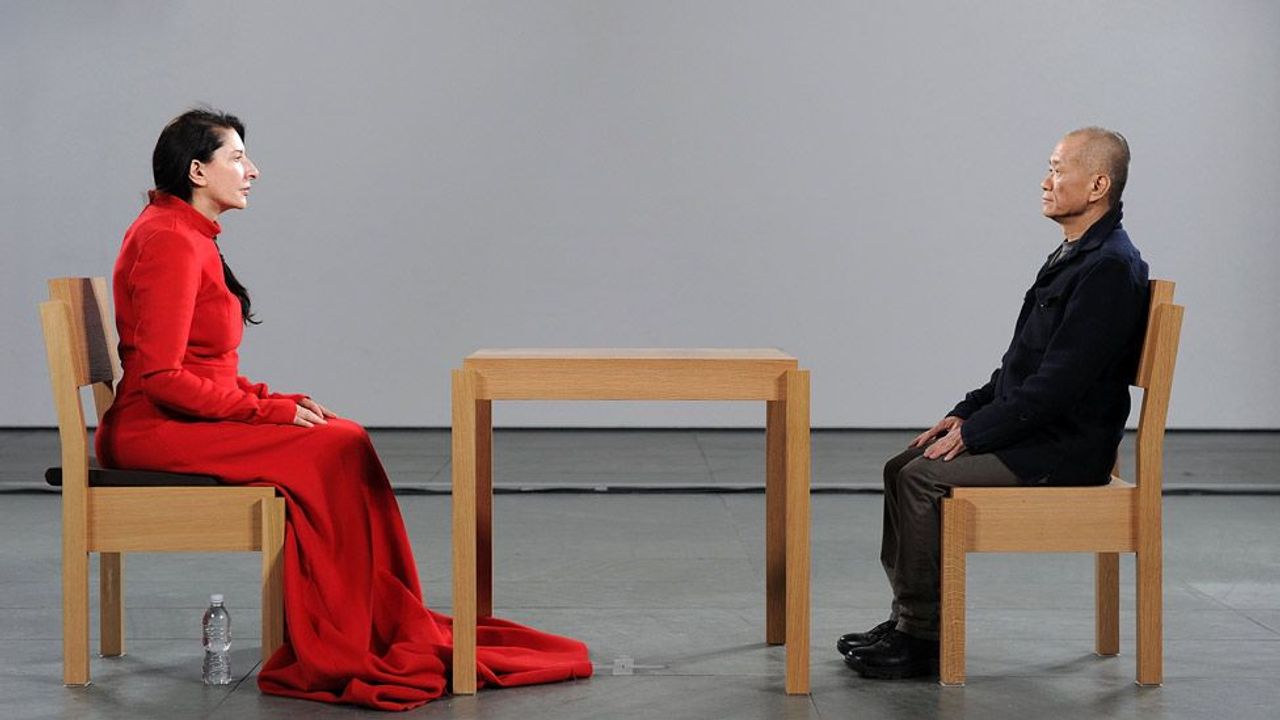
Marina Abramović: The Artist is Present

Note: Nudity, language, and adult themes
“Seductive, fearless, and outrageous, Marina Abramović has been redefining what art is for nearly forty years. Using her own body as a vehicle, pushing herself beyond her physical and mental limits–and at times risking her life in the process–she creates performances that challenge, shock, and move us. Through her and with her, boundaries are crossed, consciousness expanded, and art as we know it is reborn. She is, quite simply, one of the most compelling artists of our time.”

Note: Kanopy videos are mercurial—sometimes they are available, and sometimes they are not. If this video is unavailable on Kanopy, just find it elsewhere, or find a different "reading."

Beuys: The Life and Work of a Innovative Artist Joseph Beuys

“Thirty years after his death, Joseph Beuys still feels like a visionary and is widely considered one of the most influential artists of his generation. Known for his contributions to the Fluxus movement and his work across diverse media—from happening and performance to sculpture, installation, and graphic art—Beuys’ expanded concept of the role of the artist places him in the middle of socially relevant discourses on media, community, and capitalism. Using previously untapped visual and audio sources, director Andres Veiel has created a one-of-a-kind chronicle: BEUYS is not a portrait in the traditional sense, but an intimate and in-depth look at a human being, his art and ideas, and the way they have impacted the world.”

Note: Kanopy videos are mercurial—sometimes they are available, and sometimes they are not. If this video is unavailable on Kanopy, just find it elsewhere, or find a different "reading."

MANIFESTO — June 1: Guillermo Gomez-Peña: Manifesto

“Guillermo Gomez-Peña is a performance artist, writer, activist, radical pedagogue and director of the performance troupe La Pocha Nostra. Born in Mexico City, he moved to the US in 1978. His performance work and 10 books have contributed to the debates on cultural diversity, border culture and US-Mexico relations. His art work has been presented at over eight hundred venues across the US, Canada, Latin America, Europe, Russia, South Africa and Australia. A MacArthur Fellow, Bessie and American Book Award winner, he is a regular contributor for newspapers and magazines in the US, Mexico, and Europe and a contributing editor to The Drama Review (NYU-MIT). Gómez-Peña is a Senior Fellow of the Hemispheric Institute of Performance and Politics and a Patron for the London-based Live Art Development Agency.”

Breaking the Silence: An Interview with Bruce Nauman, ARTnews

“Bruce Nauman is notoriously reticent. In the half century of his public career, he has given only a handful of interviews. One of the most extensive was recorded in 1987 by Joan Simon, a critic, curator, and contributing editor at A.i.A. It was conducted for the 1988 documentary Four Artists: Robert Ryman, Eva Hesse, Bruce, Nauman, Susan Rothenberg. Simon published substantial excerpts from the conversation in our September 1988 issue. They cover a wide range of topics related to the interests Nauman pursued in his sculptures, performances, and videos: casts and impressions, morality and ethics, puns and jokes, and more. The text is the source of some of his best-known quotes, including the lines about his desire to make art ‘that was just there all at once. Like getting hit in the face with a baseball bat.’”

Tehching Hsieh: An Interview, Video Data Bank On Art & Artists: Performance

”At the age of twenty-four, Taiwanese artist Tehching Hsieh (b.1950), moved to New York, where he has created and documented time-specific, conceptual art performances since the 1970s. In this interview, Hsieh discusses his formative years and philosophical moorings. This dialogue includes description of the artist's early period of painting, his military service in Taiwan, and the cultural atmosphere of a country then undergoing massive political change. Much of the discussion focuses specifically on Hsieh's understanding of the relationship of art and life, his investment in "free thinking," and the politics of documentation. For Hsieh, the ability to think freely is art's bottom line--he believes the essence of his work lies in human communication. To this end, Hsieh insists that his work, though incredibly personal, is not autobiographical, but philosophical. In this interview, works such as Cage Piece, Rope Piece, and Time Clock Piece receive special attention. Hsieh discusses his decision to stop making art after the year 2000, and how the act of being a ‘believer’ has defined his practice over the years. With reference to the processes of Vincent van Gogh, Paul Cezanne, Marcel Duchamp and Jackson Pollock, Hsieh aims to make clear the importance of painting and action to his development, while avoiding strict art historical categorizations that limit the scope of what he believes his art can achieve."

Note: Kanopy videos are mercurial—sometimes they are available, and sometimes they are not. If this video is unavailable on Kanopy, just find it elsewhere, or find a different "reading."

Shot in the Name of Art | Op-Docs | The New York Times, The New York Times

“This short documentary celebrates the late conceptual artist Chris Burden’s landmark work ‘Shoot,’ in which a friend shot him in the arm.”

Burden

“An unprecedented look into the life of conceptual artist and sculptor Chris Burden. Whether he shot himself, squeezed into a 2-foot-square locker for 5 days, or mounted iconic sculptures, Burden rocked the art world.”

How to Make a Happening: Side 1

Note: This has been edited for content. “Allan Kaprow’s How to Make a Happening was released as a LP album in 1966 by Mass Art Inc. It features Kaprow delivering 11 rules on how, and how not, to make a Happening—a movement begun by Kaprow in the late fifties that is known for its unpredictability, open scores, and constantly-evolving form.” You may read the unedited transcript here if you like.

How to Make a Happening: Side 2

Note: This has been edited for content. “On the second track, which is constructed like the first, Kaprow reads the program and notes of three recent Happenings (Soap, Calling, and Raining), which serve as loose instruction, as they involve improvisation and forces beyond human control, such as acts of nature and other uncontrolled environmental forces. These elucidations further provide a clear, if somewhat circumstantial, distinction of what does and does not constitute a Happening.” You may read the unedited transcript here if you like.

George: The Story of George Maciunas and Fluxus: Story of an Avant-Garde Artist

Note: It gets a bit kinky 01:44:30–01:54:10.
“A feature documentary as mercurial as its subject, George Maciunas, impresario of the international avant-garde art movement Fluxus (1962–78). Fascinatingly contradictory interviews with artists, including Yoko Ono, Jonas Mekas, and Nam June Paik, and inventive sound and screen design, shape this rich portrait of a visionary artist. Dedicated to cooperative methods and expanded processes, everything could be Fluxus: kits, shops, festivals, islands, weddings, food, or Flux Lofts—the first network of artist-owned lofts in SoHo, New York. The iconoclastic Maciunas and the spirit of Fluxus provoke questions still critical to artists working today.”

Note: Kanopy videos are mercurial—sometimes they are available, and sometimes they are not. If this video is unavailable on Kanopy, just find it elsewhere, or find a different "reading."

The Performativity of Performance Documentation, PAJ: A Journal of Performance and Art

“As a point of departure for my analysis here, I propose that performance documentation has been understood to encompass two categories, which I shall call the documentary and the theatrical. The documentary category represents the traditional way in which the relationship between performance art and its documentation is conceived. It is assumed that the documentation of the performance event provides both a record of it through which it can be reconstructed (though, as Kathy O'Dell points out, the reconstruction is bound to be fragmentary and incomplete') and evidence that it actually occurred. The connection between performance and document is thus thought to be ontological, with the event preceding and authorizing its documentation. Burden's performance documentation, as well as most of the documentation of classic performance and body art from the 1960s and 1970s, belongs to this category.”

Laurie Anderson Interview: A Life of Stories, Louisiana Channel

“Listen to the story of how Laurie Anderson became the iconic multimedia artist she is today, why she prefers to keep things simple, and how she began telling stories as a child – and never stopped: ‘I try to make stories that really engage my mind.’

When Anderson started out as an artist, she was aware that you don’t necessarily need impressive or expensive gear in order to succeed: ‘I was trying to do something on the right scale – something that you can do yourself.’ She began as a painter and sculptor and started playing the instruments she made while making little films, which she would show to a small group of artists. This enticed her to try to get her films out into a wider audience in the mid-1970s by doing ‘these little shows’ at different venues.

Laurie Anderson was interviewed by Christian Lund at the Louisiana Museum of Modern Art, Denmark in May 2016.

Laurie Anderson’s Buddhism: Art, Meditation, and Death as Adventure, How to Train a Happy Mind

“Grammy Award winning artist Laurie Anderson, a longtime student of Buddhism and meditation, joined us today to share her personal path with Buddhism, approaching art with a beginner’s mind, staying present with suffering without letting it overwhelm you, and making our lives meaningful. Laurie Anderson is one of our greatest living artists. Her work includes spoken word and performance, top-charting albums and music videos, digital art, film, virtual reality, and the invention of ingenious instruments like the tape bow violin and the talking stick. She’s won the Grammy Award and many other honors, and is currently the subject of a fantastic solo show at the Hirschhorn Museum in Washington, D.C.”

Laurie Anderson: The 60 Minutes Interview, 60 Minutes

“Anderson Cooper speaks with Laurie Anderson about her five-decade career as an artist, singer, composer and storyteller, and visits her largest-ever U.S. exhibit.”

Laurie Anderson – Building an ARK | Starmus VII, Slovakia 2024, Starmus

“In this lecture from Starmus VII, titled ‘Building an ARK,’ Laurie Anderson, an avant-garde artist, composer, and filmmaker, delves into the intersection of art, technology, and storytelling. Anderson explores the concept of creating a modern ark for the 21st century, weaving together themes of artificial intelligence, language, and the human experience. Through her unique lens, Anderson challenges us to reconsider our relationship with technology and the natural world, offering a thought-provoking narrative on the future of humanity and our planet.

“Laurie Anderson is a pioneering figure in electronic music and an acclaimed multimedia artist known for her innovative use of technology in art. Her work spans performance art, pop music, and multimedia projects, often focusing on themes of politics, culture, and the human condition.”

Laurie Anderson discusses ‘Amelia’: a visionary new album inspired by Amelia Earhart, Qobuz

“In an illuminating conversation, the Chicago artist shares her vision of the future and tells the story of ‘Amelia,’ her tenth album dedicated to the aviatrix Amelia Earhart. Along the way, she discusses the album-making process, the AI revolution, and even her cogitations on life and death.”

Laurie Anderson 12-14-85 late night TV interview, BetGems Lost Media

“Laurie Anderson is interviewed for a late night TV show, as broadcast 12-14-85. The BetaGems channel also has "Laurie Anderson & Peter Gabriel video vanguard award.”

Free, White and 21

“In Free, White And 21, Howardena Pindell recounts bias incidents she has experienced as an African American woman in educational institutions, employment offices, and in various social settings. As a student, Pindell was prevented from overstepping black/ white boundaries. For example, she was discouraged from being ‘accelerated’ at the expense of a white student and her name was taken off a student body officer ballot because officials considered it inappropriate. Out of school, as a potential employee, she was turned away from jobs that were then offered to white candidates. As a member of a wedding party in Kennebunkport, Maine, Pindell experienced a different type of racism as guests selectively shook hands with everyone but her and later stared at her as she ate her food, thus turning basic human functions into spectacle. As Pindell tells these stories she wraps her head in white gauze bandages, an image that serves as a metaphor for being ‘white-faced’ and white, out in society. Pindell also portrays a white woman with blonde wig, a stocking over her head, and dark glasses who appears between story segments to reprimand black Howardena for being paranoid and ungrateful. "But then," says white Howardena, ‘you're not free, white and twenty one.’”

The Collector

In collaboration with Julien Devaux and Octavio Iturbe

John Baldessari Sings Sol Lewitt

“One of Baldessari's most ambitious and risky efforts. Seated and holding a sheaf of papers, he proceeds to sing each of Sol LeWitt's 35 conceptual statements to a different pop tune, after the model of Ella Fitzgerald Sings Cole Porter. What initially presents itself as humorous gradually becomes a struggle to convey Lewitt's statements through this arbitrary means.” – Helene Winer, "Scenarios/Documents/Images," Art in America 61 (March 1973)

Artist Forbids Any Reproduction of His Artworks | LIVE ART # 6 – Tino Sehgal, Palais de Tokyo, wocomoCulture

“What is a living sculpture? Can time be represented? What should be the lifespan of a work of art? Who can say do not touch the works? Can stealing an idea be justified? The LIVE ART documentary collection attempts to answer these questions by focusing on works referred to as ‘ephemeral.’ These presentations and performances exist only for the duration of an exhibition then disappear, to be - perhaps - recreated in another location. From New York to Istanbul, from the São Paulo Biennial to the Palais de Tokyo in Paris, this documentary series makes us question the place of art in our lives and the significance of the staging, the venue and the role of the visitor for an exhibition.”

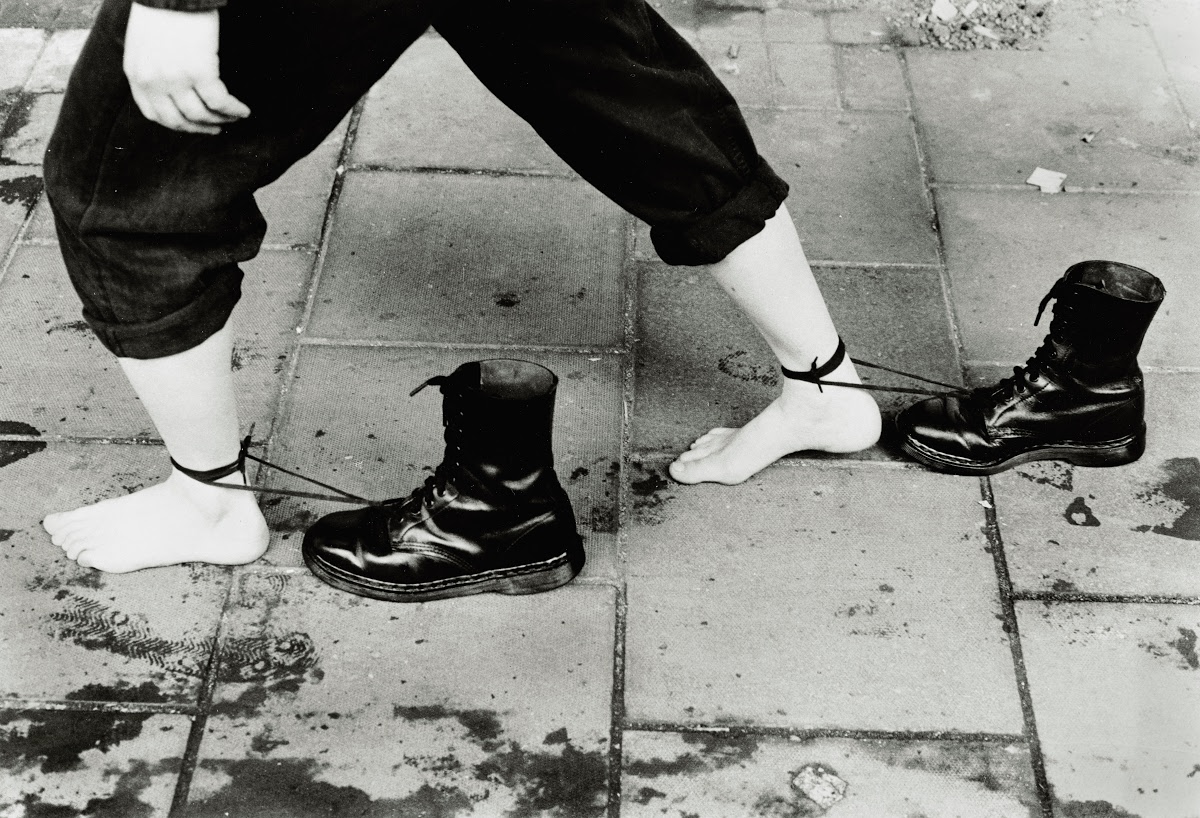
Zapatos magnéticos (Magnetic Shoes)

Havana, Cuba, 1994

Cuentos patrióticos

Mexico City, Mexico, 1997

Duett

Venice, Italy, 1999. In collaboration with Honoré d’O.

“(moderato) A & B arrive at opposite ends of Venezia. A is carrying the upper part of a tuba helicon, B is carrying the lower part, (andante) A& B wander through the city looking for each other, (crescendo) Upon meeting, A will help B to reassemble the tuba, (vibrato) With one breath B will play a note for as long as he can. A will clap for as long as he can hold his breath.”

Painting (Retoque)

Ex-Panama Canal Zone, Panama, 2008

The Green Line

Jerusalem, Israel, 2004; 17:41 min. In collaboration with Philippe Bellaiche, Rachel Leah Jones, and Julien Devaux

“Sometimes doing something poetic can become political and sometimes doing something political can become poetic In the summer of 1995 I performed a walk with a leaking can of blue paint in the city of São Paulo. The walk was then read as a poetic gesture of sorts. In June 2004, I re-enacted that same performance with a leaking can of green paint by tracing a line following the portion of the ‘Green Line’ that runs through the municipality of Jerusalem. 58 liters of green paint were used to trace 24 km. Shortly after, a filmed documentation of the walk was presented to a number of people whom I invited to react spontaneously to the action and the circumstances within which it was performed.”

Oliver Herring: “Task”, Art21

“Episode #209: This episode of ART21 ‘Exclusive’ follows artist Oliver Herring around Madison Square Park as he organizes his largest TASK Party to date. TASK parties encourage people to take creative risks and to break down social barriers through a simple, ‘self-perpetuating’ cycle: Each participant writes down a task and places it into a box and, in exchange, retrieves a task from the box. Participants work together to realize their tasks through provided materials such as paint, paper, tape, plastic wrap, and foil. ‘These tasks can be interpreted however you want,’ says Herring. ‘The tools are your imagination and your imagination is limitless.’ Since 2002, Herring has organized TASK events around the world, at military bases, museums, churches, schools, and other venues. Among Oliver Herring’s earliest works were his woven sculptures and performance pieces in which he knitted Mylar, a transparent and reflective material, into human figures, clothing and furniture. Since 1998, Herring has created stop-motion videos, photo-collaged sculptures, and impromptu participatory performances with ‘off-the-street’ strangers, embracing chance and chance-encounters in his work.”

18 Happenings in 6 Parts

18 Happenings in 6 Parts
New York City
April, 1988
Reinvented as part of
Precedings
at
The University of Texas at Arlington Center for Research on Contemporary Art organized by Jeff Kelley

Documentation Tool: Map of Interactions, Tate Research Publication

This is part of a series published by Tate about collecting and documenting performance art. “The Map of Interactions is a document that aims to provide an understanding of the networks that exist both internally and externally to Tate. These networks are critical in supporting the institution’s ability to activate performance artworks in the collection and have been developed in practice to create a tool that maps a range of interactions.”

Documentation Tool: Activation Report, Tate Research Publication

This is part of a series published by Tate about collecting and documenting performance art. “The activation report has been developed for documenting the material conditions of the activation of a performance artwork within the institution, both at Tate and beyond. This written document reflects the specific conditions of each activation of any given artwork. The activation report, the format of which is similar to the performance specification, captures new information in each instance that the artwork is brought from its dormant state through to its activated state, and seeks to capture institutional and artistic justification for consequent changes that arise from this activation.”

Documentation Tool: Performance Specification, Tate Research Publication

This is part of a series published by Tate about collecting and documenting performance art. “Developed as part of the Documentation and Conservation of Performance project, the Performance Specification is a document designed to capture written information about a performance-based artwork. The Performance Specification consists of a single central written document that captures written information about performance-based artwork. It contains seven overall category headings: ‘Artwork Requirements’, ‘Space’, ‘Time’, ‘Audience/Viewers’, ‘Performer’, ‘Physical Components’, ‘Logistics’, with two further categories: ‘Material Histories’ being captured in a separate document and ‘Activations after Acquisition’ being documented in individual folders for each instantiation of the work, saved in our artwork folder structure under ‘Display History’.”

Documentation Tool: Material History, Tate Research Publication

This is part of a series published by Tate about collecting and documenting performance art. “This tool has been developed for with the intent of mapping the material histories of the performance-based artworks in Tate’s collection. When mapping the material history of artworks, we hope to identify the material conditions of their various activations. This includes understanding, for example, what equipment and materials were used and for what, who has been involved in curating, producing, directing, or performing the work, where the activations have taken place, and the interactions between the social context and the materiality of the work. In other words, writing a material history consists of understanding how artworks evolve, how and why they change, and how those changes are traces of decision-making processes that are both material and social.”

Strategy and Glossary of Terms for the Documentation and Conservation of Performance, Tate Research Publication

This is part of a series published by Tate about collecting and documenting performance art. “Performance has been collected at Tate since 2005, with Good Feelings, Good Times 2003 by Roman Ondak being the first performance work to be acquired. These artworks fall within the remit of the time-based media conservation team, who have worked to document and conserve them. The approach to the conservation of performance was developed in the years following this first acquisition by applying existing conservation practice, working to understand each artwork and considering the short- to long-term needs of each work. At this early stage, existing documentation strategies and templates used for time-based media artworks were adapted.The approach to the documentation and conservation of performance works in the collection was revisited in early 2016, prompted by an increase in the number of performances works being collected and their increasing complexity.”

LaToya Ruby Frazier Takes on Levi’s, Art21

“What is the responsibility of an artist to her community? In this film, artist and activist LaToya Ruby Frazier discusses the economic and environmental decline of her hometown—Braddock, Pennsylvania—the city that the clothing company Levi's used as inspiration and backdrop for a major advertising campaign in 2010. Having photographed in Braddock since she was sixteen years old, LaToya's black-and-white images of her family and their surroundings present a stark contrast to the campaign images of "urban pioneers" and slogans such as "everybody's work is equally important." In a performance developed in collaboration with the artist Liz Magic Laser, LaToya carries out a choreographed series of movements on the sidewalk in front of the temporary Levi's Photo Workshop in SoHo. Wearing a costume of ordinary Levi's clothes, the artist's repetitive and relentless motion ultimately destroys the jeans she's wearing.”

Filz TV (Felt TV), Identifications

“Joseph Beuys «Felt TV: Shown in TV broadcast 'Identifications'» As a contribution to Gerry Schum's 'Identifications', Beuys adapted for television the 'Felt TV' action previously staged for a live audience at a Happening festival in Copenhagen in 1966. It was the only Beuys action executed specifically for the camera. It opens with Beuys seated in front of a TV set showing a programme which is invisible because the screen is covered by felt. The boxing-gloves used later in the action lie at the ready beneath his chair. Beuys turns up the bottom left corner of the felt, revealing a glimpse of the faulty TV picture. The voice of a TV reporter, who is talking about current milk and meat prices, is still audible. Beuys declares he has 'undertaken a gradual elimination' by 'filtering away' the picture first while leaving the sound, 'but when the picture has gone, the sound becomes absurd.'”

Tehching Hsieh: One Year Performance 1980-1981, Das Platforms

“The artist and curator Nina Miall discuss the second in Tehching Hsieh's one-year performances, commonly referred to as Time Clock Piece.”

The Great White Way: 22 Miles, 5 Years, Part 1

“The Great White Way is Pope.L’s masterwork-in-progress. For this piece, he plans to traverse Broadway’s 22 miles via painstakingly slow and rigorous crawling over the course of five years. This appropriately began at the Statue of Liberty, from which he took a ferry to the Financial District. From there, the inching up Broadway (which is uphill for a while) began. You can take your pick of the symbols relevant to Pope.L’s Broadway. Within the Financial District, one of the first that seems relevant is a large sculpture of a staggering bull, prominently located on a small island in the middle of the street. The reminder here, in the context of Pope.L’s crawl, is multifarious.”

Part 2 (03:45)

Fountain

“Fountain is a video that originated from a live performance of drinking water from a mirror. The image of confronting one’s own image recalls Narcissus, the Greek god that fell in love with his own image without recognizing it as his own, in some way being a splitting of the interior and exterior selves. In Fountain the image attempts to become whole again by drinking in the image of itself.”

Wafaa Bilal Discusses Shoot an Iraqi, City Light Books

“Award-winning Iraqi artist Wafaa Bilal discusses his new book "Shoot an Iraqi" and the impact of his highly provocative interactive art piece Domestic Tension.”

Social Practice Art
Oliver Herring: “Task”, Art21

“Episode #209: This episode of ART21 ‘Exclusive’ follows artist Oliver Herring around Madison Square Park as he organizes his largest TASK Party to date. TASK parties encourage people to take creative risks and to break down social barriers through a simple, ‘self-perpetuating’ cycle: Each participant writes down a task and places it into a box and, in exchange, retrieves a task from the box. Participants work together to realize their tasks through provided materials such as paint, paper, tape, plastic wrap, and foil. ‘These tasks can be interpreted however you want,’ says Herring. ‘The tools are your imagination and your imagination is limitless.’ Since 2002, Herring has organized TASK events around the world, at military bases, museums, churches, schools, and other venues. Among Oliver Herring’s earliest works were his woven sculptures and performance pieces in which he knitted Mylar, a transparent and reflective material, into human figures, clothing and furniture. Since 1998, Herring has created stop-motion videos, photo-collaged sculptures, and impromptu participatory performances with ‘off-the-street’ strangers, embracing chance and chance-encounters in his work.”

18 Happenings in 6 Parts

18 Happenings in 6 Parts
New York City
April, 1988
Reinvented as part of
Precedings
at
The University of Texas at Arlington Center for Research on Contemporary Art organized by Jeff Kelley

Guadalupe Maravilla & the Sound of Healing, Art21

“Does healing have a soundtrack? Sculptor, performer, and sound healer Guadalupe Maravilla combines his personal experiences as a formerly undocumented immigrant and cancer survivor with ancient and indigenous knowledge to create new rituals for healing. An impressionistic and kaleidoscopic look at Maravilla's multifaceted practice and biography, the film follows the artist as prepares his solo exhibition at Socrates Sculpture Park in Long Island City, New York and conducts healing sound performances for his community. From his Brooklyn studio, Maravilla recounts his personal journey as an unaccompanied minor fleeing the civil war in his native El Salvador and migrating through Central America to the United States. As an adult, Maravilla was diagnosed with colon cancer, which he considers a physical manifestation of the trauma he experienced as a child. During his radiation treatments, Maravilla was introduced to the sound bath, where participants are "bathed" in sound waves meant to encourage therapeutic processes. Struck by the healing potential of sound, Maravilla vowed to learn and share sound healing with others if he overcame cancer.”

Artists Seeking Social Change Bring the Public into the Picture, KQED Arts

“Social practice art can look like just about anything: journalism, community organizing, even a shop. The goal is to engage the audience and help people think about social issues in new ways. ‘For me,’ says social-practice artist and professor Stephanie Syjuco, ‘the best social practice projects actually try to attract people to join a conversation.’ Two artists, Chris Treggiari and Chris Johnson, recently went into the streets of Oakland to record conversations and make art.”

Harrell Fletcher and Jen Delos Reyes, Art Talk AM

An interview with Harrell Fletcher and Jen Delos Reyes of Portland State University's Art and Social Practice program.

Social Practice Art’s Identity Crisis, Bad at Sports

“The question of what social practice art actually is, who is defining its parameters and to what end, is a hot mess. Since the 1990s, a number of mostly European and North American art critics and historians have struggled to understand a notoriously chaotic set of practices, under an ever changing set of names including new genre public art, socially-engaged practice, relational art, dialogical aesthetics, etc. While I have no interest in throwing my hat in the art historical ring on that one (and I think the folks over at 127prince.wordpress.com/ are doing a good job on talking through the issues), I admit that I like the identity crisis that social practice art is always wrestling with. It’s rapidly becoming professionalized through MFA programs, like California College of Arts, Otis College of Art, and PSU. Yet it also heralds a kind of everyday creativity and social connectivity that is supposedly available to anyone with or without an art degree.”

Is Social Practice Gentrifying Community Arts?, Bad at Sports

“‘Is Social Practice Gentrifying Community Arts?’: This question posed by Rick Lowe of Project Row Houses in conversation with Nato Thompson at this years Creative Time Summit, Art, Place & Dislocation in the 21st Century, was a crystallizing moment in a series of gatherings and convening I’ve been part of the last few months. Addressing “gentrification,” the thematic buzz word of this year’s Creative Time convening, Lowe said that to really talk through the issue of gentrification, we must also address our issues with race.”

Social Practice | Artbound | Season 5, Episode 7, PBS SoCal

“In this episode, Artbound explores social practice arts throughout Southern California. Featuring Olga Koumoundouros' occupation of foreclosed homes in Los Angeles; The Workers' Rug/La Alfombra Del Trabajador, an art project by day laborers, organizers affiliated with IDEPSCA, artist Katie Bachler and Jade Thacker, and the Craft and Folk Art Museum; Public Matters' Market Makeover project addressing the "grocery gap" in "food deserts," areas that have limited access to quality, healthy food; the collective Fallen Fruit, who map local public fruit trees, encouraging us to rethink our relationship to food and public space; and a performance by Moses Sumney.”

Harrell Fletcher with Adam Moser, PSU Art and Social Practice Reference Points

“I had the opportunity to visit Harrell and the Art and Social Practice program at Portland State University. Through my visits and interactions with the Social Practice program, I’ve come to see it as yet another work by Harrell, with his co-director Jen Delos Reyes. The two have created an ongoing project in which the student is given much of the onus. The program is most often noted for being student-led, a pedagogical model that resembles Harrell’s works and writings, much of which is a reaction to his own frustrations with his education as a student and his experiences as an artist.”

An Incomplete and Subjective List of Terms and Topics Related to Art and Social Practice Volume 1

“Each week in the Art and Social Practice MFA Program at Portland State University we have an hour of what we call ‘topical discussion.’ During that hour we explore a term or topic related to art and social practice. Some of the terms and topics are very basic, like collaboration, and site-specificity, but there are also less common terms like a touch of evil which we heard about from Pedro Reyes when we were visiting him in Mexico City a few years ago. Many of the ideas we discuss are not specific to socially engaged art, but we are looking at them from a socially engaged art perspective. Several of the concepts are ones that I have used in my own work but until recently hadn’t named what they were or detailed how they could be used as strategies when developing or analyzing a project. I hope that the list might be useful to people interested in socially engaged art. I started with about sixty terms and topics that I wrote about in 2019, and now I have added an additional forty or so. I’m already working on several new ones for a second volume.”

Response Question

Remember to cite specific instances from the “readings” to support your views.

  • What possibilities opened up for your from watching these examples?
  • Which piece inspired you the most and why?
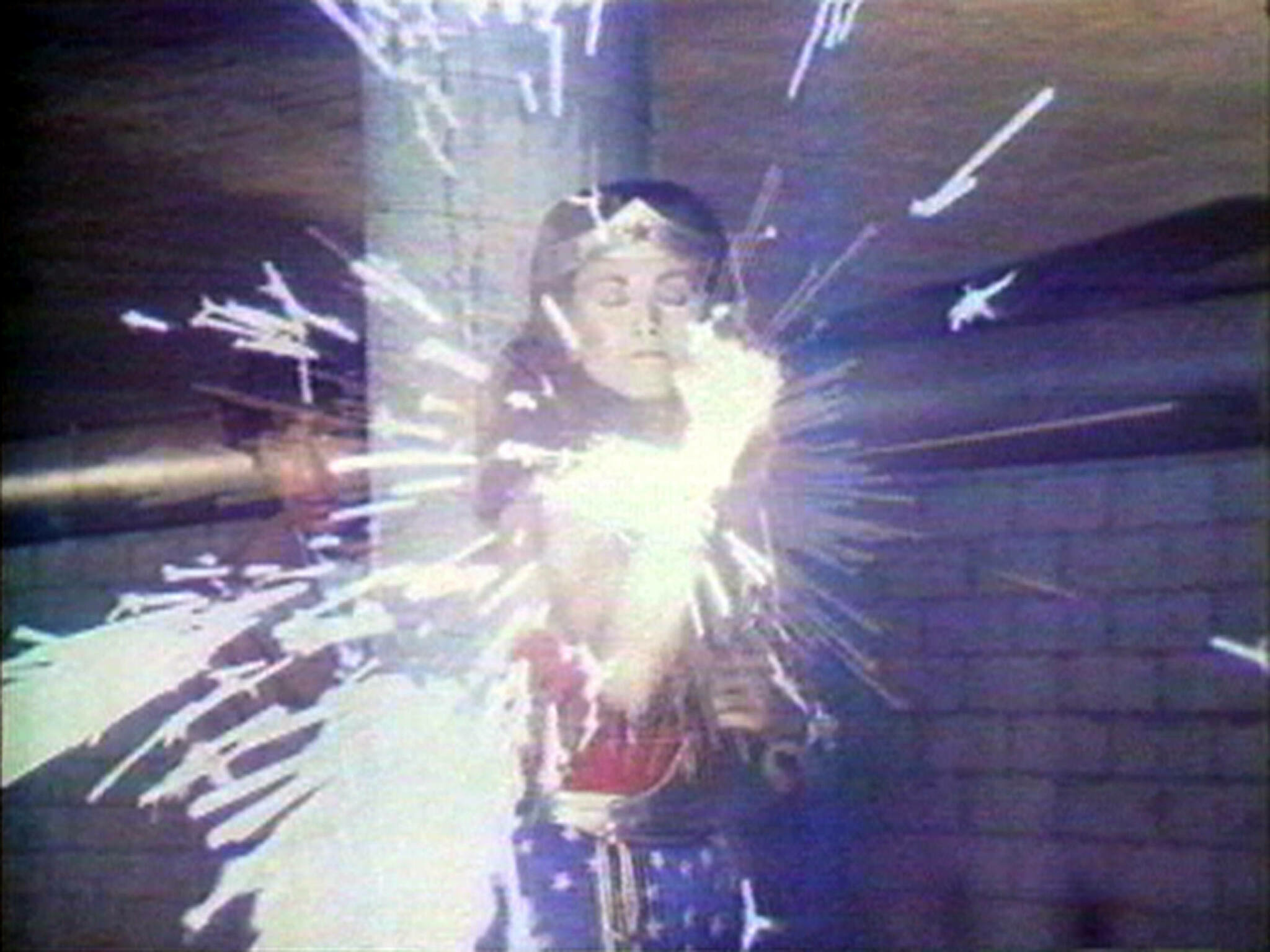
11.2: Video Art Examples

Read by Thu Nov 13, 8am
Reading Response due Thu Nov 13, 8am

Dara Birnbaum (1946–)
Technology/Transformation: Wonder Woman (video still), 1978–79
Video, color, sound, 5:50 min., looped

Why?

We can discuss video art abstractly, but you need to experience it in real time.

Note: Due to the nature of video art including aspects of performance art, some material below may be inappropriate for sensitive individuals. If you have concerns, please contact the instructor and they can guide you to material that will be suitable for you.

Required

Telephones

“American and Swiss artist Christian Marclay emphasizes ‘the process.’ He deconstructs seemingly simple actions further into finite elements and creates collages from the scraps. Before Video Quartet and his monumental 24-hour effort The Clock was Telephones (1995), a piecemeal video collage [. . .] that plunders 130 Hollywood films.

“Using his building blocks—dialing, greeting, conversing, farewells and hang-ups—Marclay plays with the notion of cinematic continuity by splicing newer and older films into his own narrative. The video opens with a man walking into a booth, the word ‘telephone’ in all caps, he slowly dials. His action is followed by several more clips of dialing, technology jumps from clunky rotary dialers from the pre-area code days to ‘up-to-date’ push buttons phones (apple would later, ahem, appropriate the spirit of Telelphones for an ad). Perhaps most impressive is Marclay’s ability to create a story from such disparate sources. Clips begin to talk to one another—A man speaks deliberately into the mouthpiece ‘I haven’t been able to think or concentrate on anything except you.’ the video cuts to a second man who hesitantly says ‘I see….’”

Rapture

“Rapture (1999) Rapture is an installation of two synchronized black-and-white video sequences that are projected on opposite walls; large in scale, they evoke cinema screens. Working with hours of footage and a team of editors, the artist constructed two parallel narratives: on one side of the room, men populate an architectural environment; in the other sequence, women move within a natural one. The piece begins with images of a stone fortress and a hostile desert, respectively. The fortress dissolves into a shot of over one hundred men—uniformly dressed in plain white shirts and black pants—walking quickly through the cobblestone streets of an old city and entering the gates of the fortress. Simultaneously, the desert scene dissolves into a shot of an apparently equal number of women, wearing flowing, full-length veils, or chadors, emerging from different points in the barren landscape.”

Technology/Transformation: Wonder Woman

“Explosive bursts of fire open Technology/Transformation, an incendiary deconstruction of the ideology embedded in television form and pop cultural iconography. Appropriating imagery from the 1970s TV series Wonder Woman, Birnbaum isolates and repeats the moment of the ‘real’ woman's symbolic transformation into super-hero. Entrapped in her magical metamorphosis by Birnbaum's stuttering edits, Wonder Woman spins dizzily like a music-box doll. Through radical manipulation of this female Pop icon, she subverts its meaning within the television text. Arresting the flow of images through fragmentation and repetition, Birnbaum condenses the comic-book narrative—Wonder Woman deflects bullets off her bracelets, "cuts" her throat in a hall of mirrors—distilling its essence to allow the subtext to emerge. In a further textual deconstruction, she spells out the words to the song Wonder Woman in Discoland on the screen. The lyrics' double entendres (‘Get us out from under... Wonder Woman’) reveal the sexual source of the superwoman's supposed empowerment: ‘Shake thy Wonder Maker.’ Writing about the “stutter-step progression of 'extended moments' of transformation from Wonder Woman,’ Birnbaum states, ‘The abbreviated narrative — running, spinning, saving a man — allows the underlying theme to surface: psychological transformation versus television product. Real becomes Wonder in order to "do good" (be moral) in an (a) or (im)moral society.’”

John 3:16

“In the video John 3:16...a reference to a passage so often quoted that its sort of the Biblical code for the New Testament that gives you the formula for salvation and eternal life. There’s an interesting kind of resonance that I see between this idea of a formula for salvation and eternal life and the promise of digital media that never break down and literally can live forever...that can always be copied endlessly. In a way, the medium itself represents a kind of promise that almost has spiritual overtones.” – Paul Pfeiffer

Supplementary Readings: Works on Video

Other Video Art Examples
Guitar Drag, Christian Marclay (1999)

“This video depicts a pickup truck dragging an amplified, electric guitar tied by a rope across a Texas roadway to its aggressive destruction. The many-layered video work references the practice of smashing guitars during rock concerts and demonstrates Marclay’s interest in inventing new types of sound. The piece was also created in response to the 1998 murder of 49-year-old James Byrd, Jr. of Jasper, Texas by three white supremacists and the tragedy’s widespread repercussions. Guitar Drag not only resonates with our aural and visual senses, but also simultaneously investigates multiple layers of history, race, geography, and timely social issues. Since 2000, Guitar Drag has been shown 24 times in museums and galleries, both nationally and internationally, including the Hayward Gallery in London, Gallery Koyanagi in Tokyo, Museum of Contemporary Art, Chicago, ZKM Center for Art and Media in Karlsruhe, Germany, and the Smithsonian Institution in Washington, DC. Sixteen years after its initial making, Artpace proudly presents the completed version of Marclay’s Guitar Drag for its Texas premiere.”

Semiotics of the Kitchen

Semiotics of the Kitchen adopts the form of a parodic cooking demonstration in which, Rosler states, ‘An anti-Julia Child replaces the domesticated “meaning” of tools with a lexicon of rage and frustration.’ In this performance-based work, a static camera is focused on a woman in a kitchen. On a counter before her are a variety of utensils, each of which she picks up, names and proceeds to demonstrate, but with gestures that depart from the normal uses of the tool. In an ironic grammatology of sound and gesture, the woman and her implements enter and transgress the familiar system of everyday kitchen meanings—the securely understood signs of domestic industry and food production erupt into anger and violence. In this alphabet of kitchen implements, states Rosler, ‘when the woman speaks, she names her own oppression.’”

John Baldessari Sings Sol Lewitt

“One of Baldessari's most ambitious and risky efforts. Seated and holding a sheaf of papers, he proceeds to sing each of Sol LeWitt's 35 conceptual statements to a different pop tune, after the model of Ella Fitzgerald Sings Cole Porter. What initially presents itself as humorous gradually becomes a struggle to convey Lewitt's statements through this arbitrary means.” – Helene Winer, "Scenarios/Documents/Images," Art in America 61 (March 1973)

Teaching a Plant the Alphabet

“Teaching a Plant the Alphabet is an exercise in futility, an absurdist lesson in cognition and recognition. The scenario is elementary: A small potted plant sits atop a stool. In the role of teacher, Baldessari holds up a series of children's alphabet cards in sequence, repeating each letter to the plant until he has completed the alphabet. The plant, of course, does not respond. Eliciting deadpan humor from the incongruous juxtaposition of the rote instruction and the uncomprehending pupil, Baldessari creates illogic from a logical construct, making nonsense from sense. An elaboration of working notes in which Baldessari wrote, ‘Is it worth it to teach ants the alphabet?’ this piece also responds to Joseph Beuys' 1965 performance How to Explain Pictures to a Dead Hare.” -- EAI

Dance or Walk on the Perimeter of a Square

“For this film, Nauman made a square of masking tape on the studio floor, with each side marked at its halfway point. To the sound of a metronome and beginning at one corner, he methodically moves around the perimeter of the square, sometimes facing into its interior, sometimes out. Each pace is the equivalent of half the length of a side of the taped square. He uses the hip-swaying walk in Walk with Contrapposto.” - EAI

Mario Movie

Mario Movie (2005) was made by Cory Arcangel with Paper Rad. It is a 15 minute movie made on a Super Mario Brothers cartridge.”

Trash Talking

Note: There is some bleeped cursing and adult content in this video. “This DVD includes lots of ephemera filling every color on the PANTONE wheel, but also including the recurring Alfe character in a brand new (never aired) TV Pilot. Also included will be the ultimate PAPER RAD "Guide to CD-ROMS" - essential knowledge for jammers everywhere. Also word comes from PAPER RAD HQ that this shiny video capsule will have "multi multi media, box eyes, and Future Genies out-takes" When all the footage is bonus, seated TV viewers come out ahead. This is for fans young and old looking for strange new voices! Put this on the next time you turn on, or the next time you turn on a small community through introduction of smiley faces into public water supply areas! Seriously buy a box lot of 30, the future is cheap if you buy in the present. Stock up for the Kulture Warz!”

Deshotten 1.0

Note: Contains adult language and scenes of gun violence. “Deshotten 1.0

akingdoncomethas

“A montage of filmed sermons and gospel songs performed in black churches from the 1980s to the 2000s.”

Fountain

“Fountain is a video that originated from a live performance of drinking water from a mirror. The image of confronting one’s own image recalls Narcissus, the Greek god that fell in love with his own image without recognizing it as his own, in some way being a splitting of the interior and exterior selves. In Fountain the image attempts to become whole again by drinking in the image of itself.”

Tooba

“Her poetic two-channel video installation Tooba is based on the Koran, in which Tooba, the sacred tree of paradise, offers shelter and sustenance to those in need. Neshat’s video places a woman within a groove in the trunk of a large fig tree, symbolising its soul. They stand, alone, in a stone-walled garden set in a mountainous landscape. Men and women draw near and enter the enclosure, seeking refuge, as the Tooba-woman disappears into the Tooba-tree. The piece is ambiguous. Who has agency? Is it the crowd, who ‘invade’ the garden or the tree-woman who draws them towards her like a magnet? Tooba is dedicated to Iranian writer Shahrnush Parsipour, whose novel Women without Men concerns five women sojourning in a garden, one of whom is transformed into a tree.”

Lennon Sontag Beuys

This is a 02:10 video looped. “The artist animates documentary footage of John Lennon and Yoko Ono's 1969 Amsterdam "bed-in" for peace, a 2001 lecture delivered by the late media philosopher Susan Sontag at Columbia University, and Joseph Beuys' 1974 lecture at the New School for Social Research in New York. These three channels play simultaneously, projected side-by-side on one wall. These videos are being made available for noncommercial and educational use only. All rights to this recorded material belong to Kota Ezawa.”

Purple Mountain

“Hand-painted gouache on paper animation. Film by Allison Schulnik. "Purple Mountain" song composed by Aaron MF Olson, performed by The Musical Tracing Ensemble. An ensemble of musicians is gathered in a performance space. Each musician has their own instrument, means of amplification (if needed), and pair of headphones. All musicians’ headphones are plugged into one outputting sound source (usually an iPod with many headphone splitters). Music (usually a well known song from the popular music canon) is played from the sound source and the musicians are instructed to play something, anything that they hear in their headphones as accurately as they can on their own instrument. The musicians never know what songs or sounds they will be hearing in advance. The audience only hears what the musicians are playing and none of the original sound source, thus creating a “tracing” of the sound source material.”

Moth

Gnossienne No. 1 written by Erik Satie, performed by Nedelle Torrisi. MOTH is a traditionally animated, hand painted, gouache-on-paper film. It is animated mostly straight-ahead, with frames painted on paper almost daily for 14 months. The film seeded and bloomed from a moth hitting my studio window and continues as a wandering through the emotions of birth, motherhood, body, nature, metamorphosis and dance.”

Eager

“Traditional clay-mation and stop-motion animated film. Cinematography by Helder K. Sun, music by Aaron M. Olson.”

Mound

“Cinematography by Helder K. Sun. "It's Raining Today" written by Noel Scott Engel.”

Encore: Tabula Rasa (Ten Thousand Waves)

“Isaac Julien is a video artist and a filmmaker who weaves powerful visual narratives when creating his multi-screen installations. The artist’s practice successfully dissolves the separations that are traditionally associated with different creative disciplines, uniting film and photography, dance and movement, theatre, music and sound art, and painting and sculpture. With works that often explore themes of class, cultural history and identity, this exclusive new media artwork Encore: Tabula Rasa (Ten Thousand Waves) relates to Julien’s nine-screen installation Ten Thousand Waves (2010), which examines the relationship between China's ancient past and rapidly-evolving present. In Latin, the term tabula rasa means blank slate, and here, we witness the cyclic depiction and erasure of traditional Chinese calligraphy, in a dance between older and newer generations.”

Response Question

Remember to cite specific instances from the “readings” to support your views.

  • What possibilities opened up for your from watching these examples?
  • Which piece inspired you the most and why?
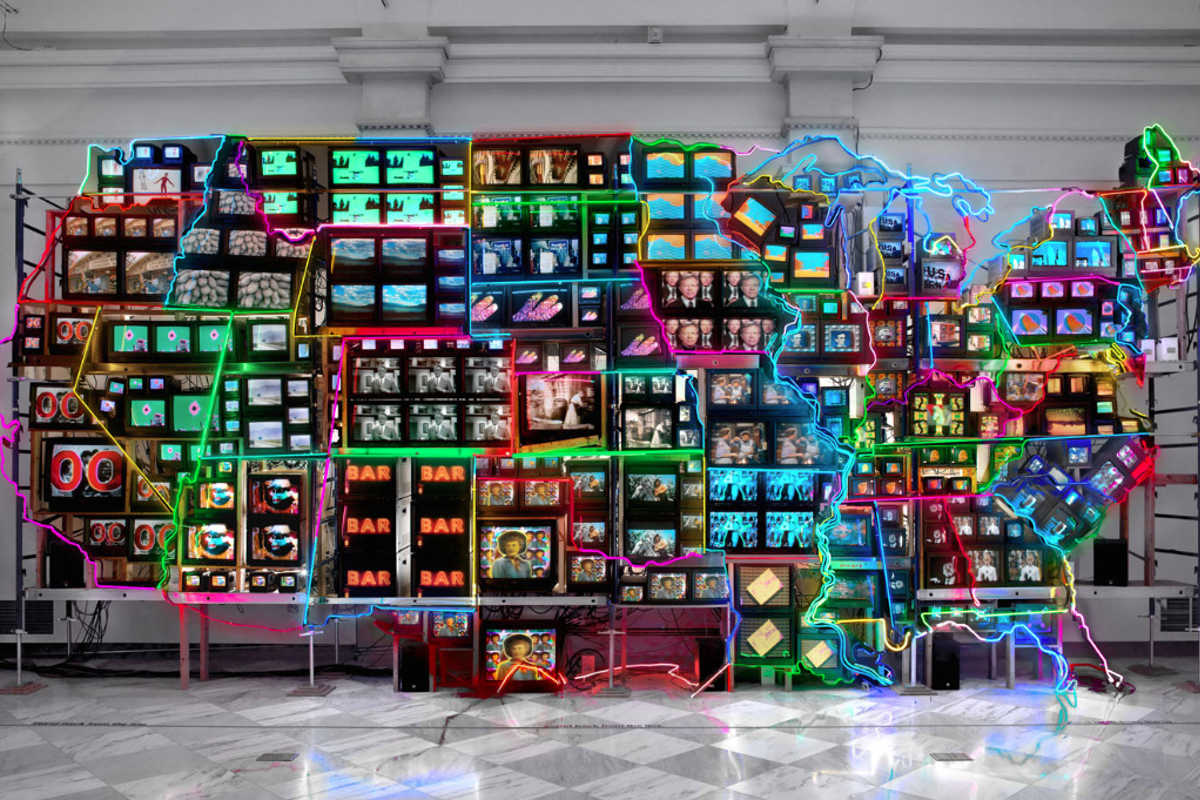
11.1: Introduction to Video Art

Read by Tue Nov 11, 8am
Reading Response due Thu Nov 13, 8am

Nam June Paik (1932–2006)
Electronic Superhighway: Continental U.S., Alaska, Hawaii, 1995
Fifty-one channel video installation (including one closed-circuit television feed), custom electronics, neon lighting, steel and wood; color, sound
approx. 15 x 40 x 4 ft.
Smithsonian American Art Museum, Gift of the artist, 2002.23, © Nam June Paik Estate

Why?

Video Art emerged from the fields of experimental film and performance art and has grown in the digital age. To understand how it is practiced now and its potential for the future, it is important to understand where it came from and how it has developed.

Note: Due to the nature of video art including aspects of performance art, some material below may be inappropriate for sensitive individuals. If you have concerns, please contact the instructor and they can guide you to material that will be suitable for you.

Required

The Case for Video Art, The Art Assignment

“What is video art? How is it any different from all the other moving pictures that are apparently not-art? Let's explore its history and present.”

The Case for Video Art—Where Does It Stand Today?, Widewalls

“Ok, you say, so you have a person, that makes ‘moving pictures’ in one way or another. How does his work separates from the work of, say, movie directors who, as well, are creating ‘moving pictures’? The biggest difference between video art and movies is the disrespect of the aforementioned one to all of the latter's conventions and rules. Usually, there's got to exist at least one of three following things in a motion picture: story, actors and screenplay. Video art is not interested in that, but rather in exploring the maximum possibilities of the media, and/or to challenge viewer's ideas about the world that surrounds him/her. It usually has many forms - broadcasted recordings, projections, performances with TV sets, online streams, but today, video installation is the most common form of video art. Installation could be seen at museums and galleries, but it is often a part of some wider work, associated with design, sculpture, and architecture.”

Video Art, Explained | Neus Miró, CIFRAWORLD

“Why is this video 7 hours long? Why doesn’t it have a plot? Is TikTok secretly the future of art? Did Andy Warhol invent video art, or was he just a branding genius? And what do medieval churches have to do with our idea of beauty? We threw 8 naive questions about video art at Neus Miró—curator, art critic, professor, and certified cinephile. Her superpower is decoding the deeper story behind the screen or the white cube of the gallery. But one of her true passions is movies. The line for tickets. The flicker of the projector. That silver screen glow. For Neus, the magic of film and video art never fades. She walked us through the history of video art, breaking down the biggest milestones and revealing what makes this medium so impactful.”

Supplementary Readings

Video Art History
Video Art: The First Fifty Years

“The curator who founded MoMA's video program recounts the artists and events that defined the medium's first 50 years. Since the introduction of portable consumer electronics nearly a half century ago, artists throughout the world have adapted their latest technologies to art-making. In this book, curator Barbara London traces the history of video art as it transformed into the broader field of media art - from analog to digital, small TV monitors to wall-scale projections, and clunky hardware to user-friendly software. In doing so, she reveals how video evolved from fringe status to be seen as one of the foremost art forms of today.”

Video Art

“In this overview of a still relatively new art form, Rush (director, Palm Beach Inst. of Contemporary Art) asserts that video art emerged as an important medium just as artists embraced conceptual and performance-based art. The popularity of video art marked a shift within contemporary art toward ideas and away from an interest in any specific medium. A key strength of Rush's analysis is his explanation of the link among performance, conceptual art, and video. Rather than exploring the technical qualities of film, artists stage performances on film to communicate ideas. Rush organizes this history around three major themes: the use of video cameras as an extension of artists' own bodies, the time-based qualities of video making way for new kinds of stories, and the combination of video with electronic, digital media to form new hybrid installations.”

Encounters in Video art in Latin America

“The emergence of video art in Latin America is marked by multiple points of development, across more than a dozen artistic centers, over a period of more than twenty-five years. When it was first introduced during the 1960s, video was seen as empowering: the portability of early equipment and the possibility of instant playback allowed artists to challenge and at times subvert the mainstream media. Video art in Latin America was—and still is—closely related to the desire for social change. Themes related to gender, ethnic, and racial identity as well as the consequences of social inequality and ecological disasters have been fundamental to many artists’ practices. This compendium explores the history and current state of artistic experimentation with video throughout Latin America. Departing from the relatively small body of existing scholarship in English, much of which focuses on individual countries, this volume approaches the topic thematically, positioning video artworks from different periods and regions throughout Latin America in dialogue with each other. Organized in four broad sections—Encounters, Networks and Archives, Memory and Crisis, and Indigenous Perspectives—the book’s essays and interviews encourage readers to examine the medium of video across varied chronologies and geographies.”

Interviews with Video Artists
Art21: Video Art

This is the Art21 database of segments concerning video art and artists. Be aware that not all content may be suitable for a BYU audience. Proceed with caution.

“The Last Post”: Shahzia Sikander, Art21

“Artist Shahzia Sikander, filmed in her Manhattan studio, discusses her animated video work The Last Post (2010). Sikander also describes how beginning to create animations was a natural evolution in her studio process because she had already been working with narrative and layering in her paintings and large-scale installations.”

Programming: Jenny Holzer, Art21

“Jenny Holzer’s history as a typesetter feels obvious, once you’re acquainted with her signature text-based artworks. From PROTECT PROTECT at the Museum of Contemporary Art, Chicago, Holzer recounts her fondness for programming the LED electronics that display her statements. Within the programming process, Holzer curates the speed of the revolving message, and orchestrates the pauses and flashes of the phrase. The emission of light by the LEDs is affected by each of these variables, simultaneously influencing the mood and energy of the exhibition space.”

Writing & Difficulty: Jenny Holzer, Art21

“Jenny Holzer discusses her difficult relationship to writing during the installation of the exhibition PROTECT PROTECT at the Museum of Contemporary Art, Chicago. ‘I have no idea whether I’ll write again,’ says Holzer. ‘One reason why I left it is because I tend to write about the most ghastly subjects. So it’s not just the difficulty in having something turn out right, it’s the difficulty of staying with the material long enough to complete it.’While multiple factors have contributed to Holzer’s writing hiatus, her body of work remains as poignant and provocative as ever. Whether questioning capitalist impulses, or describing torture, Holzer’s art expresses concepts and questions through subversive lightworks which present her queries through projections or streamlined LED marquis. ‘My work might be like theater in that I hope there’s an audience,’ says the artist.”

Conversations with Noise John Akomfrah, Art21

“Known for his visually stunning, multichannel video installations, artist and filmmaker John Akomfrah shares a lesser acknowledged, but equally vital component of his work: sound. From his London studio, the artist discusses the transformative and essential role that sound has played in both his artwork and his experience of the world. Between sessions editing recently-shot footage, Akomfrah recalls his early experiences with sound. The artist witnessed the ways that music fostered the social connection at the nightclubs of his youth and co-founded the artist group Black Audio Film Collective, which saw itself primarily as an experimental auditory outfit. His seminal experience with sound came as a university student, when Akomfrah heard the music of Estonian composer Arvo Pärt for the first time. Pärt’s music reconfigured Akomfrah’s understanding of time and of himself within it, motivating his filmic work which weaves together footage from divergent time periods, histories, and themes. While aware that early critics of his work found his use of sound and music “vulgar,” Akomfrah retorts, ‘I like the vulgarity of it.’ ‘That’s the point,’ he adds. ‘The new comes into being via the pathway of vulgarity.’”

“Anlee” Pierre Huyghe, Art21

“French artist Pierre Huyghe discusses his use of Anlee, a Japanese manga character whose copyrights he purchased and loans out to other artists. ‘Normally this kind of sign [Anlee] is bought by people to make advertising or cartoon. It’s a support for narrative,’ says the artist. ‘We give this character to different artists. Different authors speak through this character, in a certain way.’ Anlee has been featured in Huyghe’s One Million Kingdoms (2001), Two Minutes Out of Time (2000), and as part of No Ghost Just a Shell (1999–2003), a collaboration with artist Philippe Parreno.”

Pierre Huyghe in “Romance”, Art21

“‘As I start a project, I always need to create a world. Then I want to enter this world, and my walk through this world is the work,’ says Pierre Huyghe, who lives in both Paris and New York. Huyghe’s films, installations, and public events range from a small-town parade to a puppet theater, from a model amusement park to an expedition in Antarctica. ‘I’m trying to be less narrative, it’s more an emotional landscape that I’m trying to reach here,’ he explains. Huyghe describes how, through the documentation of his scripted realities, he is ‘building a kind of mythology.’ Huyghe believes that his exhibitions are not the endpoint, but rather ‘the starting point to go somewhere else.’”

Response Question

Remember to cite specific instances from the “readings” to support your views.

  • What excites you about the prospect of doing video art? What gives you pause?
  • How might things we have discussed up to this point in the semester inform your approach to video art?

9.2: Social Practice Examples

Read by Thu Oct 30, 8am
Reading Response due Thu Oct 30, 8am

Carmen Papalia
Blind Field Shuttle, 2010–
The artist, who is legally blind, leads an eyes-shut walking tour
Photo Credit: Heather Zinger / NYTimes

Why?

The examples below will hopefully help you better understand the different approaches to Social Practice.

Note: Due to facets and branches of Social Practice being political, some material below may be be contrary to your own political and social views. If you have concerns, please contact the instructor and they can guide you to material that will be suitable for you.

Required

Art and Social Practice Workbook, Portland State University Art and Social Practice Reference Points

Just read the first 41 pages (~3,330 words / 23 minutes).“The Art and Social Practice Workbook is a collaborative and interactive project. It is comprised of assignments, handouts, evaluation tools, and other resources to be used as needed in your programs, classes, institutions, and life. The book is structured in a non-linear way; you do not have to read it from page to page like you would a novel. Instead, use it like you would a cookbook, adapting or revising the assignments to your taste. The Art and Social Practice workbook is an unfinished experiment, two years in the making and still growing. It remains in a stage of development and its progress depends on you.”

SWAP #43: William Pope.L, SPACES

“Renowned performance artist William Pope.L has a proposition for Cleveland: can we manually pull an 8-ton truck through the city for over two days straight, as a testament to the power of shared labor? Pull! is a durational. city-wide community performance piece, in which hundreds of Clevelanders will manually pull a truck for 25 miles, through the neighborhoods of North Collinwood, Glenville, University Circle, Hough, AsiaTown and downtown; to West Park, Clark-Fulton and Ohio City. Over 1,000 images collected from people across Cleveland about what work means to them will be projected from the back of the truck as it is pulled through the city. An excerpt of this video is on view at SPACES from May 17 – July 19, 2013. Pull! is a show of strength that can only happen if thousands of people team together. It celebrates the labor that built the city of Cleveland and is a living reminder we should be proud of hard work (especially when we do it together). We spend half our lives working and the other half avoiding it. Work puts food on our table and our kids through school. Our jobs (or lack of jobs) shape our lives for good and bad. Pull! will provide a moment for the diverse people of Cleveland to work together, eat together, pull together and talk together about one of the most powerful, meaningful forces in our lives—our jobs. And, to accomplish all of this through a community art performance project made for and by the people of Cleveland.”

Public Artist Rick Lowe, 2014 MacArthur Fellow, MacArthur Foundation

“Public Artist reinventing community revitalization as an art form by transforming a long-neglected neighborhood in Houston into a visionary amalgam of arts venue, community support center, and historic preservation initiative.”

Steve Lambert: Capitalism Works for Me! (True/False), Times Square NYC

“Times Square Broadway Plaza between 43rd & 44th Sts | September 20, 2013, October 6-9, 2013. Steve Lambert, Capitalism Works for Me! (True/False)." The sign itself is just a catalyst for conversations and contemplation. It is really only activated in the public square.

Theaster Gates: How to Revive a Neighborhood: With Imagination, Beauty and Art, TED

“Theaster Gates, a potter by training and a social activist by calling, wanted to do something about the sorry state of his neighborhood on the south side of Chicago. So he did, transforming abandoned buildings to create community hubs that connect and inspire those who still live there (and draw in those who don't). In this passionate talk, Gates describes his efforts to build a "miniature Versailles" in Chicago, and he shares his fervent belief that culture can be a catalyst for social transformation in any city, anywhere.”

Supplementary Readings

Social Practice
Oliver Herring: “Task”, Art21

“Episode #209: This episode of ART21 ‘Exclusive’ follows artist Oliver Herring around Madison Square Park as he organizes his largest TASK Party to date. TASK parties encourage people to take creative risks and to break down social barriers through a simple, ‘self-perpetuating’ cycle: Each participant writes down a task and places it into a box and, in exchange, retrieves a task from the box. Participants work together to realize their tasks through provided materials such as paint, paper, tape, plastic wrap, and foil. ‘These tasks can be interpreted however you want,’ says Herring. ‘The tools are your imagination and your imagination is limitless.’ Since 2002, Herring has organized TASK events around the world, at military bases, museums, churches, schools, and other venues. Among Oliver Herring’s earliest works were his woven sculptures and performance pieces in which he knitted Mylar, a transparent and reflective material, into human figures, clothing and furniture. Since 1998, Herring has created stop-motion videos, photo-collaged sculptures, and impromptu participatory performances with ‘off-the-street’ strangers, embracing chance and chance-encounters in his work.”

18 Happenings in 6 Parts

18 Happenings in 6 Parts
New York City
April, 1988
Reinvented as part of
Precedings
at
The University of Texas at Arlington Center for Research on Contemporary Art organized by Jeff Kelley

Relational Aesthetics

Response Question

Remember to cite specific instances from the “readings” to support your views.

  • Which of the projects in the readings resonated with you and why?
  • What methodologies, ideas, or executions do you think you might use for your own social practice project and why?

9.1: Social Practice

Read by Tue Oct 28, 8am
Reading Response due Thu Oct 30, 8am

Social Practice chalkboard mapping. (Source)

Why?

Social Practice has been gaining popularity since the late 1990s, but has roots that go back into the 1960s. There are many definitions of social practice—some that are solely political, others that just about creating social situations, others that lean towards humanitarian work. These readings explore some avenues of social practice, and we will discuss more in class. It is important to understand the possibilities for social practice as you work toward your own social practice project.

According to Abigail Satinsky, a noted writer, curator, and practitioner of Social Practice art:

Defining the actual parameters of “social practice art” seems to be a red herring. Sometimes a dinner party should just be a dinner party, sometimes calling a dinner party an art project makes it a richer experience for the individuals participating. Social practice art doesn‘t necessarily create more democratic exchange between art and audiences, often times it creates hierarchical distinctions between artists in art school and ordinary people with creative hobbies and interests that don’t have anything to do with an art career. But while it continues to be problematic territory, the larger anxiety it brings up is pretty interesting. How are artists defining the communities their work operates in, especially when traditional contexts such as commercial galleries, museums, and non-profits aren’t the intended landing pad? If one’s work is about engaging publics supposedly outside the artworld and eschewing art-speak when it comes to creative expression, who cares if it’s called art other than social practice artists? The issue then becomes not how to judge social practice within the confines of other art disciplines, but rather how the value of that work is being defined and by who. If social practice offers us anything, it openly asks not what kind of artist one wants to be but what kind of person one wants to be and how one wants their work to operate in the world.1

Since there are different and contested definitions, there are also different terms that are used synonymously with “Social Practice,” or heavily overlap it. Terms like Relational Aesthetics, Social Sculpture, and Socially Engaged Art are the most prominent.

Note: Due to facets and branches of Social Practice being political, some material below may be be contrary to your own political and social views. If you have concerns, please contact the instructor and they can guide you to material that will be suitable for you.

Required

How the Art of Social Practice Is Changing the World, One Row House at a Time, ARTnews

“This type of art of the encounter, frequently referred to as ‘social practice,’ has been having a moment in art circles—albeit a moment that dates back a couple of decades. In that time, artists such as Rick Lowe in Houston and Theaster Gates in Chicago have turned urban renewal into an art form, transforming abandoned buildings into thriving cultural hubs. In Detroit, the Museum of Contemporary Art harbors Mobile Homestead, one of Mike Kelley’s final works, a near-exact replica of his childhood home, which now serves as an ever-evolving community center.”

Definitions, Education for Socially: Engaged Art A Materials and Techniques Handbook

“What do we mean when we say ‘socially engaged art’? As the terminology around this practice is particularly porous, it is necessary to create a provisional definition of the kind of work that will be discussed here.”

The Man Who Planted Trees

This fictional animated film is based on Jean Giono's 1953 short story The Man Who Planted Trees.

Supplementary Readings

Social Practice
Guadalupe Maravilla & the Sound of Healing, Art21

“Does healing have a soundtrack? Sculptor, performer, and sound healer Guadalupe Maravilla combines his personal experiences as a formerly undocumented immigrant and cancer survivor with ancient and indigenous knowledge to create new rituals for healing. An impressionistic and kaleidoscopic look at Maravilla's multifaceted practice and biography, the film follows the artist as prepares his solo exhibition at Socrates Sculpture Park in Long Island City, New York and conducts healing sound performances for his community. From his Brooklyn studio, Maravilla recounts his personal journey as an unaccompanied minor fleeing the civil war in his native El Salvador and migrating through Central America to the United States. As an adult, Maravilla was diagnosed with colon cancer, which he considers a physical manifestation of the trauma he experienced as a child. During his radiation treatments, Maravilla was introduced to the sound bath, where participants are "bathed" in sound waves meant to encourage therapeutic processes. Struck by the healing potential of sound, Maravilla vowed to learn and share sound healing with others if he overcame cancer.”

Artists Seeking Social Change Bring the Public into the Picture, KQED Arts

“Social practice art can look like just about anything: journalism, community organizing, even a shop. The goal is to engage the audience and help people think about social issues in new ways. ‘For me,’ says social-practice artist and professor Stephanie Syjuco, ‘the best social practice projects actually try to attract people to join a conversation.’ Two artists, Chris Treggiari and Chris Johnson, recently went into the streets of Oakland to record conversations and make art.”

Harrell Fletcher and Jen Delos Reyes, Art Talk AM

An interview with Harrell Fletcher and Jen Delos Reyes of Portland State University's Art and Social Practice program.

Social Practice Art’s Identity Crisis, Bad at Sports

“The question of what social practice art actually is, who is defining its parameters and to what end, is a hot mess. Since the 1990s, a number of mostly European and North American art critics and historians have struggled to understand a notoriously chaotic set of practices, under an ever changing set of names including new genre public art, socially-engaged practice, relational art, dialogical aesthetics, etc. While I have no interest in throwing my hat in the art historical ring on that one (and I think the folks over at 127prince.wordpress.com/ are doing a good job on talking through the issues), I admit that I like the identity crisis that social practice art is always wrestling with. It’s rapidly becoming professionalized through MFA programs, like California College of Arts, Otis College of Art, and PSU. Yet it also heralds a kind of everyday creativity and social connectivity that is supposedly available to anyone with or without an art degree.”

Is Social Practice Gentrifying Community Arts?, Bad at Sports

“‘Is Social Practice Gentrifying Community Arts?’: This question posed by Rick Lowe of Project Row Houses in conversation with Nato Thompson at this years Creative Time Summit, Art, Place & Dislocation in the 21st Century, was a crystallizing moment in a series of gatherings and convening I’ve been part of the last few months. Addressing “gentrification,” the thematic buzz word of this year’s Creative Time convening, Lowe said that to really talk through the issue of gentrification, we must also address our issues with race.”

Social Practice | Artbound | Season 5, Episode 7, PBS SoCal

“In this episode, Artbound explores social practice arts throughout Southern California. Featuring Olga Koumoundouros' occupation of foreclosed homes in Los Angeles; The Workers' Rug/La Alfombra Del Trabajador, an art project by day laborers, organizers affiliated with IDEPSCA, artist Katie Bachler and Jade Thacker, and the Craft and Folk Art Museum; Public Matters' Market Makeover project addressing the "grocery gap" in "food deserts," areas that have limited access to quality, healthy food; the collective Fallen Fruit, who map local public fruit trees, encouraging us to rethink our relationship to food and public space; and a performance by Moses Sumney.”

Harrell Fletcher with Adam Moser, PSU Art and Social Practice Reference Points

“I had the opportunity to visit Harrell and the Art and Social Practice program at Portland State University. Through my visits and interactions with the Social Practice program, I’ve come to see it as yet another work by Harrell, with his co-director Jen Delos Reyes. The two have created an ongoing project in which the student is given much of the onus. The program is most often noted for being student-led, a pedagogical model that resembles Harrell’s works and writings, much of which is a reaction to his own frustrations with his education as a student and his experiences as an artist.”

An Incomplete and Subjective List of Terms and Topics Related to Art and Social Practice Volume 1

“Each week in the Art and Social Practice MFA Program at Portland State University we have an hour of what we call ‘topical discussion.’ During that hour we explore a term or topic related to art and social practice. Some of the terms and topics are very basic, like collaboration, and site-specificity, but there are also less common terms like a touch of evil which we heard about from Pedro Reyes when we were visiting him in Mexico City a few years ago. Many of the ideas we discuss are not specific to socially engaged art, but we are looking at them from a socially engaged art perspective. Several of the concepts are ones that I have used in my own work but until recently hadn’t named what they were or detailed how they could be used as strategies when developing or analyzing a project. I hope that the list might be useful to people interested in socially engaged art. I started with about sixty terms and topics that I wrote about in 2019, and now I have added an additional forty or so. I’m already working on several new ones for a second volume.”

Relational Aesthetics

“Where does our current obsession for interactivity stem from? After the consumer society and the communication era, does art still contribute to the emergence of a rational society? Bourriaud attempts to renew our approach toward contemporary art by getting as close as possible to the artists works, and by revealing the principles that structure their thoughts: an aesthetic of the inter-human, of the encounter; of proximity, of resisting social formatting.”

Critique of Relational Aesthetics, Third Text

“Bourriaud’s fetishism of the social produces an inversion of his critical claims for relational aesthetics. His realised utopianism echoes with the commodified friendship of customer services. For all his claims to the novelty of the idea of relational aesthetics, it is a reapplication of Romanticism. Art is conceived as an immediate form of non-capitalist life. But without an account of what mediates relational art’s disengagement from capitalist life, it is helplessly reversible, obliviously occupying the other side of capitalism’s coin.”

Antagonism and Relational Aesthetics, October

“But Bourriaud is at pains to distance contemporary work from that of previous generations. The main difference, as he sees it, is the shift in attitude toward social change: instead of a “utopian” agenda, today’s artists seek only to find provisional solutions in the here and now; instead of trying to change their environment, artists today are simply ‘learning to inhabit theworld in a better way’; instead of looking forward to a future utopia, this art sets up functioning 'microtopias’ in the present.

Response to Claire Bishop’s Paper on Relational Aesthetics, Circa

“It is unfortunate (but strategic) that Bishop’s only example of a relational artwork at first hand is so far removed from any of the above. Jerry Saltz, describing his experience of a work by Rirkrit Tiravanija for Art in America, gives us an exercise in namedropping and nepotism that demonstrates how familiar types of social practice based on networks of influence and exclusivity can surface anywhere. But as Bishop points out, this actually tells us little, because if we were to base our judgement on individual testimony then every participant in the work would have to be taken into account (suggesting a wildly democratic if untenable form of art criticism).”

Response Question

Remember to cite specific instances from the “readings” to support your views.

  • Which version of Social Practice is enticing to you and why?
  • According to Helguera, SEA is not symbolic, but an actual practice. How do you understand that, and how does that impact your perspective on your own art?
  • In The Man Who Planted Trees, Elzéard Bouffier never directly interacts with people, yet creates an enormous amount of social good. Would you consider this social practice? Why or why not?
  1. Abigail Satinsky, “Social Practice Art’s Identity Crisis,” Bad at Sports, February 27, 2011, https://badatsports.com/2011/social-practice-arts-identity-crisis/

7.2: Performance Art Examples

Read by Thu Oct 16, 8am
Reading Response due Thu Oct 16, 8am
Mona Hatoum (1952–), Performance Still, 1985, black and white photograph mounted on aluminium, 30 1/8 x 42 1/2 in. (76.5 x 108 cm)

Mona Hatoum (1952–)
Performance Still from Roadworks, 1985
Black and white photograph mounted on aluminium
30 1/8 x 42 1/2 in. (76.5 x 108 cm)

Why?

To understand performance art, you actually have to see performance art. Since finding active, live performance art in Provo is unlikely, our fallback option is to watch videos of seminal performance art pieces. To really experience the performance art, you need to give yourself to it. It can be difficult since some of it is slow and difficult. Do not fast forward. Do not get distracted. Glue yourself to the screen and focus on what is happening, the gestures, the framing/angles, the artists’ choices, the pacing, all of it.

Note: Due to the nature of performance art being an exploration of the body, some material below may be inappropriate for sensitive individuals. If you have concerns, please contact the instructor and they can guide you to material that will be suitable for you.

Required

Semiotics of the Kitchen

Semiotics of the Kitchen adopts the form of a parodic cooking demonstration in which, Rosler states, ‘An anti-Julia Child replaces the domesticated “meaning” of tools with a lexicon of rage and frustration.’ In this performance-based work, a static camera is focused on a woman in a kitchen. On a counter before her are a variety of utensils, each of which she picks up, names and proceeds to demonstrate, but with gestures that depart from the normal uses of the tool. In an ironic grammatology of sound and gesture, the woman and her implements enter and transgress the familiar system of everyday kitchen meanings—the securely understood signs of domestic industry and food production erupt into anger and violence. In this alphabet of kitchen implements, states Rosler, ‘when the woman speaks, she names her own oppression.’”

Selected Works

Includes the following documented performances:

  • Fall 1, 1970 (Los Angeles)
  • Fall II, 1970 (Amsterdam)
  • I'm Too Sad To Tell You, 1971
  • Broken Fall, 1971 (Geometric) (West Kapelle, Holland)
  • Broken Fall, 1971 (Organic) (Amsterdamse Bos, Holland)
  • Nightfall, 1971

Roadworks (clip)

“A lively street scene in the London borough of Brixton in the mid-1980s: people hurry along the busy streets carrying full shopping bags as they pass shabby shops and stalls. Amid all this is a young woman dressed in black walks barefoot along the dingy sidewalk. Tied to her ankles is a pair of black Dr. Martens boots, which she drags behind her, step by step. Very few people notice the young woman; some stop in amazement, shaking their heads or making fun of her display. The action, in fact, is a performance by Mona Hatoum, which the artist staged as part of an exhibition project at the Brixton Art Gallery and which she documented on video. A working-class, residential area in south London, Brixton is characterized by its multicultural population. In the 1980s, there was racist police violence against its Black residents, which led to a riot. In her performance, Mona Hatoum refers to these political events: the Dr. Martens, which she dragged through the neighborhood’s streets, were traditionally worn by the British police. Like a dark shadow, the boots seem to follow the barefoot artist, who seems naked and vulnerable. The black, lace-up Dr. Martens boots were not only part of police officers’ uniforms but were also worn by punks and skinheads. In the context of this performance, the shoes embody a system of control, violence, and oppression against which the individual is defenseless. In her video film Roadworks, Hatoum has condensed the 30-minute plus eponymous performance into a 6’45” cinematic collage that primarily focuses on the audience’s reaction.”

Joseph Beuys – English Subtitles – How to Explain Pictures to a Dead Hare 1/2

Joseph Beuys discusses his seminal work How to Explain Pictures to a Dead Hare on the German TV program “Club 2” am on January 27, 1983. Make sure you turn on English subtitles. Part 1.

Joseph Beuys – English Subtitles – How to Explain Pictures to a Dead Hare 2/2

Joseph Beuys discusses his seminal work How to Explain Pictures to a Dead Hare on the German TV program “Club 2” am on January 27, 1983. Make sure you turn on English subtitles. Part 2.

Paradox of Praxis 1: Sometimes Making Something Leads to Nothing

Mexico City, Mexico, 1997

Supplementary Readings: Performance Artworks

Performance Art and Documentation
The Performativity of Performance Documentation, PAJ: A Journal of Performance and Art

“As a point of departure for my analysis here, I propose that performance documentation has been understood to encompass two categories, which I shall call the documentary and the theatrical. The documentary category represents the traditional way in which the relationship between performance art and its documentation is conceived. It is assumed that the documentation of the performance event provides both a record of it through which it can be reconstructed (though, as Kathy O'Dell points out, the reconstruction is bound to be fragmentary and incomplete') and evidence that it actually occurred. The connection between performance and document is thus thought to be ontological, with the event preceding and authorizing its documentation. Burden's performance documentation, as well as most of the documentation of classic performance and body art from the 1960s and 1970s, belongs to this category.”

Documentation Tool: Map of Interactions, Tate Research Publication

This is part of a series published by Tate about collecting and documenting performance art. “The Map of Interactions is a document that aims to provide an understanding of the networks that exist both internally and externally to Tate. These networks are critical in supporting the institution’s ability to activate performance artworks in the collection and have been developed in practice to create a tool that maps a range of interactions.”

Documentation Tool: Activation Report, Tate Research Publication

This is part of a series published by Tate about collecting and documenting performance art. “The activation report has been developed for documenting the material conditions of the activation of a performance artwork within the institution, both at Tate and beyond. This written document reflects the specific conditions of each activation of any given artwork. The activation report, the format of which is similar to the performance specification, captures new information in each instance that the artwork is brought from its dormant state through to its activated state, and seeks to capture institutional and artistic justification for consequent changes that arise from this activation.”

Documentation Tool: Performance Specification, Tate Research Publication

This is part of a series published by Tate about collecting and documenting performance art. “Developed as part of the Documentation and Conservation of Performance project, the Performance Specification is a document designed to capture written information about a performance-based artwork. The Performance Specification consists of a single central written document that captures written information about performance-based artwork. It contains seven overall category headings: ‘Artwork Requirements’, ‘Space’, ‘Time’, ‘Audience/Viewers’, ‘Performer’, ‘Physical Components’, ‘Logistics’, with two further categories: ‘Material Histories’ being captured in a separate document and ‘Activations after Acquisition’ being documented in individual folders for each instantiation of the work, saved in our artwork folder structure under ‘Display History’.”

Documentation Tool: Material History, Tate Research Publication

This is part of a series published by Tate about collecting and documenting performance art. “This tool has been developed for with the intent of mapping the material histories of the performance-based artworks in Tate’s collection. When mapping the material history of artworks, we hope to identify the material conditions of their various activations. This includes understanding, for example, what equipment and materials were used and for what, who has been involved in curating, producing, directing, or performing the work, where the activations have taken place, and the interactions between the social context and the materiality of the work. In other words, writing a material history consists of understanding how artworks evolve, how and why they change, and how those changes are traces of decision-making processes that are both material and social.”

Strategy and Glossary of Terms for the Documentation and Conservation of Performance, Tate Research Publication

This is part of a series published by Tate about collecting and documenting performance art. “Performance has been collected at Tate since 2005, with Good Feelings, Good Times 2003 by Roman Ondak being the first performance work to be acquired. These artworks fall within the remit of the time-based media conservation team, who have worked to document and conserve them. The approach to the conservation of performance was developed in the years following this first acquisition by applying existing conservation practice, working to understand each artwork and considering the short- to long-term needs of each work. At this early stage, existing documentation strategies and templates used for time-based media artworks were adapted.The approach to the documentation and conservation of performance works in the collection was revisited in early 2016, prompted by an increase in the number of performances works being collected and their increasing complexity.”

Documented Performance Art
The Collector

In collaboration with Julien Devaux and Octavio Iturbe

Artist Forbids Any Reproduction of His Artworks | LIVE ART # 6 – Tino Sehgal, Palais de Tokyo, wocomoCulture

“What is a living sculpture? Can time be represented? What should be the lifespan of a work of art? Who can say do not touch the works? Can stealing an idea be justified? The LIVE ART documentary collection attempts to answer these questions by focusing on works referred to as ‘ephemeral.’ These presentations and performances exist only for the duration of an exhibition then disappear, to be - perhaps - recreated in another location. From New York to Istanbul, from the São Paulo Biennial to the Palais de Tokyo in Paris, this documentary series makes us question the place of art in our lives and the significance of the staging, the venue and the role of the visitor for an exhibition.”

Zapatos magnéticos (Magnetic Shoes)

Havana, Cuba, 1994

Cuentos patrióticos

Mexico City, Mexico, 1997

Duett

Venice, Italy, 1999. In collaboration with Honoré d’O.

“(moderato) A & B arrive at opposite ends of Venezia. A is carrying the upper part of a tuba helicon, B is carrying the lower part, (andante) A& B wander through the city looking for each other, (crescendo) Upon meeting, A will help B to reassemble the tuba, (vibrato) With one breath B will play a note for as long as he can. A will clap for as long as he can hold his breath.”

Painting (Retoque)

Ex-Panama Canal Zone, Panama, 2008

The Green Line

Jerusalem, Israel, 2004; 17:41 min. In collaboration with Philippe Bellaiche, Rachel Leah Jones, and Julien Devaux

“Sometimes doing something poetic can become political and sometimes doing something political can become poetic In the summer of 1995 I performed a walk with a leaking can of blue paint in the city of São Paulo. The walk was then read as a poetic gesture of sorts. In June 2004, I re-enacted that same performance with a leaking can of green paint by tracing a line following the portion of the ‘Green Line’ that runs through the municipality of Jerusalem. 58 liters of green paint were used to trace 24 km. Shortly after, a filmed documentation of the walk was presented to a number of people whom I invited to react spontaneously to the action and the circumstances within which it was performed.”

The Great White Way: 22 Miles, 5 Years, Part 1

“The Great White Way is Pope.L’s masterwork-in-progress. For this piece, he plans to traverse Broadway’s 22 miles via painstakingly slow and rigorous crawling over the course of five years. This appropriately began at the Statue of Liberty, from which he took a ferry to the Financial District. From there, the inching up Broadway (which is uphill for a while) began. You can take your pick of the symbols relevant to Pope.L’s Broadway. Within the Financial District, one of the first that seems relevant is a large sculpture of a staggering bull, prominently located on a small island in the middle of the street. The reminder here, in the context of Pope.L’s crawl, is multifarious.”

Part 2 (03:45)

Performance for Documentation
Free, White and 21

“In Free, White And 21, Howardena Pindell recounts bias incidents she has experienced as an African American woman in educational institutions, employment offices, and in various social settings. As a student, Pindell was prevented from overstepping black/ white boundaries. For example, she was discouraged from being ‘accelerated’ at the expense of a white student and her name was taken off a student body officer ballot because officials considered it inappropriate. Out of school, as a potential employee, she was turned away from jobs that were then offered to white candidates. As a member of a wedding party in Kennebunkport, Maine, Pindell experienced a different type of racism as guests selectively shook hands with everyone but her and later stared at her as she ate her food, thus turning basic human functions into spectacle. As Pindell tells these stories she wraps her head in white gauze bandages, an image that serves as a metaphor for being ‘white-faced’ and white, out in society. Pindell also portrays a white woman with blonde wig, a stocking over her head, and dark glasses who appears between story segments to reprimand black Howardena for being paranoid and ungrateful. "But then," says white Howardena, ‘you're not free, white and twenty one.’”

John Baldessari Sings Sol Lewitt

“One of Baldessari's most ambitious and risky efforts. Seated and holding a sheaf of papers, he proceeds to sing each of Sol LeWitt's 35 conceptual statements to a different pop tune, after the model of Ella Fitzgerald Sings Cole Porter. What initially presents itself as humorous gradually becomes a struggle to convey Lewitt's statements through this arbitrary means.” – Helene Winer, "Scenarios/Documents/Images," Art in America 61 (March 1973)

Teaching a Plant the Alphabet

“Teaching a Plant the Alphabet is an exercise in futility, an absurdist lesson in cognition and recognition. The scenario is elementary: A small potted plant sits atop a stool. In the role of teacher, Baldessari holds up a series of children's alphabet cards in sequence, repeating each letter to the plant until he has completed the alphabet. The plant, of course, does not respond. Eliciting deadpan humor from the incongruous juxtaposition of the rote instruction and the uncomprehending pupil, Baldessari creates illogic from a logical construct, making nonsense from sense. An elaboration of working notes in which Baldessari wrote, ‘Is it worth it to teach ants the alphabet?’ this piece also responds to Joseph Beuys' 1965 performance How to Explain Pictures to a Dead Hare.” -- EAI

Dance or Walk on the Perimeter of a Square

“For this film, Nauman made a square of masking tape on the studio floor, with each side marked at its halfway point. To the sound of a metronome and beginning at one corner, he methodically moves around the perimeter of the square, sometimes facing into its interior, sometimes out. Each pace is the equivalent of half the length of a side of the taped square. He uses the hip-swaying walk in Walk with Contrapposto.” - EAI

Fountain

“Fountain is a video that originated from a live performance of drinking water from a mirror. The image of confronting one’s own image recalls Narcissus, the Greek god that fell in love with his own image without recognizing it as his own, in some way being a splitting of the interior and exterior selves. In Fountain the image attempts to become whole again by drinking in the image of itself.”

Collaborative Performance
Oliver Herring: “Task”, Art21

“Episode #209: This episode of ART21 ‘Exclusive’ follows artist Oliver Herring around Madison Square Park as he organizes his largest TASK Party to date. TASK parties encourage people to take creative risks and to break down social barriers through a simple, ‘self-perpetuating’ cycle: Each participant writes down a task and places it into a box and, in exchange, retrieves a task from the box. Participants work together to realize their tasks through provided materials such as paint, paper, tape, plastic wrap, and foil. ‘These tasks can be interpreted however you want,’ says Herring. ‘The tools are your imagination and your imagination is limitless.’ Since 2002, Herring has organized TASK events around the world, at military bases, museums, churches, schools, and other venues. Among Oliver Herring’s earliest works were his woven sculptures and performance pieces in which he knitted Mylar, a transparent and reflective material, into human figures, clothing and furniture. Since 1998, Herring has created stop-motion videos, photo-collaged sculptures, and impromptu participatory performances with ‘off-the-street’ strangers, embracing chance and chance-encounters in his work.”

18 Happenings in 6 Parts

18 Happenings in 6 Parts
New York City
April, 1988
Reinvented as part of
Precedings
at
The University of Texas at Arlington Center for Research on Contemporary Art organized by Jeff Kelley

Francis Alÿs
The Collector

In collaboration with Julien Devaux and Octavio Iturbe

Zapatos magnéticos (Magnetic Shoes)

Havana, Cuba, 1994

Cuentos patrióticos

Mexico City, Mexico, 1997

Duett

Venice, Italy, 1999. In collaboration with Honoré d’O.

“(moderato) A & B arrive at opposite ends of Venezia. A is carrying the upper part of a tuba helicon, B is carrying the lower part, (andante) A& B wander through the city looking for each other, (crescendo) Upon meeting, A will help B to reassemble the tuba, (vibrato) With one breath B will play a note for as long as he can. A will clap for as long as he can hold his breath.”

Painting (Retoque)

Ex-Panama Canal Zone, Panama, 2008

The Green Line

Jerusalem, Israel, 2004; 17:41 min. In collaboration with Philippe Bellaiche, Rachel Leah Jones, and Julien Devaux

“Sometimes doing something poetic can become political and sometimes doing something political can become poetic In the summer of 1995 I performed a walk with a leaking can of blue paint in the city of São Paulo. The walk was then read as a poetic gesture of sorts. In June 2004, I re-enacted that same performance with a leaking can of green paint by tracing a line following the portion of the ‘Green Line’ that runs through the municipality of Jerusalem. 58 liters of green paint were used to trace 24 km. Shortly after, a filmed documentation of the walk was presented to a number of people whom I invited to react spontaneously to the action and the circumstances within which it was performed.”

Joseph Beuys
Beuys: The Life and Work of a Innovative Artist Joseph Beuys

“Thirty years after his death, Joseph Beuys still feels like a visionary and is widely considered one of the most influential artists of his generation. Known for his contributions to the Fluxus movement and his work across diverse media—from happening and performance to sculpture, installation, and graphic art—Beuys’ expanded concept of the role of the artist places him in the middle of socially relevant discourses on media, community, and capitalism. Using previously untapped visual and audio sources, director Andres Veiel has created a one-of-a-kind chronicle: BEUYS is not a portrait in the traditional sense, but an intimate and in-depth look at a human being, his art and ideas, and the way they have impacted the world.”

Note: Kanopy videos are mercurial—sometimes they are available, and sometimes they are not. If this video is unavailable on Kanopy, just find it elsewhere, or find a different "reading."

Filz TV (Felt TV), Identifications

“Joseph Beuys «Felt TV: Shown in TV broadcast 'Identifications'» As a contribution to Gerry Schum's 'Identifications', Beuys adapted for television the 'Felt TV' action previously staged for a live audience at a Happening festival in Copenhagen in 1966. It was the only Beuys action executed specifically for the camera. It opens with Beuys seated in front of a TV set showing a programme which is invisible because the screen is covered by felt. The boxing-gloves used later in the action lie at the ready beneath his chair. Beuys turns up the bottom left corner of the felt, revealing a glimpse of the faulty TV picture. The voice of a TV reporter, who is talking about current milk and meat prices, is still audible. Beuys declares he has 'undertaken a gradual elimination' by 'filtering away' the picture first while leaving the sound, 'but when the picture has gone, the sound becomes absurd.'”

Chris Burden
Shot in the Name of Art | Op-Docs | The New York Times, The New York Times

“This short documentary celebrates the late conceptual artist Chris Burden’s landmark work ‘Shoot,’ in which a friend shot him in the arm.”

Burden

“An unprecedented look into the life of conceptual artist and sculptor Chris Burden. Whether he shot himself, squeezed into a 2-foot-square locker for 5 days, or mounted iconic sculptures, Burden rocked the art world.”

Allan Kaprow and Happenings
An Interview with Allan Kaprow

“The following interview was videotaped at the Dallas Public Library Cable Access Studio in 1988 while Mr. Kaprow was attending, ‘Proceedings,’ a sympiosium in his honor held at the University of Texas at Arligngton. It was subsequently broadcast on Dallas Cable Access TV.”

The Legacy of Jackson Pollock

“Young artists of today need no longer say, ‘I am a painter’ or ‘a poet’ or ‘a dancer.’ They are simply ‘artists.’ All of life will be open to them. They will discover out of ordinary things the meaning of ordinariness. They will not try to make them extraordinary but will only state their real meaning. But out of nothing they will devise the extraordinary and then maybe nothingness as well. People will be horrified, critics will be confused or amused, but these, I am certain, will be the alchemies of the 1960s.”

How to Make a Happening: Side 1

Note: This has been edited for content. “Allan Kaprow’s How to Make a Happening was released as a LP album in 1966 by Mass Art Inc. It features Kaprow delivering 11 rules on how, and how not, to make a Happening—a movement begun by Kaprow in the late fifties that is known for its unpredictability, open scores, and constantly-evolving form.” You may read the unedited transcript here if you like.

How to Make a Happening: Side 2

Note: This has been edited for content. “On the second track, which is constructed like the first, Kaprow reads the program and notes of three recent Happenings (Soap, Calling, and Raining), which serve as loose instruction, as they involve improvisation and forces beyond human control, such as acts of nature and other uncontrolled environmental forces. These elucidations further provide a clear, if somewhat circumstantial, distinction of what does and does not constitute a Happening.” You may read the unedited transcript here if you like.

18 Happenings in 6 Parts

18 Happenings in 6 Parts
New York City
April, 1988
Reinvented as part of
Precedings
at
The University of Texas at Arlington Center for Research on Contemporary Art organized by Jeff Kelley

Fluxus and Performance
George: The Story of George Maciunas and Fluxus: Story of an Avant-Garde Artist

Note: It gets a bit kinky 01:44:30–01:54:10.
“A feature documentary as mercurial as its subject, George Maciunas, impresario of the international avant-garde art movement Fluxus (1962–78). Fascinatingly contradictory interviews with artists, including Yoko Ono, Jonas Mekas, and Nam June Paik, and inventive sound and screen design, shape this rich portrait of a visionary artist. Dedicated to cooperative methods and expanded processes, everything could be Fluxus: kits, shops, festivals, islands, weddings, food, or Flux Lofts—the first network of artist-owned lofts in SoHo, New York. The iconoclastic Maciunas and the spirit of Fluxus provoke questions still critical to artists working today.”

Note: Kanopy videos are mercurial—sometimes they are available, and sometimes they are not. If this video is unavailable on Kanopy, just find it elsewhere, or find a different "reading."

Filz TV (Felt TV), Identifications

“Joseph Beuys «Felt TV: Shown in TV broadcast 'Identifications'» As a contribution to Gerry Schum's 'Identifications', Beuys adapted for television the 'Felt TV' action previously staged for a live audience at a Happening festival in Copenhagen in 1966. It was the only Beuys action executed specifically for the camera. It opens with Beuys seated in front of a TV set showing a programme which is invisible because the screen is covered by felt. The boxing-gloves used later in the action lie at the ready beneath his chair. Beuys turns up the bottom left corner of the felt, revealing a glimpse of the faulty TV picture. The voice of a TV reporter, who is talking about current milk and meat prices, is still audible. Beuys declares he has 'undertaken a gradual elimination' by 'filtering away' the picture first while leaving the sound, 'but when the picture has gone, the sound becomes absurd.'”

Yoko Ono
Yoko Ono: A Kind of Meeting Point, Getty: Recording Artists

“This episode focuses on Yoko Ono (b. 1933). Joining host Helen Molesworth are artists Catherine Lord and Sanford Biggers. In an interview from 1990, Ono reflects on her influences, her years on the international avant-garde scene, and the impact of her marriage on the reception of her work.”

Howardena Pindell
Free, White and 21

“In Free, White And 21, Howardena Pindell recounts bias incidents she has experienced as an African American woman in educational institutions, employment offices, and in various social settings. As a student, Pindell was prevented from overstepping black/ white boundaries. For example, she was discouraged from being ‘accelerated’ at the expense of a white student and her name was taken off a student body officer ballot because officials considered it inappropriate. Out of school, as a potential employee, she was turned away from jobs that were then offered to white candidates. As a member of a wedding party in Kennebunkport, Maine, Pindell experienced a different type of racism as guests selectively shook hands with everyone but her and later stared at her as she ate her food, thus turning basic human functions into spectacle. As Pindell tells these stories she wraps her head in white gauze bandages, an image that serves as a metaphor for being ‘white-faced’ and white, out in society. Pindell also portrays a white woman with blonde wig, a stocking over her head, and dark glasses who appears between story segments to reprimand black Howardena for being paranoid and ungrateful. "But then," says white Howardena, ‘you're not free, white and twenty one.’”

Martha Wilson
Martha Wilson: An Interview, Video Data Bank On Art & Artists: Performance

“Feminist performance artist, Martha Wilson, is director and founder of the alternative New York art space, Franklin Furnace Gallery, in operation since 1976. In this interview, Wilson discusses her Quaker upbringing, the impetus for her move from Nova Scotia to New York, and the founding of Franklin Furnace, as well as her involvement in the feminist punk band collective Disband. She also discusses her collaboration with the Guerrilla Girls, a group established in the mid 1980s to confront the art world's sexism and racism. In the interview, Wilson describes the ‘sculpting of personality’ that mobilized her early investment in art and continued to sustain her later satirical performances parodying the personas of Nancy Reagan, Barbara Bush, and Tipper Gore.”

Note: Kanopy videos are mercurial—sometimes they are available, and sometimes they are not. If this video is unavailable on Kanopy, just find it elsewhere, or find a different "reading."

Response Question

Remember to cite specific instances from the “readings” to support your views.

  • What stood out to you as exciting in the performance art examples?
  • What might you take from the performance art examples to apply in your own practice and why?
  • How might the performance art examples impact your thinking about documenting your performance art?

7.1.5: Introduction to Performance Art

Read by Wed Oct 15, 8am
Reading Response due Thu Oct 16, 8am
In Marina Abramović’s 2010 retrospective at MoMA, The Artist is Present, she sat silently facing visitors for over 700 hours.

Marina Abramović
The Artist is Present, 2010
MoMA
The artist sat silently facing visitors for over 700 hours

Why?

These readings are to give you a foundation for our future discussions and work with performance art. Keep in mind that these are initial overviews of the genre and future readings will include more particulars and deeper dives into specific artists.

Performance has long been a part of visual art practices and it is difficult to extract it from experimental theater (Hugo Ball, Spalding Gray), film (Howardena Pindell, Martha Rosler), and music (Laurie Anderson, John Cage) as well as hybrid work with the plastic arts (Anne Hamilton, Senga Nengudi), since all may involve performance. Therefore, there will be overlap between performance and a number of other fields which opens up exciting possibilities. Even if you don’t work in performance art in your own practice, consider how it might play a role for you outside of just being an assignment or exercise.

Note: Due to the nature of performance art being an exploration of the body, some material below may be inappropriate for sensitive individuals. If you have concerns, please contact the instructor and they can guide you to material that will be suitable for you.

Required

The Case for Performance Art, The Art Assignment

“Dubious of performance art? Break into a cold sweat when you realize it’s about to begin? There’s a reason. Here we present you with a brief history of performance art and attempt to sway you to its potential charms. Let us know if you buy it.”

Some Thoughts On Teaching Performance Art in Five Parts, Total Art Journal

This is an abridged version. “In the classic understanding of the medium, performance art is the act of doing. It is not representing, not recounting, not re-enacting, but simply doing. It is live and it is real. It is direct action. It is not about rehearsing a text or recreating a narrative, but rather it is an experiment with a portion of one’s life. It is not about entertainment, but about the desire to learn. Ideally, performance artists are always generating new challenges for themselves, never repeating an action. Performance is driven by curiosity, and the quest is discovery, transformation, knowledge.”

Full, unabridged paper is here.

Supplementary Readings

Performance Art
Marina Abramović: What is Performance Art?

Abramović defines performance art as she sees it.

Performance Art and Documentation
The Performativity of Performance Documentation, PAJ: A Journal of Performance and Art

“As a point of departure for my analysis here, I propose that performance documentation has been understood to encompass two categories, which I shall call the documentary and the theatrical. The documentary category represents the traditional way in which the relationship between performance art and its documentation is conceived. It is assumed that the documentation of the performance event provides both a record of it through which it can be reconstructed (though, as Kathy O'Dell points out, the reconstruction is bound to be fragmentary and incomplete') and evidence that it actually occurred. The connection between performance and document is thus thought to be ontological, with the event preceding and authorizing its documentation. Burden's performance documentation, as well as most of the documentation of classic performance and body art from the 1960s and 1970s, belongs to this category.”

Documentation Tool: Map of Interactions, Tate Research Publication

This is part of a series published by Tate about collecting and documenting performance art. “The Map of Interactions is a document that aims to provide an understanding of the networks that exist both internally and externally to Tate. These networks are critical in supporting the institution’s ability to activate performance artworks in the collection and have been developed in practice to create a tool that maps a range of interactions.”

Documentation Tool: Activation Report, Tate Research Publication

This is part of a series published by Tate about collecting and documenting performance art. “The activation report has been developed for documenting the material conditions of the activation of a performance artwork within the institution, both at Tate and beyond. This written document reflects the specific conditions of each activation of any given artwork. The activation report, the format of which is similar to the performance specification, captures new information in each instance that the artwork is brought from its dormant state through to its activated state, and seeks to capture institutional and artistic justification for consequent changes that arise from this activation.”

Documentation Tool: Performance Specification, Tate Research Publication

This is part of a series published by Tate about collecting and documenting performance art. “Developed as part of the Documentation and Conservation of Performance project, the Performance Specification is a document designed to capture written information about a performance-based artwork. The Performance Specification consists of a single central written document that captures written information about performance-based artwork. It contains seven overall category headings: ‘Artwork Requirements’, ‘Space’, ‘Time’, ‘Audience/Viewers’, ‘Performer’, ‘Physical Components’, ‘Logistics’, with two further categories: ‘Material Histories’ being captured in a separate document and ‘Activations after Acquisition’ being documented in individual folders for each instantiation of the work, saved in our artwork folder structure under ‘Display History’.”

Documentation Tool: Material History, Tate Research Publication

This is part of a series published by Tate about collecting and documenting performance art. “This tool has been developed for with the intent of mapping the material histories of the performance-based artworks in Tate’s collection. When mapping the material history of artworks, we hope to identify the material conditions of their various activations. This includes understanding, for example, what equipment and materials were used and for what, who has been involved in curating, producing, directing, or performing the work, where the activations have taken place, and the interactions between the social context and the materiality of the work. In other words, writing a material history consists of understanding how artworks evolve, how and why they change, and how those changes are traces of decision-making processes that are both material and social.”

Strategy and Glossary of Terms for the Documentation and Conservation of Performance, Tate Research Publication

This is part of a series published by Tate about collecting and documenting performance art. “Performance has been collected at Tate since 2005, with Good Feelings, Good Times 2003 by Roman Ondak being the first performance work to be acquired. These artworks fall within the remit of the time-based media conservation team, who have worked to document and conserve them. The approach to the conservation of performance was developed in the years following this first acquisition by applying existing conservation practice, working to understand each artwork and considering the short- to long-term needs of each work. At this early stage, existing documentation strategies and templates used for time-based media artworks were adapted.The approach to the documentation and conservation of performance works in the collection was revisited in early 2016, prompted by an increase in the number of performances works being collected and their increasing complexity.”

Marina Abramović
Marina Abramović: What is Performance Art?

Abramović defines performance art as she sees it.

Marina Abramović: The Artist is Present

Note: Nudity, language, and adult themes
“Seductive, fearless, and outrageous, Marina Abramović has been redefining what art is for nearly forty years. Using her own body as a vehicle, pushing herself beyond her physical and mental limits–and at times risking her life in the process–she creates performances that challenge, shock, and move us. Through her and with her, boundaries are crossed, consciousness expanded, and art as we know it is reborn. She is, quite simply, one of the most compelling artists of our time.”

Note: Kanopy videos are mercurial—sometimes they are available, and sometimes they are not. If this video is unavailable on Kanopy, just find it elsewhere, or find a different "reading."

Laurie Anderson
The Sensual Nature of Sound: 4 Composers Laurie Anderson Tania Leon Meredith Monk Pauline Oliveros

The Sensual Nature of Sound portrays these New York based composer/performers in terms of their musical lives. Although all four women are pioneers in American music, each composer pursues a distinct direction of her own. Since the early 1980s, Laurie Anderson has used music and performance as the foundation for her multi-media stage shows which have since become her trademark. Cuban born Tania Leon composes orchestral music that is an intricate weave of Afro-Cuban and Latin jazz elements embedded within a classical Western concerto format. Meredith Monk experiments with new ideas in music theater and has developed a genre of opera very much her own. Pauline Oliveros draws upon the rich resources of ritual, myth, meditation, and improvisation to create a body of work that is truly visionary. Filmed at rehearsals and performances in the United States and abroad, The Sensual Nature of Sound examines the contributions of these diverse composers to contemporary American music.”

Note: Kanopy videos are mercurial—sometimes they are available, and sometimes they are not. If this video is unavailable on Kanopy, just find it elsewhere, or find a different "reading."

Laurie Anderson Interview: A Life of Stories, Louisiana Channel

“Listen to the story of how Laurie Anderson became the iconic multimedia artist she is today, why she prefers to keep things simple, and how she began telling stories as a child – and never stopped: ‘I try to make stories that really engage my mind.’

When Anderson started out as an artist, she was aware that you don’t necessarily need impressive or expensive gear in order to succeed: ‘I was trying to do something on the right scale – something that you can do yourself.’ She began as a painter and sculptor and started playing the instruments she made while making little films, which she would show to a small group of artists. This enticed her to try to get her films out into a wider audience in the mid-1970s by doing ‘these little shows’ at different venues.

Laurie Anderson was interviewed by Christian Lund at the Louisiana Museum of Modern Art, Denmark in May 2016.

Laurie Anderson’s Buddhism: Art, Meditation, and Death as Adventure, How to Train a Happy Mind

“Grammy Award winning artist Laurie Anderson, a longtime student of Buddhism and meditation, joined us today to share her personal path with Buddhism, approaching art with a beginner’s mind, staying present with suffering without letting it overwhelm you, and making our lives meaningful. Laurie Anderson is one of our greatest living artists. Her work includes spoken word and performance, top-charting albums and music videos, digital art, film, virtual reality, and the invention of ingenious instruments like the tape bow violin and the talking stick. She’s won the Grammy Award and many other honors, and is currently the subject of a fantastic solo show at the Hirschhorn Museum in Washington, D.C.”

Laurie Anderson: The 60 Minutes Interview, 60 Minutes

“Anderson Cooper speaks with Laurie Anderson about her five-decade career as an artist, singer, composer and storyteller, and visits her largest-ever U.S. exhibit.”

Laurie Anderson – Building an ARK | Starmus VII, Slovakia 2024, Starmus

“In this lecture from Starmus VII, titled ‘Building an ARK,’ Laurie Anderson, an avant-garde artist, composer, and filmmaker, delves into the intersection of art, technology, and storytelling. Anderson explores the concept of creating a modern ark for the 21st century, weaving together themes of artificial intelligence, language, and the human experience. Through her unique lens, Anderson challenges us to reconsider our relationship with technology and the natural world, offering a thought-provoking narrative on the future of humanity and our planet.

“Laurie Anderson is a pioneering figure in electronic music and an acclaimed multimedia artist known for her innovative use of technology in art. Her work spans performance art, pop music, and multimedia projects, often focusing on themes of politics, culture, and the human condition.”

Laurie Anderson discusses ‘Amelia’: a visionary new album inspired by Amelia Earhart, Qobuz

“In an illuminating conversation, the Chicago artist shares her vision of the future and tells the story of ‘Amelia,’ her tenth album dedicated to the aviatrix Amelia Earhart. Along the way, she discusses the album-making process, the AI revolution, and even her cogitations on life and death.”

Laurie Anderson 12-14-85 late night TV interview, BetGems Lost Media

“Laurie Anderson is interviewed for a late night TV show, as broadcast 12-14-85. The BetaGems channel also has "Laurie Anderson & Peter Gabriel video vanguard award.”

Joseph Beuys
Beuys: The Life and Work of a Innovative Artist Joseph Beuys

“Thirty years after his death, Joseph Beuys still feels like a visionary and is widely considered one of the most influential artists of his generation. Known for his contributions to the Fluxus movement and his work across diverse media—from happening and performance to sculpture, installation, and graphic art—Beuys’ expanded concept of the role of the artist places him in the middle of socially relevant discourses on media, community, and capitalism. Using previously untapped visual and audio sources, director Andres Veiel has created a one-of-a-kind chronicle: BEUYS is not a portrait in the traditional sense, but an intimate and in-depth look at a human being, his art and ideas, and the way they have impacted the world.”

Note: Kanopy videos are mercurial—sometimes they are available, and sometimes they are not. If this video is unavailable on Kanopy, just find it elsewhere, or find a different "reading."

Joseph Beuys – English Subtitles – How to Explain Pictures to a Dead Hare 1/2

Joseph Beuys discusses his seminal work How to Explain Pictures to a Dead Hare on the German TV program “Club 2” am on January 27, 1983. Make sure you turn on English subtitles. Part 1.

Joseph Beuys – English Subtitles – How to Explain Pictures to a Dead Hare 2/2

Joseph Beuys discusses his seminal work How to Explain Pictures to a Dead Hare on the German TV program “Club 2” am on January 27, 1983. Make sure you turn on English subtitles. Part 2.

Filz TV (Felt TV), Identifications

“Joseph Beuys «Felt TV: Shown in TV broadcast 'Identifications'» As a contribution to Gerry Schum's 'Identifications', Beuys adapted for television the 'Felt TV' action previously staged for a live audience at a Happening festival in Copenhagen in 1966. It was the only Beuys action executed specifically for the camera. It opens with Beuys seated in front of a TV set showing a programme which is invisible because the screen is covered by felt. The boxing-gloves used later in the action lie at the ready beneath his chair. Beuys turns up the bottom left corner of the felt, revealing a glimpse of the faulty TV picture. The voice of a TV reporter, who is talking about current milk and meat prices, is still audible. Beuys declares he has 'undertaken a gradual elimination' by 'filtering away' the picture first while leaving the sound, 'but when the picture has gone, the sound becomes absurd.'”

Chris Burden
Shot in the Name of Art | Op-Docs | The New York Times, The New York Times

“This short documentary celebrates the late conceptual artist Chris Burden’s landmark work ‘Shoot,’ in which a friend shot him in the arm.”

Burden

“An unprecedented look into the life of conceptual artist and sculptor Chris Burden. Whether he shot himself, squeezed into a 2-foot-square locker for 5 days, or mounted iconic sculptures, Burden rocked the art world.”

Fluxus and Performance
George: The Story of George Maciunas and Fluxus: Story of an Avant-Garde Artist

Note: It gets a bit kinky 01:44:30–01:54:10.
“A feature documentary as mercurial as its subject, George Maciunas, impresario of the international avant-garde art movement Fluxus (1962–78). Fascinatingly contradictory interviews with artists, including Yoko Ono, Jonas Mekas, and Nam June Paik, and inventive sound and screen design, shape this rich portrait of a visionary artist. Dedicated to cooperative methods and expanded processes, everything could be Fluxus: kits, shops, festivals, islands, weddings, food, or Flux Lofts—the first network of artist-owned lofts in SoHo, New York. The iconoclastic Maciunas and the spirit of Fluxus provoke questions still critical to artists working today.”

Note: Kanopy videos are mercurial—sometimes they are available, and sometimes they are not. If this video is unavailable on Kanopy, just find it elsewhere, or find a different "reading."

Filz TV (Felt TV), Identifications

“Joseph Beuys «Felt TV: Shown in TV broadcast 'Identifications'» As a contribution to Gerry Schum's 'Identifications', Beuys adapted for television the 'Felt TV' action previously staged for a live audience at a Happening festival in Copenhagen in 1966. It was the only Beuys action executed specifically for the camera. It opens with Beuys seated in front of a TV set showing a programme which is invisible because the screen is covered by felt. The boxing-gloves used later in the action lie at the ready beneath his chair. Beuys turns up the bottom left corner of the felt, revealing a glimpse of the faulty TV picture. The voice of a TV reporter, who is talking about current milk and meat prices, is still audible. Beuys declares he has 'undertaken a gradual elimination' by 'filtering away' the picture first while leaving the sound, 'but when the picture has gone, the sound becomes absurd.'”

Guillermo Gomez-Peña
MANIFESTO — June 1: Guillermo Gomez-Peña: Manifesto

“Guillermo Gomez-Peña is a performance artist, writer, activist, radical pedagogue and director of the performance troupe La Pocha Nostra. Born in Mexico City, he moved to the US in 1978. His performance work and 10 books have contributed to the debates on cultural diversity, border culture and US-Mexico relations. His art work has been presented at over eight hundred venues across the US, Canada, Latin America, Europe, Russia, South Africa and Australia. A MacArthur Fellow, Bessie and American Book Award winner, he is a regular contributor for newspapers and magazines in the US, Mexico, and Europe and a contributing editor to The Drama Review (NYU-MIT). Gómez-Peña is a Senior Fellow of the Hemispheric Institute of Performance and Politics and a Patron for the London-based Live Art Development Agency.”

Allan Kaprow and Happenings
An Interview with Allan Kaprow

“The following interview was videotaped at the Dallas Public Library Cable Access Studio in 1988 while Mr. Kaprow was attending, ‘Proceedings,’ a sympiosium in his honor held at the University of Texas at Arligngton. It was subsequently broadcast on Dallas Cable Access TV.”

The Legacy of Jackson Pollock

“Young artists of today need no longer say, ‘I am a painter’ or ‘a poet’ or ‘a dancer.’ They are simply ‘artists.’ All of life will be open to them. They will discover out of ordinary things the meaning of ordinariness. They will not try to make them extraordinary but will only state their real meaning. But out of nothing they will devise the extraordinary and then maybe nothingness as well. People will be horrified, critics will be confused or amused, but these, I am certain, will be the alchemies of the 1960s.”

How to Make a Happening: Side 1

Note: This has been edited for content. “Allan Kaprow’s How to Make a Happening was released as a LP album in 1966 by Mass Art Inc. It features Kaprow delivering 11 rules on how, and how not, to make a Happening—a movement begun by Kaprow in the late fifties that is known for its unpredictability, open scores, and constantly-evolving form.” You may read the unedited transcript here if you like.

How to Make a Happening: Side 2

Note: This has been edited for content. “On the second track, which is constructed like the first, Kaprow reads the program and notes of three recent Happenings (Soap, Calling, and Raining), which serve as loose instruction, as they involve improvisation and forces beyond human control, such as acts of nature and other uncontrolled environmental forces. These elucidations further provide a clear, if somewhat circumstantial, distinction of what does and does not constitute a Happening.” You may read the unedited transcript here if you like.

18 Happenings in 6 Parts

18 Happenings in 6 Parts
New York City
April, 1988
Reinvented as part of
Precedings
at
The University of Texas at Arlington Center for Research on Contemporary Art organized by Jeff Kelley

Tehching Hsieh
Tehching Hsieh – ‘All Art Comes From Life’, TateShots

“In this short film we hear the story of how Taiwanese performance artist Tehching Hsieh's life as an illegal immigrant informed his piece One Year Performance 1980-1981. Hsieh moved from Taiwan to the United States as a stowaway in 1974, living as an illegal immigrant until he was granted amnesty in 1988. For One Year Performance 1980–1981, Hsieh rigorously punched a time clock every hour for 366 days from 11 April 1980 to 11 April 1981. The resulting installation consists of letters, statements, uniforms, photographs, punch clock and a time card. Between 1978 and 1986 Hsieh made five year-long performances, followed by a thirteen-year performance of making art but not publicly showing it.”

Tehching Hsieh: An Interview, Video Data Bank On Art & Artists: Performance

”At the age of twenty-four, Taiwanese artist Tehching Hsieh (b.1950), moved to New York, where he has created and documented time-specific, conceptual art performances since the 1970s. In this interview, Hsieh discusses his formative years and philosophical moorings. This dialogue includes description of the artist's early period of painting, his military service in Taiwan, and the cultural atmosphere of a country then undergoing massive political change. Much of the discussion focuses specifically on Hsieh's understanding of the relationship of art and life, his investment in "free thinking," and the politics of documentation. For Hsieh, the ability to think freely is art's bottom line--he believes the essence of his work lies in human communication. To this end, Hsieh insists that his work, though incredibly personal, is not autobiographical, but philosophical. In this interview, works such as Cage Piece, Rope Piece, and Time Clock Piece receive special attention. Hsieh discusses his decision to stop making art after the year 2000, and how the act of being a ‘believer’ has defined his practice over the years. With reference to the processes of Vincent van Gogh, Paul Cezanne, Marcel Duchamp and Jackson Pollock, Hsieh aims to make clear the importance of painting and action to his development, while avoiding strict art historical categorizations that limit the scope of what he believes his art can achieve."

Note: Kanopy videos are mercurial—sometimes they are available, and sometimes they are not. If this video is unavailable on Kanopy, just find it elsewhere, or find a different "reading."

Tehching Hsieh: One Year Performance 1980-1981, Das Platforms

“The artist and curator Nina Miall discuss the second in Tehching Hsieh's one-year performances, commonly referred to as Time Clock Piece.”

Senga Nengudi
On Art and Collaboration: Artist Talk with Maren Hassinger and Senga Nengudi, Hirshhorn Museum

“Artists Maren Hassinger and Senga Nengudi joined Hirshhorn senior curator Evelyn Hankins for a discussion on their respective cross-disciplinary practices as well as their longstanding collaboration with each other, which dates back to the early 1970s, when they were both living and working in Los Angeles. Hassinger’s practice includes sculptures, videos, and performances that reflect her background in fiber arts, sculpture, and dance. She employs her signature twisted wire rope and other unconventional materials to consider love and unity as a possibility in our common experience. Hassinger believes that issues of vanishing nature, politics, and discrimination among people are related to our inability to see ourselves as one. Hassinger was the director of the Rinehart School of Graduate Sculpture at Maryland Institute College of Art for more than twenty years before retiring in 2017. Nengudi likewise works across a wide range of media, but is particularly well-known for sculptures that combine natural and synthetic materials to explore connections between visual arts, dance, body mechanics, and matters of the spirit. Her work ‘R.S.V.P. X’ (1977/2014) entered the Hirshhorn’s collection in 2015 and was featured in Masterworks from the Hirshhorn Collection the following year. The work is part of a series of sculptures made of worn nylon stockings that are stretched, knotted, and weighed down with sand, rocks, rose petals, and other natural materials before being attached to the surrounding architecture in varying configurations. The decades-long collaboration between Hassinger and Nengudi reflects their shared interest in movement and performance, as exemplified by Hassinger’s activation of Nengudi’s ‘R.S.V.P.’ sculptures.”

How Senga Nengudi’s ‘Performance Objects’ Stretched Sculpture Into New Forms—and How She’s Still Pressing the Limits Today, Artnet News

“As a sculptor, Senga Nengudi (b. 1943) is well-known for one material in particular: nylon pantyhose, variously stretched, tied, and filled with sand, made over into abstracted renditions of the body. Yet this instantly recognizable artistic signature can also mask the depths of her work. Performance has been as fundamental to Nengudi’s practice as her materials. Her just-opened show at Art + Practice in L.A., ‘Head Back and High,’ reveals an artistic process fueled by her associations with a tight community of artists who pushed the boundaries of black contemporary art just as surely as she herself stretched nylon into new and challenging forms.”

Yoko Ono
Yoko Ono: A Kind of Meeting Point, Getty: Recording Artists

“This episode focuses on Yoko Ono (b. 1933). Joining host Helen Molesworth are artists Catherine Lord and Sanford Biggers. In an interview from 1990, Ono reflects on her influences, her years on the international avant-garde scene, and the impact of her marriage on the reception of her work.”

Martha Wilson
Martha Wilson: An Interview, Video Data Bank On Art & Artists: Performance

“Feminist performance artist, Martha Wilson, is director and founder of the alternative New York art space, Franklin Furnace Gallery, in operation since 1976. In this interview, Wilson discusses her Quaker upbringing, the impetus for her move from Nova Scotia to New York, and the founding of Franklin Furnace, as well as her involvement in the feminist punk band collective Disband. She also discusses her collaboration with the Guerrilla Girls, a group established in the mid 1980s to confront the art world's sexism and racism. In the interview, Wilson describes the ‘sculpting of personality’ that mobilized her early investment in art and continued to sustain her later satirical performances parodying the personas of Nancy Reagan, Barbara Bush, and Tipper Gore.”

Note: Kanopy videos are mercurial—sometimes they are available, and sometimes they are not. If this video is unavailable on Kanopy, just find it elsewhere, or find a different "reading."

Response Question

Remember to cite specific instances from the “readings” to support your views.

  • What excites you about the prospect of doing performance art? What gives you pause?
  • How might things we have discussed up to this point in the semester inform your approach to performance art?
  • Where do you stand on the idea of documentation in performance art—is it a necessary evil, necessary good, unnecessary evil, or just plain unnecessary?

5.2: Shooting and Editing Video Basics

Read by Thu Oct 02, 8am
Reading Response due Thu Oct 02, 8am
Adobe Premiere Pro screenshot

Why?

To prepare you for all video documentation and editing that will be coming this semester, below are some tutorials so you can find something at your current level and help you to achieve what you want to do with video.

Required

Select at least sixty minutes of material to learn more about video editing. I recommend working along with all of the tutorials to solidify the information in your head and help you create muscle memory when it comes to hot keys, finding menus, etc.

Shooting Video
Video Shot Quick Guide

“A pocket-sized technical guide to shooting good video that [Collin Bradford] made for [his] students.”

Photo and Video Glossary

This is an aggregated list of terms and definitions along with illustrative images and videos to help you understand some of the concepts around photo and video work—particularly dealing with cameras and understanding how they work.

Logging and Organizing Video Files
How to Organize Your Video Assets | Folder Structure for Video Editors, Alexander Behne

“Learn how to organize your video files so that you never again have to go insane tracking down that one last piece of footage. Although I edit in Adobe Premiere Pro and the examples here specifically deal with projects created in that software, the same basic principles will work regardless of which NLE you're using.”

6 Easy Steps for Logging Footage, Pond5 Blog

“Need help logging footage? Let’s look at six easy steps that will get you on your way and your next project out the door. No matter what type of production you do, at some point you will need to go through and log the footage and ready it for editing. This practice holds true for narrative, documentary, commercial, and industrial. There are some that I’ve met over the years who do not take the time to run through this process, and in the end their project suffers because of it.”

My Video Editing Folder Structure and File Management Template, Joshua Kirk

“Hey guys this is a simple video today explaining my folder structure and file management template for every new video project we produce in the commercial world. This folder structure is simple enough to duplicate for every project and robust enough to be expanded for larger projects.”

Video Editing with Premiere
Adobe Premiere Tutorials, LinkedIn Learning

Once you have logged in using your Provo City Library credentials, then you can click here, or do you own search for “Adobe Premiere.”

Learn Five Editing Basics in Premiere Pro, Adobe

“See how easy it is to import your footage, create a sequence, add a title, adjust audio levels, and export video in Premiere Pro.”

Learn Premiere Pro, Adobe

This is a series of tutorials on different aspects of Adobe Premiere—from working with graphics and titles, to color matching, to captioning videos, to audio mixing.

Learn Premiere Pro in 15 Minutes! (2025), Premiere Basics

“Learn how to use Adobe Premiere Pro to edit your videos for beginners in this Adobe Premiere Pro tutorial video.” Note: There is a built-in ad for a business from 05:13 to 07:16. Feel free to skip that.

Learn to Use a Green Screen in Premiere Pro with Motoki, Adobe Video and Motion

“Join Content Creator Motoki as he shows you his favorite tips and tricks for mastering the green screen. Ever heard of a blue screen? In this video, he'll show you when you might want to consider using a blue screen instead of a green screen, and how to edit your awesome effects in PremierePro.”

Video Effects with After Effects
Adobe After Effects Tutorials, LinkedIn Learning

Once you have logged in using your Provo City Library credentials, then you can click here, or do you own search for “Adobe After Effects.”

Non-Adobe Video Editing
DaVinci Resolve 18 – COMPLETE Tutorial For Beginners in 2024!, Primal Video

Note: You will want to download and install DaVinci Resolve (it is free). “Our complete DaVinci Resolve tutorial for beginners! Learn how to edit videos with DaVinci Resolve 18 & find out why it’s one of the best free video editing software right now.”

Blender for Video Editing: It’s Surprisingly Good. Here Are Some Tips, Linux Creative

Note: You will need to download Blender (it is free). “Here are some of the small workflow tips that make editing video in Blender just a little bit better. I hope you enjoy!”

Non-Adobe Video Effects
Learn Fusion in 10 Minutes! – Beginner Tutorial for Blackmagic DaVinci Resolve, Casey Faris

This is a quick introduction to DaVinci Resolve's Fusion, which is akin to Adobe After Effects. This is just part of the free DaVinci Resolve download.

Response Question

Remember to cite specific instances from the “readings” to support your views.

  • What sparked something in your thinking that may impact your future projects?

4.2: Sonorous Objects and Instruments

Read by Thu Sep 25, 8am
Reading Response due Thu Sep 25, 8am
Zimoun (1977–), 658 Prepared DC Motors, Cotton Balls, Cardboard Boxes, 70×70×70, 2017

Why?

Leading up to your next assignment, these readings will give you some ideas of how sonorous objects are used in sound art—as installations, A/V recordings, or performance objects/instruments.

Required

Zimoun : Compilation Video 4.3 (2024) : Sound Sculptures & Installations

You can skip around this video rather than watching it from start to finish. This provides an overview of the sound installation artist Zimoun.

Tarek Atoui, The Whisperers, 2021, Galerie Chantal Crousel

“Galerie Chantal Crousel is pleased to present a new exhibition by Tarek Atoui. The artist shows his new series, The Whisperers (2021), which continues his investigations of sound and the way it can sculpt perceptions. Tarek Atoui’s hybrid compositions create soundscapes where sound morphs through a phenomenon of translation.”

Leonel Vasquez / Canto Rodado

“‘Canto Rodado’ is the story of a river that is composed of stones that I have been collecting in various rivers in Colombia. I started a couple of years ago with the project 'Listening in times of water', for that purpose I traveled across various landscapes in Colombia listening and collecting different materials that allowed me to discover and get closer to the stories of each of the rivers I encountered. We are only seeing appearances and we are not perceiving what sustains the relationships and to understand those connections we have to enter the world of these multisensory expressions, we have to break the retinal logocentrism, so I end up producing art that besides being seen, sounds.”

Destruction Diaries 35

Jan Hakon Erichsen is known for his ridiculous performance contraptions. “Compilation of the latest videos from my Instagram @janerichsen with all new camera angles.”

Supplementary Readings

Sonorous Objects
Aural Obscura, Twenty Thousand Hertz

“All over the world, there are unique and breathtaking sounds that you can only hear in one specific place. In this episode, we travel to two of the most astounding sonic wonders in the United States. The first is a hidden sound installation in Times Square that might be the most visited art exhibit on Earth. The second is an enormous organ built right into the rock of an ancient Virginian cave. These stories originally aired on the Atlas Obscura podcast.”

Making Different Sounds with a Bertoia Sculpture, Allentown Art Museum

“Our Museum Auxiliary visited Bertoia Studio in Bally, PA, on April 7, 2016, and were treated to a tour by Val Bertoia, who keeps the legacy and the sounds of his father Harry's work alive. The Museum's permanent collection includes sounding sculptures from Harry Bertoia.”

Harry Bertoia Sonambient Barn

“Visited the Harry Bertoia Sonambient Barn and studio today. This is his son, Val, as well as me and some other folks on the tour playing with the various sculptures and gongs.”

The Great Stalacpipe Organ (a cave that you play)

The world’s largest musical instrument is located underground in the Luray Caverns near Luray, VA. The interface resembles a standard church organ, but small rubber mallets strike the stalactites of the cave to create resonant tones.

This Musical Instrument Took Eons To Make

“This musical instrument is 400,000+ years old and still growing.”

Canto Rodado Polifónico | Leonel Vásquez

“Canto Rodado Polifónico
Sound Sculpture
120 x 50 x 50 cm

Sonorous object; wooden acoustic, analog amplification system with resonant membranes; stones from a dried or anthropogenicly intervened river in Colombia; mecanic system; motion gearbox; geared motor”

Canto Rodado Modular | Leonel Vásquez

“Canto Rodado modular
Escultura sonora · Sound sculpture
45 x 45 x 45 cm

Wooden acoustic, analog amplification system with resonant membranes; stone from a dried or anthropogenicly intervened river in Colombia; mecanic system; motion gearbox; geared motor”

Rafael Lozano-Hemmer in “Borderlands” Extended Segment, Art21

“Known for his large-scale, interactive installations, Rafael Lozano-Hemmer uses contemporary technologies like computerized surveillance, heart-rate sensors, and robotics to create participatory experiences and platforms for public participation and connection. The artist frequently works in and transforms public spaces, creating awe-inspiring, poetic, and critical installations, like Voz Alta: a massive megaphone system erected in a Mexico City plaza to commemorate the infamous Tlatelolco student massacre in 1968. Spurred by his Mexican heritage and the growing nationalism in the United States, Lozano-Hemmer embarks on his most ambitious project to date: Border Tuner, an enormous intercom system at the border between El Paso and Juárez that allows participants from both sides to speak and listen to each other via radio-enabled searchlights. At his studio in Montreal, the artist works with a team of scientists, engineers, programmers, architects, and designers to develop the project; at the El Paso–Juárez border, he invites local artists and performers and members of the public to use Border Tuner to listen to, share, and visualize their voices and stories.”

“The Bell Project” Hiwa K, Art21

“Kurdish-Iraqi artist Hiwa K discusses his desire to make artwork that is understandable to a wide audience. Describing his video and sculpture installation, The Bell Project (2007–2015), the artist explains how he spent years following and filming a Kurdish scrap yard owner named Nazhad, who collected the U.S. and European military waste that was sold to and used in Iraq during the Iran-Iraq and Gulf Wars. Melted down into bricks of raw metal, these weapons of war took on new life and became, as the artist states, ‘possibilities of transformation.’ Inspired by the fact that church bells were often melted down to make cannons during times of war in pre-industrial Europe, Hiwa K explains how he became interested in swapping this process by making a bell out of melted down weapons. The artist had Nazhad’s metal bricks sent to Italy, where a foundry cast the material into a large bell, adorned with Assyrian imagery. The bell, installed at MoMA PS1 in Queens, New York alongside the artist’s videos of Nazhad’s scrap yard and the Italian foundry, becomes a simple but potent depiction of the circulation of materials and how countries are linked through warfare. Expressing his own difficulty with the art often exhibited in museums and his intention to make his work intelligible to all viewers, Hiwa K states, ‘I have an affair with knowledge, I don’t have a relationship with knowledge. I don’t want to overdose my work with philosophy.’”

Foley Artists
Sounds Natural, 99% Invisible

“In most wildlife films, the sounds you hear were not recorded while the cameras were rolling. Most filmmakers use long telephoto lenses to film animals, but there’s no sonic equivalent of a zoom lens. Good audio requires a microphone close to the source of the sound, which can be difficult and dangerous.”

The Magic of Making Sound

“In Hollywood, everything is magic and make-believe, even sounds. When you watch a film that immerses you completely in its world, you’re probably hearing the work of sound artists. If the work is done right, you won’t be able to tell that the “natural” sounds on screen are manufactured with studio props. That's the challenge for Warner Bros. Foley artists Alyson Moore, Chris Moriana and mixer Mary Jo Lang. Theirs is a practice in recreation, one creative element at a time.”

Unconventional Instruments
Playlist: The Baschet Instrumentarium

“This video is part of a 12-part series on the Baschet instrumentarium. Each video features a specific sound sculpture. While the Baschet brothers have designed other instruments intended for performance and music therapy, these particular structures belong to the education line and are intended for sound exploration with children. Or for big children, like me!”

Cristal Baschet (an instrument that needs to be wet)

Dennis James demonstrates the Cristal Baschet that requires the player to wet their fingers before stroking glass stems that vibrate and are amplified by metal cones/resonators.

The Great Stalacpipe Organ (a cave that you play)

The world’s largest musical instrument is located underground in the Luray Caverns near Luray, VA. The interface resembles a standard church organ, but small rubber mallets strike the stalactites of the cave to create resonant tones.

This Musical Instrument Took Eons To Make

“This musical instrument is 400,000+ years old and still growing.”

Close Up Sounds of Everyday Objects

“Close-up sounds of everyday objects.”

3 Floors Instrument, My Tallest One (For Now) – CFMI Selestat

“Back in my school, CFMI de Sélestat, France, formation for ‘Musiciens Intervenants’ to create a giant installation with students”

Extended Turntable Developments Spring 2024

“An collection of clips I've uploaded to instagram over the last few months, collated here with annotations explaining what's happening. These contraptions are components for use in performance and recording with the Mechanical Techno setup and various other experimental music collaborations.”

Graham Dunning | A4 – priestor súčasnej kultúry

“Instrumental innovator Graham Dunning perceives sound as texture, colour or a haptic impulse, his playful approach based in DIY production and found object recycling. In tandem with DJ Food, he wields his record player sequencers – an unusual apparatus built on a turntable platter, which relies on specially adapted discs, optical reflex sensors, active beat coordinates and ping pong balls (!) to generate a frantic mechanical techno. Strictly Kev is another turntable dismantler and recontextualization enthusiast. Kev has been part of DJ Food (formerly the multi-producer collective Coldcut and PC) for nearly three decades. For 25 years, he was the main contributor to the radio show Solid Steel produced by – you guessed it – the Coldcut duo. Teaming up with Graham Dunning, his four-armed record player and so-called locked grooves elevate the DJ set into a performance of ceaselessly morphic sonic surfaces and rhythms.”

Christian Marclay on Night Music

“A piece by ‘turntablist’ Christian Marclay, from the October 29, 1989 episode of the short-lived music television show Night Music. Other guests that night included Todd Rundgren, Taj Mahal, Pat Metheny, and Nanci Griffith.”

Guitar Drag, Christian Marclay (1999)

“This video depicts a pickup truck dragging an amplified, electric guitar tied by a rope across a Texas roadway to its aggressive destruction. The many-layered video work references the practice of smashing guitars during rock concerts and demonstrates Marclay’s interest in inventing new types of sound. The piece was also created in response to the 1998 murder of 49-year-old James Byrd, Jr. of Jasper, Texas by three white supremacists and the tragedy’s widespread repercussions. Guitar Drag not only resonates with our aural and visual senses, but also simultaneously investigates multiple layers of history, race, geography, and timely social issues. Since 2000, Guitar Drag has been shown 24 times in museums and galleries, both nationally and internationally, including the Hayward Gallery in London, Gallery Koyanagi in Tokyo, Museum of Contemporary Art, Chicago, ZKM Center for Art and Media in Karlsruhe, Germany, and the Smithsonian Institution in Washington, DC. Sixteen years after its initial making, Artpace proudly presents the completed version of Marclay’s Guitar Drag for its Texas premiere.”

Harry Partch
A New Note in Music: Harry Partch’s Kooky 1950s Instruments

“Composer and instrument inventor Harry Partch conducts a student music performance on his instruments, built with insights from atomic research and Partch's 30-year obsession to find the elusive tones that exist between the tones of a regular piano, at Oakland's Mills College.”

The Dreamer That Remains

“‘A Study in Loving’ and portrait at a time in Harry's life. 1972 Film by Betty Freeman and Stephen Pouliot, conducted by Jack Logan, music direction Danlee Mitchell, sound recordist Mark Hoffman. Filmed on location at San Diego State University, and Encinitas California.”

Harry Partch – Music Studio

“A documentary about Partch's hand-built microtonal instruments. Film by Madeline Tourtelot 1958. Purchase this on the Innova Enclosure Series at Amazon...so Harry can take everyone out for ice cream sometime soon.”

Harry Partch introducing The Bewitched, WTTW-Chicago, “Imprint”, 1957

“Harry Partch (1901-1974) with ensemble members: Danlee Mitchell, Jack McKenzie, Thomas Gauger, Michael Donzella. WTTW-Chicago, Art Director, Bob Kostka; Producer, Richard Mansfield.

“Danlee Mitchell writes (in 2022):
“The studio that the 1957 WTTW-Chicago program was held was at the WTTW TV studios located (as I recall) in the Chicago Museum of Science (or adjacent to), just south of downtown Chicago. This was after the 1957 THE BEWITCHED being performed on the UI campus (rehearsals in the Fall of 56), with an immediate runout to St. Louis. Bob Kostka, the producer of the WTTW show, was somehow acquainted with Harry, but I forget how their connection began.

“Why Harry agreed to this WTTW appearance also escapes me. It only involved the Diamond Marimba, the Surrogate Kithara, and the Boo I, playing a pared-down version of a scene from BW, plus a few dancers rendering some abstract choreography. This production was but a minor foray involving Harry and a scaled down version of a scene from BW. But it did give Harry an opportunity to explain himself verbally.

“As far a traveling up to WTTW-Chicago from Champaign-Urbana, as I recall it was accomplished all in one day——drive up, unload, rehearse, shoot, load up, and drive back. I recall Tom Gauger and myself driving the instruments used up and back in a university truck. Most probably Jack McKenzie drove himself, Harry, and Mike Donzella up in a university car. In the end—yes—it was ‘rinky-dink,’ and presents a very incorrect impression concerning BW, and Harry’s vision of it.”

The Outsider: The Story of Harry Partch

“A documentary about avant-garde composer Harry Partch. Broadcast on the BBC.”

Response Question

Remember to cite specific instances from the “readings” to support your views.

  • What sparked something in your thinking that may impact your project?

4.1: Field Recording and Soundscapes

Read by Tue Sep 23, 8am
Reading Response due Thu Sep 25, 8am
Hayley Suviste on PMTVUK
Hayley Suviste on PMTVUK (Source)

Why?

These readings are here to get you thinking more about your upcoming soundscape project—how to collect, process, and organize sounds; how to think about where to collect sounds and how to use an environment to make sounds; and how to conceptualize sounds.

A soundscape can be defined as “the sonic environment which surrounds the sentient. The hearer, or listener, is at the center of the soundscape. It is a context, it surrounds and it generally consists of many sounds coming from different directions and of differeing characteristics. [. . .] Soundscapes surround and unfold in complex symphonies or cacophonies of sound.”1

Required

Making Soundscapes from Nature | Stephen Vitiello – ILIO Artist Circle, ILIO

“Stephen Vitiello is an American visual and sound artist, who has a talent for transforming ‘incidental atmospheric noises into mesmerizing soundscapes that alter our perception of the surrounding environment.’ We recently found out that Stephen has been using Delta Sound Labs' Stream (granular sampler plug-in) in his music and art. We had to find out more, so we visited the historic Pump House in Richmond Virginia to witness a day in the life of Stephen as he captures field recordings, then using Stream from Delta Sound Labs, manipulates and transforms those field recordings into grandiose and mesmerizing soundscapes and artistic musical works. Originally a punk guitarist Vitiello has collaborated with Pauline Oliveros, Scanner aka Robin Rimbaud, and Frances-Marie Uitti as well as visual artists Julie Mehretu, Tony Oursler and Joan Jonas. Vitiello was a resident artist at the World Trade Center in 1999 where he recorded sounds from the 91st floor using home-built contact microphones, as well as photocells and used that material in his Bright and Dusty Things album (New Albion Records) as well as in an installation environment, World Trade Center Recordings: Winds After Hurricane Floyd.”

What Is Field Recording? – How To Get Started Field Recording With Hayley Suviste!, PMTVUK

There are good tips in here about how to think about gathering and organizing sound. “As musicians, we're always making noise with our instruments. But there's a whole other world of sound that surrounds us all the time - and the talented Hayley Suviste is here to answer all your questions! Meg and Ria from PMTVUK join Hayley to discuss frequently asked questions such as what is field recording, how do you get started field recording, what skills you need to start field recording and so much more! ‪@hayleysuviste7237‬ is a sound artist and composer based in Manchester. Working across field recording, archival sound, electronic hardware and live instrumentation, Hayley uses her music to explore community and culture. Her work draws on first-hand oral histories and is made in close collaboration with those who can provide the most accurate document of their environment. Much of her music is immersed in the rural and urban narratives of her local Manchester, observing the city’s threatened natural spaces and our experiences preserving and polluting them. In this video, PMTVUK presenters Meg and Ria are joined by Hayley as she takes them on a sound tour of Manchester's canals. They seek out any and every interesting sound they come across, and Hayley shares her expert advice on how best to capture audio in your immediate environment. She reveals that anyone can start field recording - the only limit is your creativity! There are countless sounds around us that have musical qualities, and the potential to create interesting music, sound effects and soundscapes from them is truly endless.”

How Can Sound Change the Way We Experience Visual Art?, Walker Art Center

Read the article and listen to the six soundscapes. “Can hearing particular sounds affect the way we see things? Los Angeles–based sound designer Joseph Fraioli worked with creative agency Interesting Development and the Walker Art Center to consider this question, creating sonic backdrops, or soundscapes, for three paintings in the Walker’s exhibition Five Ways In: Themes from the Permanent Collection. Visitors can listen to the soundscapes through headphones installed in front of the artworks in the galleries—as well as here on the Walker Reader.”

Supplementary Readings

Field Recording
How to Get Started with Field Recording?, Free to Use Sounds

“Interested in recording high-quality audio recordings of natural sounds or urban environments? Field recording is the art of recording sound outside of a studio, and it's a fantastic way to gather unique sounds for music production, film, sound design, or just for fun.”

Avoid These Field Recording Mistakes, Free to Use Sounds

When you can get pas the click-baitiness of this video, there is some useful information. “Are you making these common field recording mistakes? In this video, we break down some of the most common pitfalls in field recording and provide you with actionable tips on how to avoid them. Whether you're a beginner or have some experience in field recording, avoiding these mistakes can elevate the quality of your audio and save you a lot of time in post-production.”

Simplify Metadata Writing For Field Recording with Universal Category System, Free to Use Sounds

“Tired of struggling to write clear and effective metadata for your content? Look no further! In this video, we introduce you to the Universal Category System, a simple and easy-to-use system for organizing and categorizing your metadata. Learn how to write metadata that accurately reflects the content of your videos and makes them easier to find. Get ready to take your metadata writing skills to the next level!”

KMRU: Spaces, Ableton

“KMRU explores the influence our surroundings can have on hearing and composing.”

Field Recording Introduction With Ian Wellman – Zoom H5 Setup And Other Microphones Explained, Perfect Circuit

“In this video, recordist and musician Ian Wellman discusses approaches to field recording, including practical and creative techniques for capturing real-world sounds. Ian Wellman has a unique perspective on sound—as a musician who works professionally as a recordist, he brings a careful ear to sound design...as well as as set of tools uncommon for typical musicians. In this video, Ian walks through some sounds he has recorded, discussing the equipment and mic techniques used to capture them along the way. From stereo miking techniques to tactics for capturing sounds inaudible to the naked ear, this video walks an incredible array of ways to hear and record all the sounds that surround us. Ian also presents an overview of Zoom's H5, an excellent choice for starting out in the world of field recording. With multiple available microphone capsules, it's a great way to explore different mic techniques without needing a ton of specialized equipment—and best of all, it's small enough to go wherever you do.”

Field Recording with Sound Artist Jez riley French | Sound Makers, Sound of Life

“Sound and field recording artist Jez Riley French is renowned for his aural explorations. Capturing sounds imperceptible to the naked ear through his field recording for more than four decades, he’s taken a quietly stunning approach to sound design. Jez riley French’s field recordings often exhibit an awe-inspiring magnitude, taking us to melting glaciers and the tremulations of the Humber Bridge. But his influence in sound design doesn’t stop there – his wide range of field recording mics are widespread in both the film and music industries. Watch this veteran sound artist as he walks us through his field recording process, elevating quiet spaces to new heights.”

”Field Recording Art” Lecture-Workshop with Yiorgis Sakellariou

“”Field recording art” lecture-workshop with Yiorgis Sakellariou
22nd of August
2 p.m. - 4 p.m.
Kirtimai Cultural Center
Dariaus ir Girėno str. 69

This lecture-workshop is a part of the Sonic Vilnius project program. Here we learned more about the history of recorded sound, field recording equipment and techniques. Sonic Vilnius is a project containing the processuality of soundwalk exploring method and actualization of the art of recording field sounds.”

Universal Category System (UCS)

“The Universal Category System (UCS) is a public domain initiative by Tim Nielsen, Justin Drury, Kai Paquin, among others, and supported by sound librarians, vendors, and users from around the globe. Our aim is to provide and encourage the use of a set category list for the classification of sound effects. We hope that in doing so, we can offer a framework for consistent categorization of sound effects, offer uniformity in a filename structure, and ease the pain of maintaining a sound effects library.”

Quiet American

Aaron Ximm works under the project name Quiet American to create field recordings and soundscapes.

Soundscapes
Aural Obscura, Twenty Thousand Hertz

“All over the world, there are unique and breathtaking sounds that you can only hear in one specific place. In this episode, we travel to two of the most astounding sonic wonders in the United States. The first is a hidden sound installation in Times Square that might be the most visited art exhibit on Earth. The second is an enormous organ built right into the rock of an ancient Virginian cave. These stories originally aired on the Atlas Obscura podcast.”

The Sound of Life: What Is a Soundscape?, Folklife

This is the first article in a two-part series. Read part two. “Close your eyes for a moment and listen to the space you are in. From my chair, I can hear the rhythmic agitation of my washing machine’s spin cycle muffled only slightly by a closed door. In the next room, my fiancé picks out a lilting melody on his mandolin. Even further away, the hint of a low drone, like that of a jet passing by in the sky, reminds me of the presence of the refrigerator upstairs in the kitchen. If I concentrate more, I can hear the distant whine of leaf blowers down the street, though what they could possibly be blowing in the middle of the winter is beyond me. And right next to the click clack of my typing as I commit these words to the page is the purr of an external hard drive, a reassuring sounding of the digital age.”

The Sound of Life: The Making of a Soundscape, Folklike

This is the second article in a two-part series. Read part one. “The conception of these soundscapes stems from a deep love of history that I have had since childhood. The idea of recreating the sound of the past in a way that was meaningful to modern listeners provided me with a creative challenge. My aim was to tell a story solely through sound while simultaneously presenting an authentic and valid interpretation of a group of people at a specific point in time.”

KMRU: Spaces, Ableton

“KMRU explores the influence our surroundings can have on hearing and composing.”

Field Recording with Sound Artist Jez riley French | Sound Makers, Sound of Life

“Sound and field recording artist Jez Riley French is renowned for his aural explorations. Capturing sounds imperceptible to the naked ear through his field recording for more than four decades, he’s taken a quietly stunning approach to sound design. Jez riley French’s field recordings often exhibit an awe-inspiring magnitude, taking us to melting glaciers and the tremulations of the Humber Bridge. But his influence in sound design doesn’t stop there – his wide range of field recording mics are widespread in both the film and music industries. Watch this veteran sound artist as he walks us through his field recording process, elevating quiet spaces to new heights.”

How Can Sound Change the Way We Experience Visual Art?, Walker Art Center

Read the article and listen to the six soundscapes. “Can hearing particular sounds affect the way we see things? Los Angeles–based sound designer Joseph Fraioli worked with creative agency Interesting Development and the Walker Art Center to consider this question, creating sonic backdrops, or soundscapes, for three paintings in the Walker’s exhibition Five Ways In: Themes from the Permanent Collection. Visitors can listen to the soundscapes through headphones installed in front of the artworks in the galleries—as well as here on the Walker Reader.”

Ten Minutes with Emeka Ogboh: On Active Listening, MoMA

“In 2014, Nigerian-born artist Emeka Ogboh moved from Lagos to Berlin. This experience marked not only a shift in his surroundings, but also a shift in his artwork. ‘Shuttling between two places,’ Ogboh explains, ‘your brain has to do this switch. And that fusion of two places started occurring to me.’ His immersive installation Lagos State of Mind III, currently on view in MoMA’s second-floor galleries, blends the experience of living in these two cities. It includes a sign for an imagined street called Lagosstrasse, and a layered soundscape composed of field recordings made in both cities’ public spaces.”

Hayley Suviste, Soundcloud

An assortment of sound pieces by Hayley Suviste including soundscapes.

Quiet American

Aaron Ximm works under the project name Quiet American to create field recordings and soundscapes.

Response Question

Remember to cite specific instances from the “readings” to support your views.

  • What sparked something in your thinking that may impact your project?
  1. Paul Rodaway, Sensuous Geographies (London and New York: Routledge, 1994), 86–87.