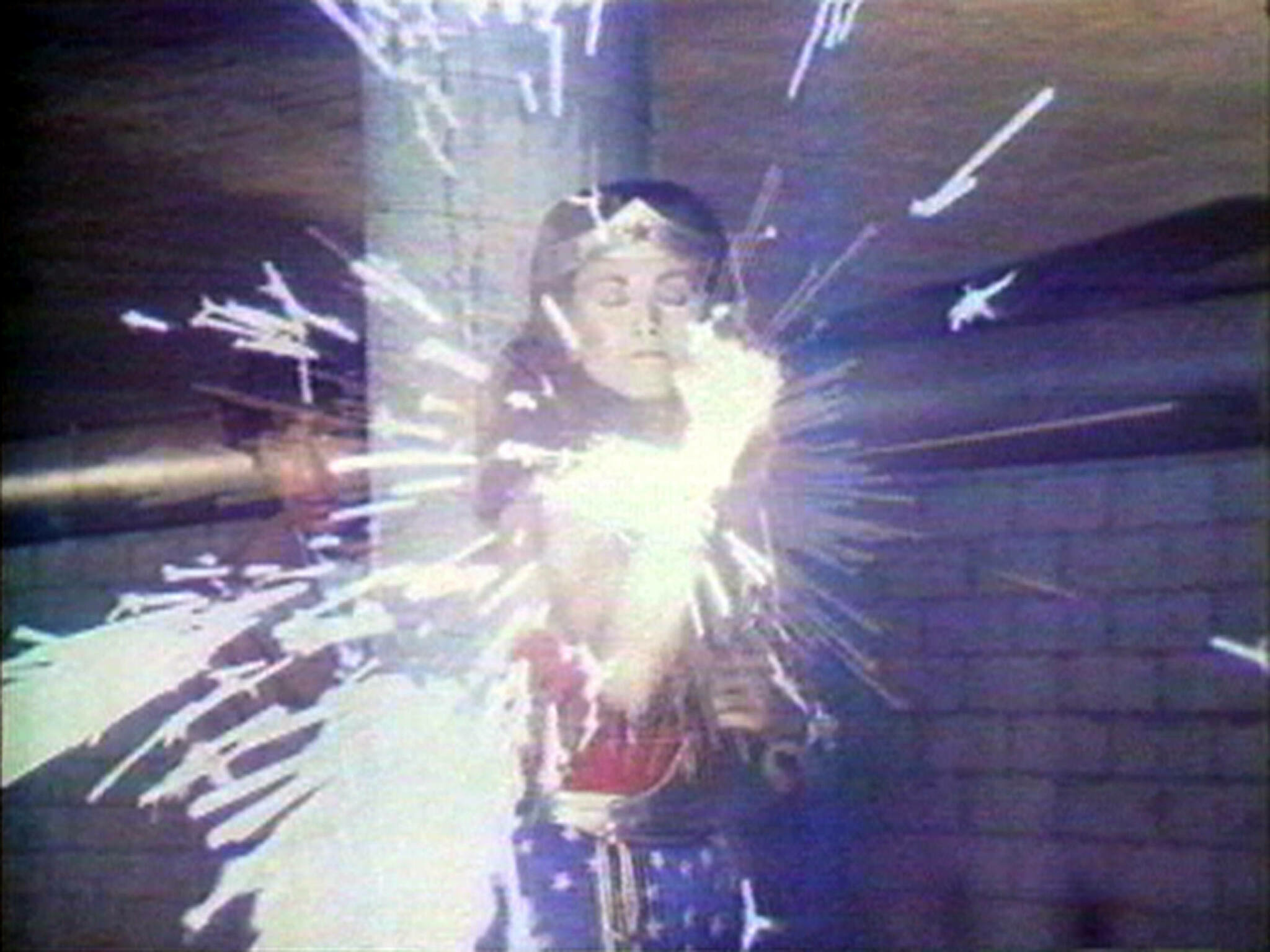
Dara Birnbaum (1946–)
Technology/Transformation: Wonder Woman (video still), 1978–79
Video, color, sound, 5:50 min., looped
Why?
We can discuss video art abstractly, but you need to experience it in real time.
Note: Due to the nature of video art including aspects of performance art, some material below may be inappropriate for sensitive individuals. If you have concerns, please contact the instructor and they can guide you to material that will be suitable for you.
Required
Telephones
“American and Swiss artist Christian Marclay emphasizes ‘the process.’ He deconstructs seemingly simple actions further into finite elements and creates collages from the scraps. Before Video Quartet and his monumental 24-hour effort The Clock was Telephones (1995), a piecemeal video collage [. . .] that plunders 130 Hollywood films.
“Using his building blocks—dialing, greeting, conversing, farewells and hang-ups—Marclay plays with the notion of cinematic continuity by splicing newer and older films into his own narrative. The video opens with a man walking into a booth, the word ‘telephone’ in all caps, he slowly dials. His action is followed by several more clips of dialing, technology jumps from clunky rotary dialers from the pre-area code days to ‘up-to-date’ push buttons phones (apple would later, ahem, appropriate the spirit of Telelphones for an ad). Perhaps most impressive is Marclay’s ability to create a story from such disparate sources. Clips begin to talk to one another—A man speaks deliberately into the mouthpiece ‘I haven’t been able to think or concentrate on anything except you.’ the video cuts to a second man who hesitantly says ‘I see….’”
Rapture
“Rapture (1999) Rapture is an installation of two synchronized black-and-white video sequences that are projected on opposite walls; large in scale, they evoke cinema screens. Working with hours of footage and a team of editors, the artist constructed two parallel narratives: on one side of the room, men populate an architectural environment; in the other sequence, women move within a natural one. The piece begins with images of a stone fortress and a hostile desert, respectively. The fortress dissolves into a shot of over one hundred men—uniformly dressed in plain white shirts and black pants—walking quickly through the cobblestone streets of an old city and entering the gates of the fortress. Simultaneously, the desert scene dissolves into a shot of an apparently equal number of women, wearing flowing, full-length veils, or chadors, emerging from different points in the barren landscape.”
Technology/Transformation: Wonder Woman
“Explosive bursts of fire open Technology/Transformation, an incendiary deconstruction of the ideology embedded in television form and pop cultural iconography. Appropriating imagery from the 1970s TV series Wonder Woman, Birnbaum isolates and repeats the moment of the ‘real’ woman's symbolic transformation into super-hero. Entrapped in her magical metamorphosis by Birnbaum's stuttering edits, Wonder Woman spins dizzily like a music-box doll. Through radical manipulation of this female Pop icon, she subverts its meaning within the television text. Arresting the flow of images through fragmentation and repetition, Birnbaum condenses the comic-book narrative—Wonder Woman deflects bullets off her bracelets, "cuts" her throat in a hall of mirrors—distilling its essence to allow the subtext to emerge. In a further textual deconstruction, she spells out the words to the song Wonder Woman in Discoland on the screen. The lyrics' double entendres (‘Get us out from under... Wonder Woman’) reveal the sexual source of the superwoman's supposed empowerment: ‘Shake thy Wonder Maker.’ Writing about the “stutter-step progression of 'extended moments' of transformation from Wonder Woman,’ Birnbaum states, ‘The abbreviated narrative — running, spinning, saving a man — allows the underlying theme to surface: psychological transformation versus television product. Real becomes Wonder in order to "do good" (be moral) in an (a) or (im)moral society.’”
John 3:16
“In the video John 3:16...a reference to a passage so often quoted that its sort of the Biblical code for the New Testament that gives you the formula for salvation and eternal life. There’s an interesting kind of resonance that I see between this idea of a formula for salvation and eternal life and the promise of digital media that never break down and literally can live forever...that can always be copied endlessly. In a way, the medium itself represents a kind of promise that almost has spiritual overtones.” – Paul Pfeiffer
Supplementary Readings: Works on Video
- Other Video Art Examples
-
Guitar Drag, Christian Marclay (1999)
“This video depicts a pickup truck dragging an amplified, electric guitar tied by a rope across a Texas roadway to its aggressive destruction. The many-layered video work references the practice of smashing guitars during rock concerts and demonstrates Marclay’s interest in inventing new types of sound. The piece was also created in response to the 1998 murder of 49-year-old James Byrd, Jr. of Jasper, Texas by three white supremacists and the tragedy’s widespread repercussions. Guitar Drag not only resonates with our aural and visual senses, but also simultaneously investigates multiple layers of history, race, geography, and timely social issues. Since 2000, Guitar Drag has been shown 24 times in museums and galleries, both nationally and internationally, including the Hayward Gallery in London, Gallery Koyanagi in Tokyo, Museum of Contemporary Art, Chicago, ZKM Center for Art and Media in Karlsruhe, Germany, and the Smithsonian Institution in Washington, DC. Sixteen years after its initial making, Artpace proudly presents the completed version of Marclay’s Guitar Drag for its Texas premiere.”
Semiotics of the Kitchen
“Semiotics of the Kitchen adopts the form of a parodic cooking demonstration in which, Rosler states, ‘An anti-Julia Child replaces the domesticated “meaning” of tools with a lexicon of rage and frustration.’ In this performance-based work, a static camera is focused on a woman in a kitchen. On a counter before her are a variety of utensils, each of which she picks up, names and proceeds to demonstrate, but with gestures that depart from the normal uses of the tool. In an ironic grammatology of sound and gesture, the woman and her implements enter and transgress the familiar system of everyday kitchen meanings—the securely understood signs of domestic industry and food production erupt into anger and violence. In this alphabet of kitchen implements, states Rosler, ‘when the woman speaks, she names her own oppression.’”
John Baldessari Sings Sol Lewitt
“One of Baldessari's most ambitious and risky efforts. Seated and holding a sheaf of papers, he proceeds to sing each of Sol LeWitt's 35 conceptual statements to a different pop tune, after the model of Ella Fitzgerald Sings Cole Porter. What initially presents itself as humorous gradually becomes a struggle to convey Lewitt's statements through this arbitrary means.” – Helene Winer, "Scenarios/Documents/Images," Art in America 61 (March 1973)
Teaching a Plant the Alphabet
“Teaching a Plant the Alphabet is an exercise in futility, an absurdist lesson in cognition and recognition. The scenario is elementary: A small potted plant sits atop a stool. In the role of teacher, Baldessari holds up a series of children's alphabet cards in sequence, repeating each letter to the plant until he has completed the alphabet. The plant, of course, does not respond. Eliciting deadpan humor from the incongruous juxtaposition of the rote instruction and the uncomprehending pupil, Baldessari creates illogic from a logical construct, making nonsense from sense. An elaboration of working notes in which Baldessari wrote, ‘Is it worth it to teach ants the alphabet?’ this piece also responds to Joseph Beuys' 1965 performance How to Explain Pictures to a Dead Hare.” -- EAI
Dance or Walk on the Perimeter of a Square
“For this film, Nauman made a square of masking tape on the studio floor, with each side marked at its halfway point. To the sound of a metronome and beginning at one corner, he methodically moves around the perimeter of the square, sometimes facing into its interior, sometimes out. Each pace is the equivalent of half the length of a side of the taped square. He uses the hip-swaying walk in Walk with Contrapposto.” - EAI
Mario Movie
“Mario Movie (2005) was made by Cory Arcangel with Paper Rad. It is a 15 minute movie made on a Super Mario Brothers cartridge.”
Trash Talking
Note: There is some bleeped cursing and adult content in this video. “This DVD includes lots of ephemera filling every color on the PANTONE wheel, but also including the recurring Alfe character in a brand new (never aired) TV Pilot. Also included will be the ultimate PAPER RAD "Guide to CD-ROMS" - essential knowledge for jammers everywhere. Also word comes from PAPER RAD HQ that this shiny video capsule will have "multi multi media, box eyes, and Future Genies out-takes" When all the footage is bonus, seated TV viewers come out ahead. This is for fans young and old looking for strange new voices! Put this on the next time you turn on, or the next time you turn on a small community through introduction of smiley faces into public water supply areas! Seriously buy a box lot of 30, the future is cheap if you buy in the present. Stock up for the Kulture Warz!”
Deshotten 1.0
Note: Contains adult language and scenes of gun violence. “Deshotten 1.0
akingdoncomethas
“A montage of filmed sermons and gospel songs performed in black churches from the 1980s to the 2000s.”
Fountain
“Fountain is a video that originated from a live performance of drinking water from a mirror. The image of confronting one’s own image recalls Narcissus, the Greek god that fell in love with his own image without recognizing it as his own, in some way being a splitting of the interior and exterior selves. In Fountain the image attempts to become whole again by drinking in the image of itself.”
Tooba
“Her poetic two-channel video installation Tooba is based on the Koran, in which Tooba, the sacred tree of paradise, offers shelter and sustenance to those in need. Neshat’s video places a woman within a groove in the trunk of a large fig tree, symbolising its soul. They stand, alone, in a stone-walled garden set in a mountainous landscape. Men and women draw near and enter the enclosure, seeking refuge, as the Tooba-woman disappears into the Tooba-tree. The piece is ambiguous. Who has agency? Is it the crowd, who ‘invade’ the garden or the tree-woman who draws them towards her like a magnet? Tooba is dedicated to Iranian writer Shahrnush Parsipour, whose novel Women without Men concerns five women sojourning in a garden, one of whom is transformed into a tree.”
Lennon Sontag Beuys
This is a 02:10 video looped. “The artist animates documentary footage of John Lennon and Yoko Ono's 1969 Amsterdam "bed-in" for peace, a 2001 lecture delivered by the late media philosopher Susan Sontag at Columbia University, and Joseph Beuys' 1974 lecture at the New School for Social Research in New York. These three channels play simultaneously, projected side-by-side on one wall. These videos are being made available for noncommercial and educational use only. All rights to this recorded material belong to Kota Ezawa.”
Purple Mountain
“Hand-painted gouache on paper animation. Film by Allison Schulnik. "Purple Mountain" song composed by Aaron MF Olson, performed by The Musical Tracing Ensemble. An ensemble of musicians is gathered in a performance space. Each musician has their own instrument, means of amplification (if needed), and pair of headphones. All musicians’ headphones are plugged into one outputting sound source (usually an iPod with many headphone splitters). Music (usually a well known song from the popular music canon) is played from the sound source and the musicians are instructed to play something, anything that they hear in their headphones as accurately as they can on their own instrument. The musicians never know what songs or sounds they will be hearing in advance. The audience only hears what the musicians are playing and none of the original sound source, thus creating a “tracing” of the sound source material.”
Moth
“Gnossienne No. 1 written by Erik Satie, performed by Nedelle Torrisi. MOTH is a traditionally animated, hand painted, gouache-on-paper film. It is animated mostly straight-ahead, with frames painted on paper almost daily for 14 months. The film seeded and bloomed from a moth hitting my studio window and continues as a wandering through the emotions of birth, motherhood, body, nature, metamorphosis and dance.”
Eager
“Traditional clay-mation and stop-motion animated film. Cinematography by Helder K. Sun, music by Aaron M. Olson.”
Mound
“Cinematography by Helder K. Sun. "It's Raining Today" written by Noel Scott Engel.”
Encore: Tabula Rasa (Ten Thousand Waves)
“Isaac Julien is a video artist and a filmmaker who weaves powerful visual narratives when creating his multi-screen installations. The artist’s practice successfully dissolves the separations that are traditionally associated with different creative disciplines, uniting film and photography, dance and movement, theatre, music and sound art, and painting and sculpture. With works that often explore themes of class, cultural history and identity, this exclusive new media artwork Encore:
Tabula Rasa (Ten Thousand Waves) relates to Julien’s nine-screen installation Ten Thousand Waves (2010), which examines the relationship between China's ancient past and rapidly-evolving present. In Latin, the term tabula rasa means blank slate, and here, we witness the cyclic depiction and erasure of traditional Chinese calligraphy, in a dance between older and newer generations.”
Response Question
Remember to cite specific instances from the “readings” to support your views.
- What possibilities opened up for your from watching these examples?
- Which piece inspired you the most and why?