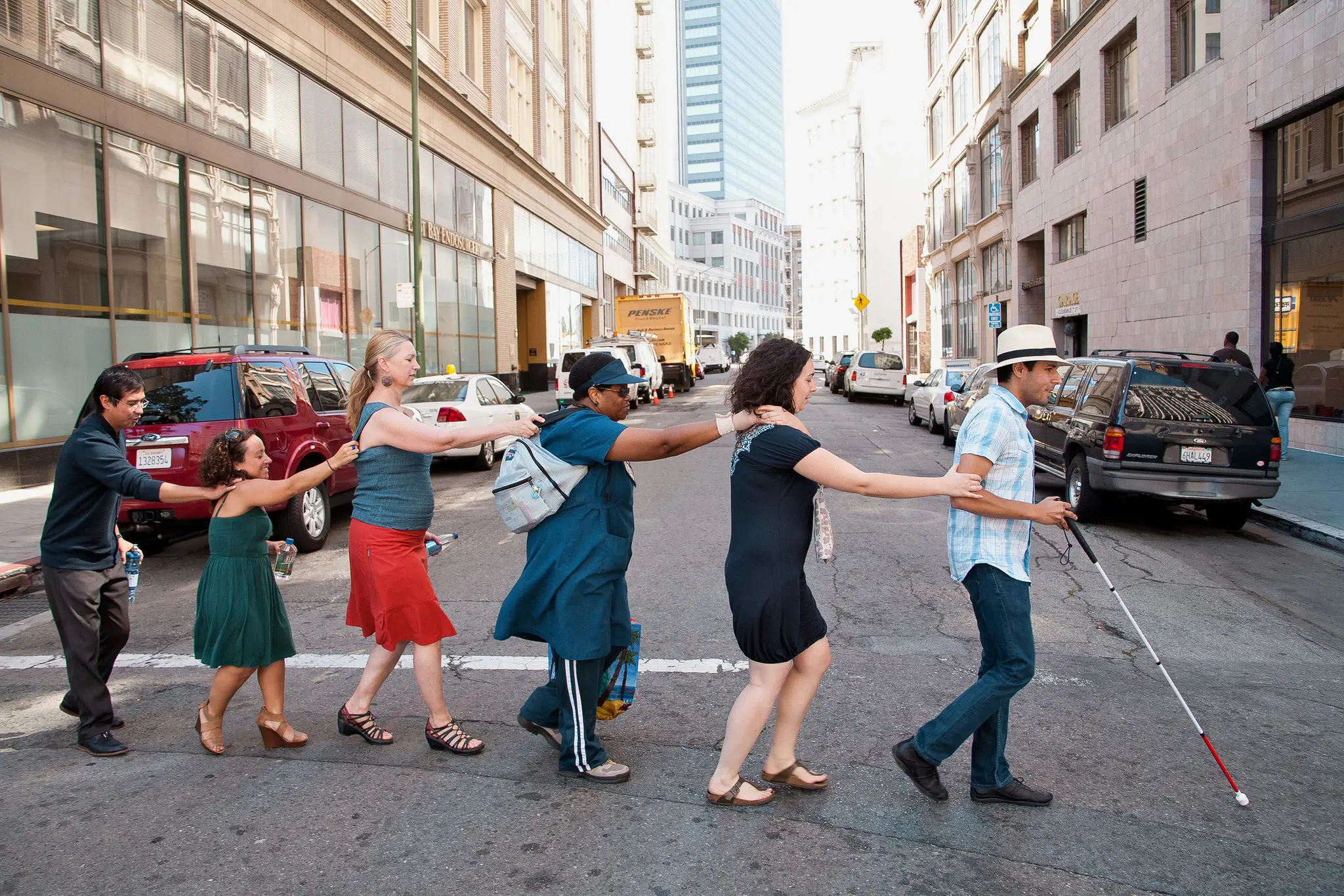
Carmen Papalia
Blind Field Shuttle, 2010–
The artist, who is legally blind, leads an eyes-shut walking tour
Photo Credit: Heather Zinger / NYTimes
Why?
The examples below will hopefully help you better understand the different approaches to Social Practice.
Note: Due to facets and branches of Social Practice being political, some material below may be be contrary to your own political and social views. If you have concerns, please contact the instructor and they can guide you to material that will be suitable for you.
Required
Art and Social Practice Workbook, Portland State University Art and Social Practice Reference Points
Just read the first 41 pages (~3,330 words / 23 minutes).“The Art and Social Practice Workbook is a collaborative and interactive project. It is comprised of assignments, handouts, evaluation tools, and other resources to be used as needed in your programs, classes, institutions, and life. The book is structured in a non-linear way; you do not have to read it from page to page like you would a novel. Instead, use it like you would a cookbook, adapting or revising the assignments to your taste. The Art and Social Practice workbook is an unfinished experiment, two years in the making and still growing. It remains in a stage of development and its progress depends on you.”
SWAP #43: William Pope.L, SPACES
“Renowned performance artist William Pope.L has a proposition for Cleveland: can we manually pull an 8-ton truck through the city for over two days straight, as a testament to the power of shared labor? Pull! is a durational. city-wide community performance piece, in which hundreds of Clevelanders will manually pull a truck for 25 miles, through the neighborhoods of North Collinwood, Glenville, University Circle, Hough, AsiaTown and downtown; to West Park, Clark-Fulton and Ohio City. Over 1,000 images collected from people across Cleveland about what work means to them will be projected from the back of the truck as it is pulled through the city. An excerpt of this video is on view at SPACES from May 17 – July 19, 2013. Pull! is a show of strength that can only happen if thousands of people team together. It celebrates the labor that built the city of Cleveland and is a living reminder we should be proud of hard work (especially when we do it together). We spend half our lives working and the other half avoiding it. Work puts food on our table and our kids through school. Our jobs (or lack of jobs) shape our lives for good and bad. Pull! will provide a moment for the diverse people of Cleveland to work together, eat together, pull together and talk together about one of the most powerful, meaningful forces in our lives—our jobs. And, to accomplish all of this through a community art performance project made for and by the people of Cleveland.”
Public Artist Rick Lowe, 2014 MacArthur Fellow, MacArthur Foundation
“Public Artist reinventing community revitalization as an art form by transforming a long-neglected neighborhood in Houston into a visionary amalgam of arts venue, community support center, and historic preservation initiative.”
Steve Lambert: Capitalism Works for Me! (True/False), Times Square NYC
“Times Square Broadway Plaza between 43rd & 44th Sts | September 20, 2013, October 6-9, 2013. Steve Lambert, Capitalism Works for Me! (True/False)." The sign itself is just a catalyst for conversations and contemplation. It is really only activated in the public square.
Theaster Gates: How to Revive a Neighborhood: With Imagination, Beauty and Art, TED
“Theaster Gates, a potter by training and a social activist by calling, wanted to do something about the sorry state of his neighborhood on the south side of Chicago. So he did, transforming abandoned buildings to create community hubs that connect and inspire those who still live there (and draw in those who don't). In this passionate talk, Gates describes his efforts to build a "miniature Versailles" in Chicago, and he shares his fervent belief that culture can be a catalyst for social transformation in any city, anywhere.”
Supplementary Readings
- Social Practice
-
Oliver Herring: “Task”, Art21
“Episode #209: This episode of ART21 ‘Exclusive’ follows artist Oliver Herring around Madison Square Park as he organizes his largest TASK Party to date. TASK parties encourage people to take creative risks and to break down social barriers through a simple, ‘self-perpetuating’ cycle: Each participant writes down a task and places it into a box and, in exchange, retrieves a task from the box. Participants work together to realize their tasks through provided materials such as paint, paper, tape, plastic wrap, and foil. ‘These tasks can be interpreted however you want,’ says Herring. ‘The tools are your imagination and your imagination is limitless.’ Since 2002, Herring has organized TASK events around the world, at military bases, museums, churches, schools, and other venues. Among Oliver Herring’s earliest works were his woven sculptures and performance pieces in which he knitted Mylar, a transparent and reflective material, into human figures, clothing and furniture. Since 1998, Herring has created stop-motion videos, photo-collaged sculptures, and impromptu participatory performances with ‘off-the-street’ strangers, embracing chance and chance-encounters in his work.”
18 Happenings in 6 Parts
18 Happenings in 6 Parts
New York City
April, 1988
Reinvented as part of
Precedings
at
The University of Texas at Arlington Center for Research on Contemporary Art organized by Jeff Kelley - Relational Aesthetics
Response Question
Remember to cite specific instances from the “readings” to support your views.
- Which of the projects in the readings resonated with you and why?
- What methodologies, ideas, or executions do you think you might use for your own social practice project and why?