Read by Thu Oct 30, 8am
Reading Response due Thu Oct 30, 8am
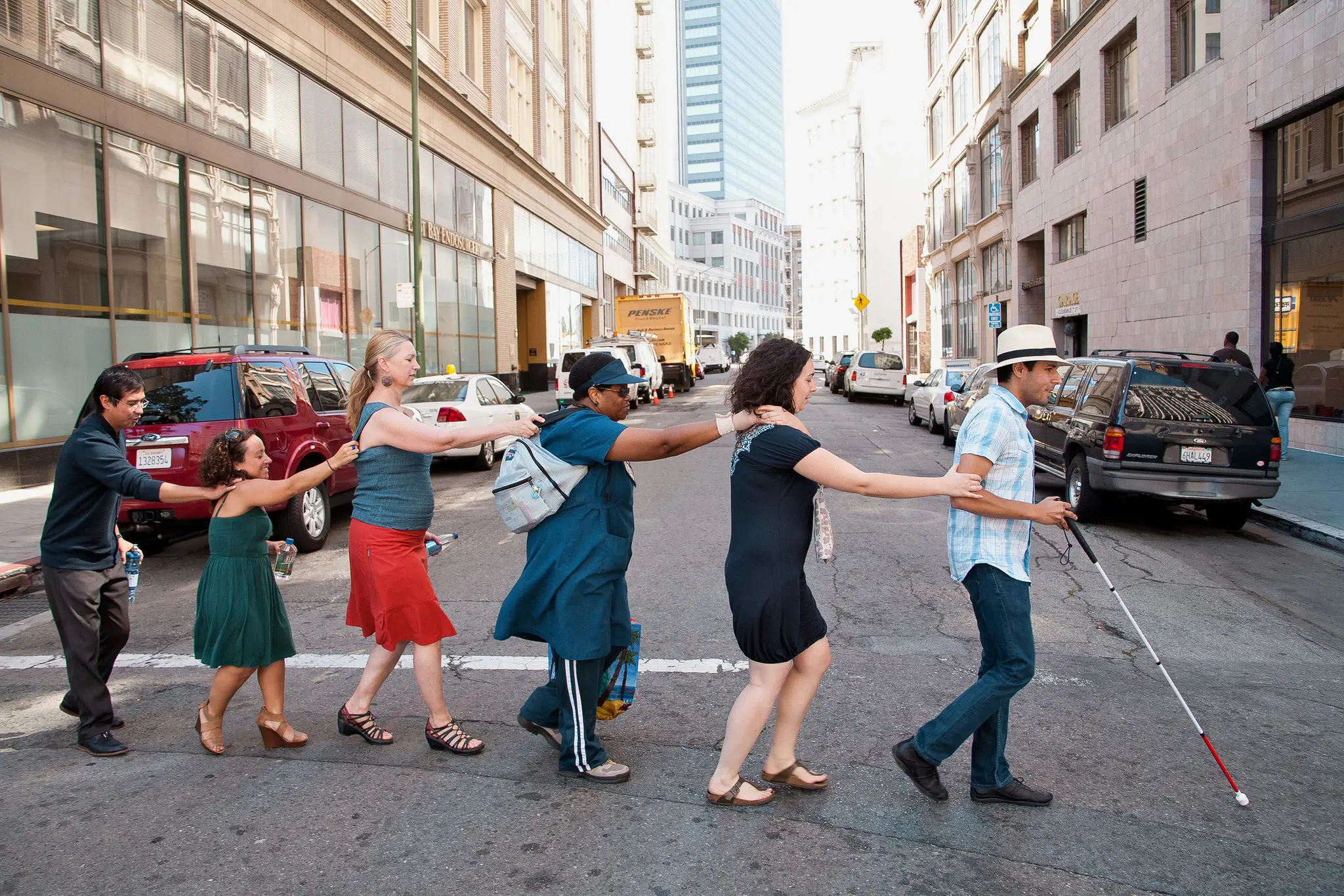
Carmen Papalia Blind Field Shuttle, 2010–
The artist, who is legally blind, leads an eyes-shut walking tour
Photo Credit: Heather Zinger / NYTimes
Why?
The examples below will hopefully help you better understand the different approaches to Social Practice.
Note: Due to facets and branches of Social Practice being political, some material below may be be contrary to your own political and social views. If you have concerns, please contact the instructor and they can guide you to material that will be suitable for you.
Just read the first 41 pages (~3,330 words / 23 minutes).“The Art and Social Practice Workbook is a collaborative and interactive project. It is comprised of assignments, handouts, evaluation tools, and other resources to be used as needed in your programs, classes, institutions, and life. The book is structured in a non-linear way; you do not have to read it from page to page like you would a novel. Instead, use it like you would a cookbook, adapting or revising the assignments to your taste. The Art and Social Practice workbook is an unfinished experiment, two years in the making and still growing. It remains in a stage of development and its progress depends on you.”
“Renowned performance artist William Pope.L has a proposition for Cleveland: can we manually pull an 8-ton truck through the city for over two days straight, as a testament to the power of shared labor? Pull! is a durational. city-wide community performance piece, in which hundreds of Clevelanders will manually pull a truck for 25 miles, through the neighborhoods of North Collinwood, Glenville, University Circle, Hough, AsiaTown and downtown; to West Park, Clark-Fulton and Ohio City. Over 1,000 images collected from people across Cleveland about what work means to them will be projected from the back of the truck as it is pulled through the city. An excerpt of this video is on view at SPACES from May 17 – July 19, 2013. Pull! is a show of strength that can only happen if thousands of people team together. It celebrates the labor that built the city of Cleveland and is a living reminder we should be proud of hard work (especially when we do it together). We spend half our lives working and the other half avoiding it. Work puts food on our table and our kids through school. Our jobs (or lack of jobs) shape our lives for good and bad. Pull! will provide a moment for the diverse people of Cleveland to work together, eat together, pull together and talk together about one of the most powerful, meaningful forces in our lives—our jobs. And, to accomplish all of this through a community art performance project made for and by the people of Cleveland.”
“Public Artist reinventing community revitalization as an art form by transforming a long-neglected neighborhood in Houston into a visionary amalgam of arts venue, community support center, and historic preservation initiative.”
“Times Square Broadway Plaza between 43rd & 44th Sts | September 20, 2013, October 6-9, 2013. Steve Lambert, Capitalism Works for Me! (True/False)." The sign itself is just a catalyst for conversations and contemplation. It is really only activated in the public square.
“Theaster Gates, a potter by training and a social activist by calling, wanted to do something about the sorry state of his neighborhood on the south side of Chicago. So he did, transforming abandoned buildings to create community hubs that connect and inspire those who still live there (and draw in those who don't). In this passionate talk, Gates describes his efforts to build a "miniature Versailles" in Chicago, and he shares his fervent belief that culture can be a catalyst for social transformation in any city, anywhere.”
“Episode #209: This episode of ART21 ‘Exclusive’ follows artist Oliver Herring around Madison Square Park as he organizes his largest TASK Party to date. TASK parties encourage people to take creative risks and to break down social barriers through a simple, ‘self-perpetuating’ cycle: Each participant writes down a task and places it into a box and, in exchange, retrieves a task from the box. Participants work together to realize their tasks through provided materials such as paint, paper, tape, plastic wrap, and foil. ‘These tasks can be interpreted however you want,’ says Herring. ‘The tools are your imagination and your imagination is limitless.’ Since 2002, Herring has organized TASK events around the world, at military bases, museums, churches, schools, and other venues. Among Oliver Herring’s earliest works were his woven sculptures and performance pieces in which he knitted Mylar, a transparent and reflective material, into human figures, clothing and furniture. Since 1998, Herring has created stop-motion videos, photo-collaged sculptures, and impromptu participatory performances with ‘off-the-street’ strangers, embracing chance and chance-encounters in his work.”
18 Happenings in 6 Parts
New York City
April, 1988
Reinvented as part of
Precedings
at
The University of Texas at Arlington Center for Research on Contemporary Art organized by Jeff Kelley
Relational Aesthetics
Response Question
Remember to cite specific instances from the “readings” to support your views.
Which of the projects in the readings resonated with you and why?
What methodologies, ideas, or executions do you think you might use for your own social practice project and why?
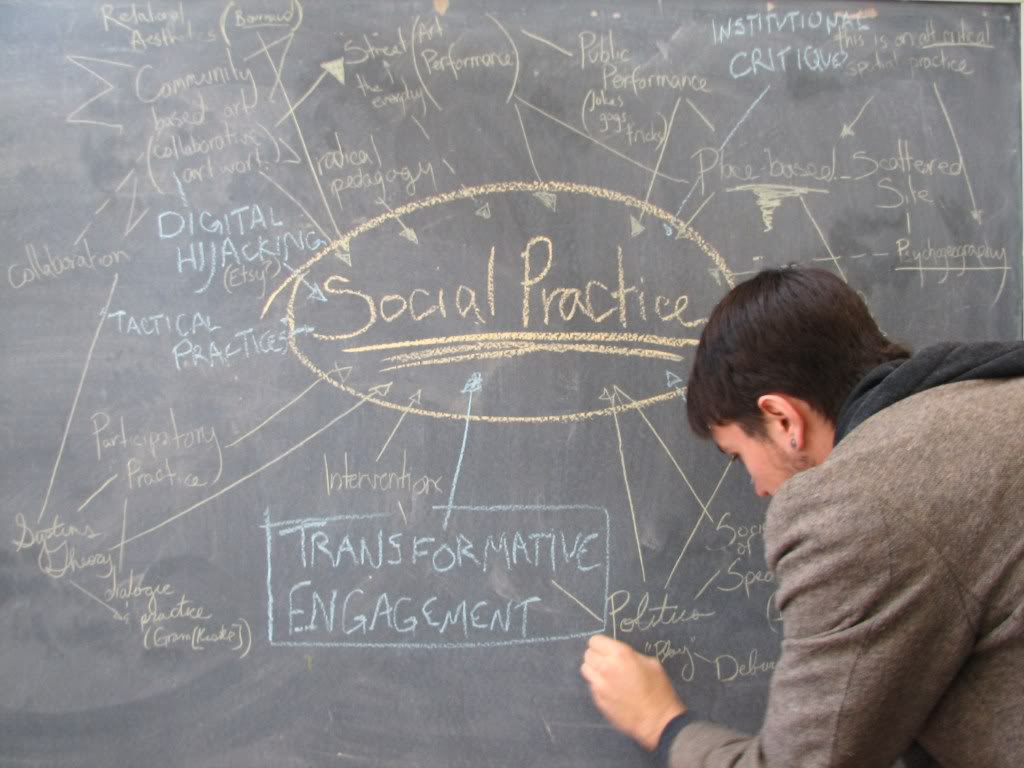
Social Practice has been gaining popularity since the late 1990s, but has roots that go back into the 1960s. There are many definitions of social practice—some that are solely political, others that just about creating social situations, others that lean towards humanitarian work. These readings explore some avenues of social practice, and we will discuss more in class. It is important to understand the possibilities for social practice as you work toward your own social practice project.
According to Abigail Satinsky, a noted writer, curator, and practitioner of Social Practice art:
Defining the actual parameters of “social practice art” seems to be a red herring. Sometimes a dinner party should just be a dinner party, sometimes calling a dinner party an art project makes it a richer experience for the individuals participating. Social practice art doesn‘t necessarily create more democratic exchange between art and audiences, often times it creates hierarchical distinctions between artists in art school and ordinary people with creative hobbies and interests that don’t have anything to do with an art career. But while it continues to be problematic territory, the larger anxiety it brings up is pretty interesting. How are artists defining the communities their work operates in, especially when traditional contexts such as commercial galleries, museums, and non-profits aren’t the intended landing pad? If one’s work is about engaging publics supposedly outside the artworld and eschewing art-speak when it comes to creative expression, who cares if it’s called art other than social practice artists? The issue then becomes not how to judge social practice within the confines of other art disciplines, but rather how the value of that work is being defined and by who. If social practice offers us anything, it openly asks not what kind of artist one wants to be but what kind of person one wants to be and how one wants their work to operate in the world.1
Since there are different and contested definitions, there are also different terms that are used synonymously with “Social Practice,” or heavily overlap it. Terms like Relational Aesthetics, Social Sculpture, and Socially Engaged Art are the most prominent.
Note: Due to facets and branches of Social Practice being political, some material below may be be contrary to your own political and social views. If you have concerns, please contact the instructor and they can guide you to material that will be suitable for you.
“This type of art of the encounter, frequently referred to as ‘social practice,’ has been having a moment in art circles—albeit a moment that dates back a couple of decades. In that time, artists such as Rick Lowe in Houston and Theaster Gates in Chicago have turned urban renewal into an art form, transforming abandoned buildings into thriving cultural hubs. In Detroit, the Museum of Contemporary Art harbors Mobile Homestead, one of Mike Kelley’s final works, a near-exact replica of his childhood home, which now serves as an ever-evolving community center.”
“What do we mean when we say ‘socially engaged art’? As the terminology around this practice is particularly porous, it is necessary to create a provisional definition of the kind of work that will be discussed here.”
“Does healing have a soundtrack? Sculptor, performer, and sound healer Guadalupe Maravilla combines his personal experiences as a formerly undocumented immigrant and cancer survivor with ancient and indigenous knowledge to create new rituals for healing. An impressionistic and kaleidoscopic look at Maravilla's multifaceted practice and biography, the film follows the artist as prepares his solo exhibition at Socrates Sculpture Park in Long Island City, New York and conducts healing sound performances for his community. From his Brooklyn studio, Maravilla recounts his personal journey as an unaccompanied minor fleeing the civil war in his native El Salvador and migrating through Central America to the United States. As an adult, Maravilla was diagnosed with colon cancer, which he considers a physical manifestation of the trauma he experienced as a child. During his radiation treatments, Maravilla was introduced to the sound bath, where participants are "bathed" in sound waves meant to encourage therapeutic processes. Struck by the healing potential of sound, Maravilla vowed to learn and share sound healing with others if he overcame cancer.”
“Social practice art can look like just about anything: journalism, community organizing, even a shop. The goal is to engage the audience and help people think about social issues in new ways. ‘For me,’ says social-practice artist and professor Stephanie Syjuco, ‘the best social practice projects actually try to attract people to join a conversation.’ Two artists, Chris Treggiari and Chris Johnson, recently went into the streets of Oakland to record conversations and make art.”
“The question of what social practice art actually is, who is defining its parameters and to what end, is a hot mess. Since the 1990s, a number of mostly European and North American art critics and historians have struggled to understand a notoriously chaotic set of practices, under an ever changing set of names including new genre public art, socially-engaged practice, relational art, dialogical aesthetics, etc. While I have no interest in throwing my hat in the art historical ring on that one (and I think the folks over at 127prince.wordpress.com/ are doing a good job on talking through the issues), I admit that I like the identity crisis that social practice art is always wrestling with. It’s rapidly becoming professionalized through MFA programs, like California College of Arts, Otis College of Art, and PSU. Yet it also heralds a kind of everyday creativity and social connectivity that is supposedly available to anyone with or without an art degree.”
“‘Is Social Practice Gentrifying Community Arts?’: This question posed by Rick Lowe of Project Row Houses in conversation with Nato Thompson at this years Creative Time Summit, Art, Place & Dislocation in the 21st Century, was a crystallizing moment in a series of gatherings and convening I’ve been part of the last few months. Addressing “gentrification,” the thematic buzz word of this year’s Creative Time convening, Lowe said that to really talk through the issue of gentrification, we must also address our issues with race.”
“In this episode, Artbound explores social practice arts throughout Southern California. Featuring Olga Koumoundouros' occupation of foreclosed homes in Los Angeles; The Workers' Rug/La Alfombra Del Trabajador, an art project by day laborers, organizers affiliated with IDEPSCA, artist Katie Bachler and Jade Thacker, and the Craft and Folk Art Museum; Public Matters' Market Makeover project addressing the "grocery gap" in "food deserts," areas that have limited access to quality, healthy food; the collective Fallen Fruit, who map local public fruit trees, encouraging us to rethink our relationship to food and public space; and a performance by Moses Sumney.”
“I had the opportunity to visit Harrell and the Art and Social Practice program at Portland State University. Through my visits and interactions with the Social Practice program, I’ve come to see it as yet another work by Harrell, with his co-director Jen Delos Reyes. The two have created an ongoing project in which the student is given much of the onus. The program is most often noted for being student-led, a pedagogical model that resembles Harrell’s works and writings, much of which is a reaction to his own frustrations with his education as a student and his experiences as an artist.”
“Each week in the Art and Social Practice MFA Program at Portland State University we have an hour of what we call ‘topical discussion.’ During that hour we explore a term or topic related to art and social practice. Some of the terms and topics are very basic, like collaboration, and site-specificity, but there are also less common terms like a touch of evil which we heard about from Pedro Reyes when we were visiting him in Mexico City a few years ago. Many of the ideas we discuss are not specific to socially engaged art, but we are looking at them from a socially engaged art perspective. Several of the concepts are ones that I have used in my own work but until recently hadn’t named what they were or detailed how they could be used as strategies when developing or analyzing a project. I hope that the list might be useful to people interested in socially engaged art. I started with about sixty terms and topics that I wrote about in 2019, and now I have added an additional forty or so. I’m already working on several new ones for a second volume.”
“Where does our current obsession for interactivity stem from? After the consumer society and the communication era, does art still contribute to the emergence of a rational society? Bourriaud attempts to renew our approach toward contemporary art by getting as close as possible to the artists works, and by revealing the principles that structure their thoughts: an aesthetic of the inter-human, of the encounter; of proximity, of resisting social formatting.”
“Bourriaud’s fetishism of the social produces an inversion of his critical claims for relational aesthetics. His realised utopianism echoes with the commodified friendship of customer services. For all his claims to the novelty of the idea of relational aesthetics, it is a reapplication of Romanticism. Art is conceived as an immediate form of non-capitalist life. But without an account of what mediates relational art’s disengagement from capitalist life, it is helplessly reversible, obliviously occupying the other side of capitalism’s coin.”
“But Bourriaud is at pains to distance contemporary work from that of previous generations. The main difference, as he sees it, is the shift in attitude toward social change: instead of a “utopian” agenda, today’s artists seek only to find provisional solutions in the here and now; instead of trying to change their environment, artists today are simply ‘learning to inhabit theworld in a better way’; instead of looking forward to a future utopia, this art sets up functioning 'microtopias’ in the present.
“It is unfortunate (but strategic) that Bishop’s only example of a relational artwork at first hand is so far removed from any of the above. Jerry Saltz, describing his experience of a work by Rirkrit Tiravanija for Art in America, gives us an exercise in namedropping and nepotism that demonstrates how familiar types of social practice based on networks of influence and exclusivity can surface anywhere. But as Bishop points out, this actually tells us little, because if we were to base our judgement on individual testimony then every participant in the work would have to be taken into account (suggesting a wildly democratic if untenable form of art criticism).”
Response Question
Remember to cite specific instances from the “readings” to support your views.
Which version of Social Practice is enticing to you and why?
According to Helguera, SEA is not symbolic, but an actual practice. How do you understand that, and how does that impact your perspective on your own art?
In The Man Who Planted Trees, Elzéard Bouffier never directly interacts with people, yet creates an enormous amount of social good. Would you consider this social practice? Why or why not?