3.2: Sound Editing and Effects

Read by Thu Sep 18, 8am
Reading Response due Thu Sep 18, 8am
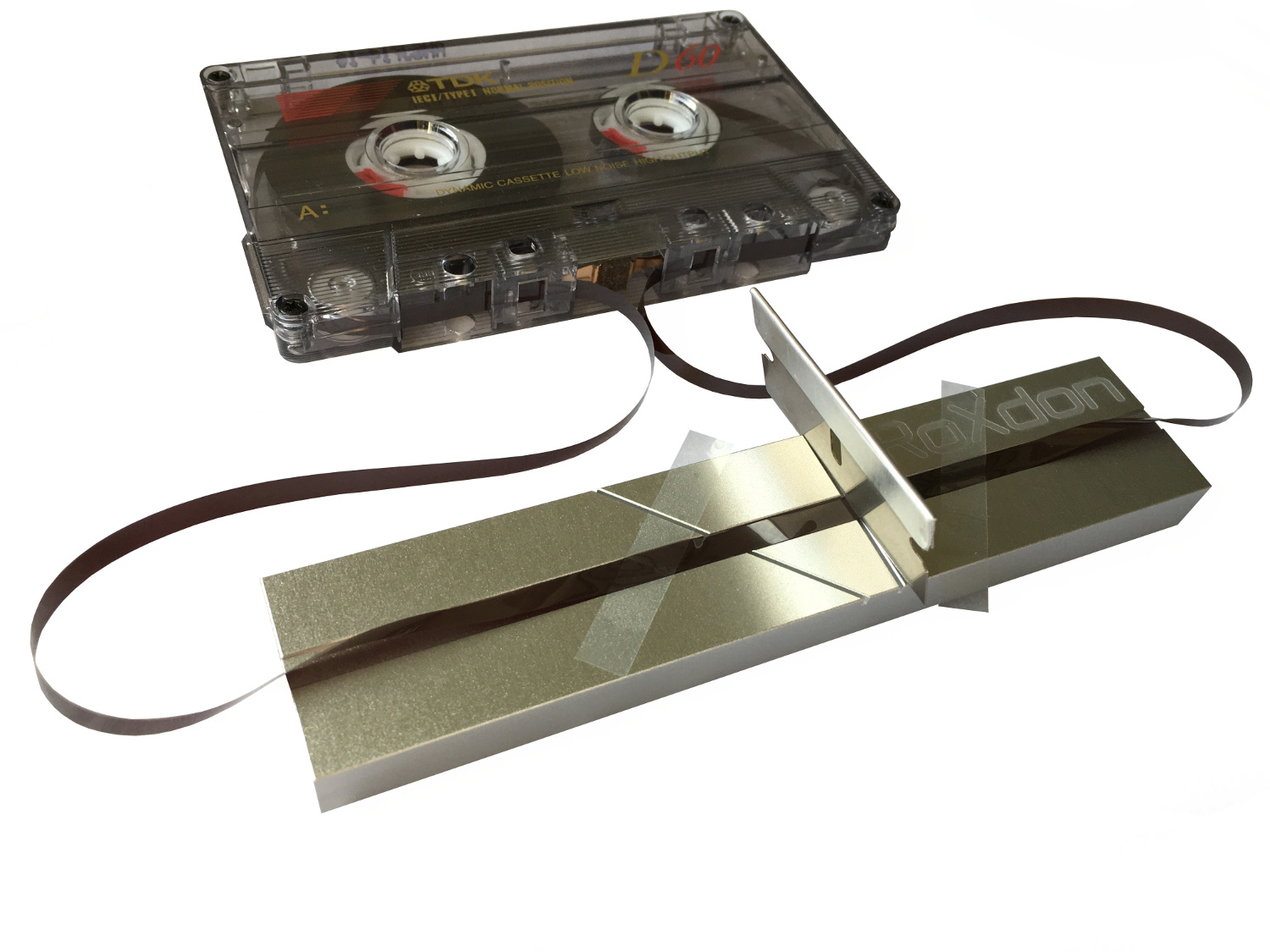
Editing magnetic cassette tape

Why?

For this reading set you’ll be learning some digital audio editing basics so you can begin to manipulate and arrange your sounds to get results that you are happy with.

There are a number of DAWs (digital audio workstations) available for audio editing: Logic (Apple), Garageband (Apple), Audition (Adobe), Ableton, Audacity and more. The pay options are not particularly cheap, but they will get you professional tools and quality. In our classroom, we have Audition available for you. However, for working it home, I will have you download and use Audacity, which is free and open source software that still gets your good results, especially for introductory use. All of these tools have similar interfaces and tools, so what you learn in Audacity can translate to Audition and others.

Download Audacity and install it on your computer. You may need to also download and install FFmpeg separately to allow you to import and export a variety of audio formats, including M4A and WMA. Don’t click on any of the giant buttons. You should be looking for basic text links for your particular operating system near the bottom of the page.

Below is a video showing you how old analog tape was edited, so you understand some of the features and terminology in DAWs because the digital workspaces use skeumorphs to help people understand how to use new technology. There is also a tutorial to get you started with Audacity. I want you to follow along with the tutorial, pause as necessary, and do what he does. This will help you remember the tools and features moving forward. We will then take this further in class to create your own sound art.

Finally, there are a few videos to introduce you to the basics of audio effects. We will explore more in class.

Required

Analogue Audio Tape Editing

“Editing and splicing analogue audio tape using a vintage Revox reel-to-reel tape deck.”

How to Use Audacity to Record & Edit Audio | Beginners Tutorial

“In this step-by-step tutorial, learn how to record and edit audio using Audacity. Audacity is free and open source and works across platforms, including Windows, Mac, and Linux.”

What are Audio Effects? Sound Basics with Stella – Episode 1

“What is reverb? What is delay? How about overdrive, fuzz or distortion? Watch audio engineer Stella Gotshtein guide you through the evolution of sound effects in music production.”

EQ Explained – Sound Basics with Stella Episode 2

“What is EQ? When and why do we use it? How can it change the sound of a single instrument or a full mix? Watch audio engineer Stella Gotshtein explain the importance of EQ in audio mixing.”

Reverb and Delay Explained – Sound Basics with Stella Episode 4

“Reverb and delay both create echo effects and are often used in recording and mixing. Watch audio engineer Stella Gotshtein demonstrate them on vocals and drum loops.”

Supplementary Readings

Audacity
Audacity Tutorials, LinkedIn Learning

Once you have logged in using your Provo City Library credentials, then you can click here, or do you own search for “Audacity.”

Adobe Audition
Learn Audition, Adobe

This series of relatively short video tutorials covers how to use Adobe's Audition, a professional tool for precision audio editing, mixing, and sound effects.

Learn How to Use Adobe Audition in 8 Minutes!

“This was a quick tutorial on how to get started with Adobe Audition.”

Adobe Audition Tutorials, LinkedIn Learning

Once you have logged in using your Provo City Library credentials, then you can click here, or do you own search for “Adobe Audition.”

Multi-channel Audio Editing
Multi-channel Audio Installation Guide

Collin Bradford wrote this guide specifically for BYU students using the equipment available through tech checkout. “How to use the MOTU UltraLite AVB audio interface with your software (Adobe Audition or Max/MSP) to control spatialization of sound in sound installations.”

Response Question

Remember to cite specific instances from the “readings” to support your views.

  • What are the most helpful things that you learned, and how might you use this in your own sound art projects?
2.2: Sound Art

Read by Thu Sep 11, 8am
Reading Response due Thu Sep 11, 8am
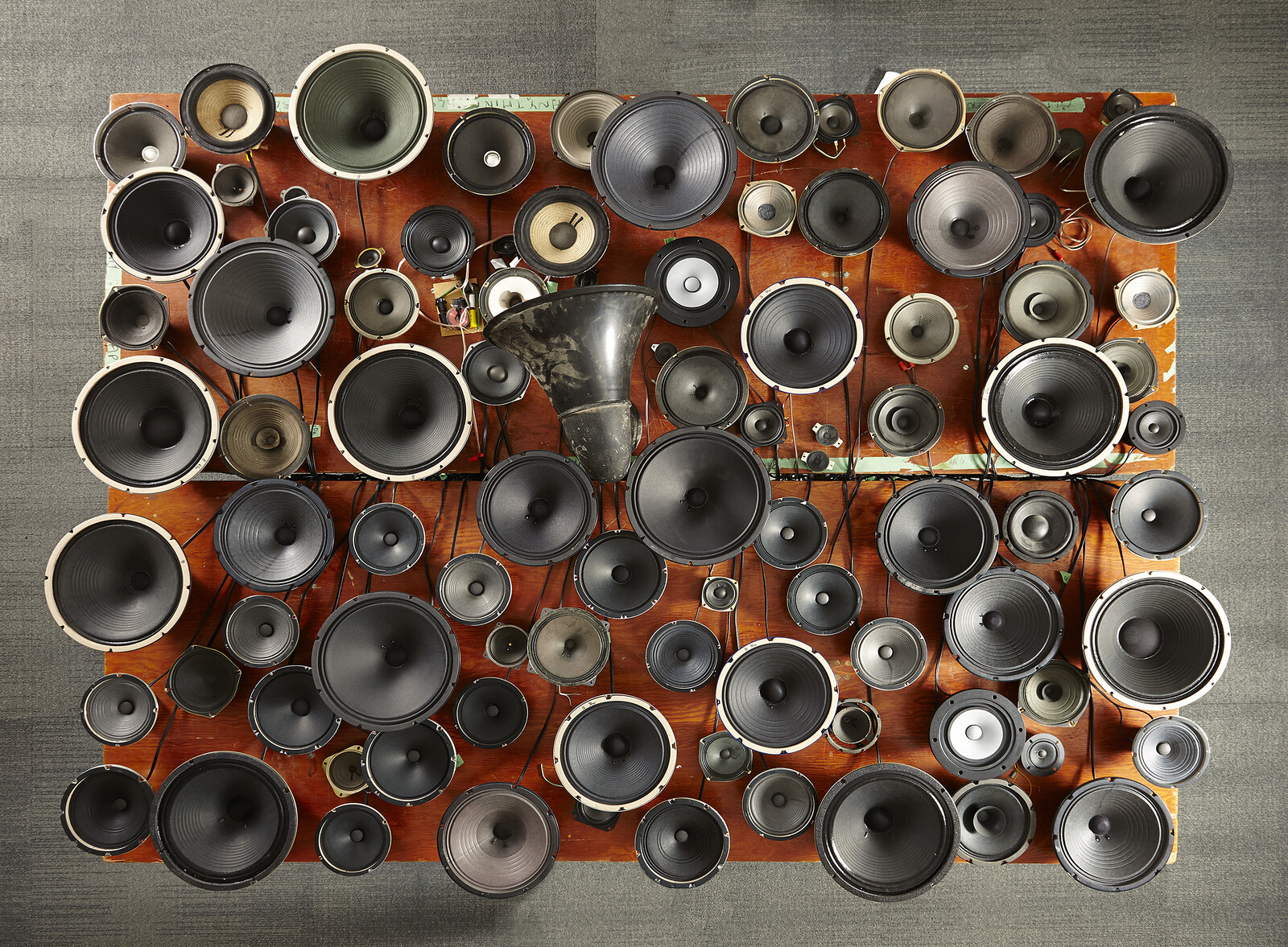
Janet Cardiff and George Bures Miller, Experiment in F# Minor, 2013

Why?

Experiencing time-based art takes. . . time. In this course, some of your “readings” will consist of recordings of time-based art so you get a feel for how artists have tackled this in the past. Do not watch or listen to these at accelerated speeds because you will be altering the pieces and robbing them of an essential characteristic. Take the time to experience them as they unfold. Do not do other work as you you watch or listen—digesting the work in a distracted state, but it’s OK to read about the works as you listen. Give yourself to the work and focus. Some of these may be difficult or even grating at times, requiring a lot of you as the audience. Think about timing and pacing; how pieces build, evolve, or plateau; and how the use of recording plays a role in your understanding of the work. Headphones are recommended to help you focus and take advantage of stereo recordings (when available).

We are going to start with Alvin Lucier’s I Am Sitting in a Room wherein he records himself speaking (he had a lifelong stutter), then plays back the recording and records that. The acoustics of the space alter the original recording as they bound off the room’s surfaces. Then that new recording is played back and recorded. Each time, the reverberations of the room become amplified until his voice becomes unrecognizable in a sea of robotic squeaks and chirps. This piece underscores the nature of sound in space, and how recording alters our perceptions of sound.

The other piece for you is Janet Cardiff and George Bures Miller’s Pandemonium, which is a percussion piece (of a sort) that has its own unique take on site-specific sound.

Required

Alvin Lucier on “I am sitting in a room”, Arts at MIT

“Glimpse minimalist composer Alvin Lucier’s sound check and performance of his most famous work I am sitting in a room, which was the musical focus of CAST’s symposium ‘Seeing, Sounding, Sensing.’ Lucier gives context for this piece in an intimate interview with Evan Ziporyn. Ziporyn, together with the symposium’s organizers Stefan Helmreich and Caroline Jones, share their thoughts about Lucier’s music, the idea of reverberation within the broader context of the symposium’s panel ‘Sounding’ and the ways art and technology inform one another.”

I Am Sitting in a room, Ubu Web

for voice and electromagnetic tape.

Necessary Equipment:
1 microphone 2 tape recorders amplifier 1 loudspeaker
Choose a room the musical qualities of which you would like to evoke.

Attach the microphone to the input of tape recorder #1.

To the output of tape recorder #2 attach the amplifier and loudspeaker.

Use the following text or any other text of any length:
“I am sitting in a room different from the one you are in now. I am recording the sound of my speaking voice and I am going to play it back into the room again and again until the resonant frequencies of the room reinforce themselves so that any semblance of my speech, with perhaps the exception of rhythm, is destroyed. What you will hear, then, are the natural resonant frequencies of the room articulated by speech. I regard this activity not so much as a demonstration of a physical fact, but more as a way to smooth out any irregularities my speech might have.”

Record your voice on tape through the microphone attached to tape recorder #1.

Rewind the tape to its beginning, transfer it to tape recorder #2, play it back into the room through the loudspeaker and record a second generation of the original recorded statement through the microphone attached to tape recorder #1.

Rewind the second generation to its beginning and splice it onto the end of the original recorded statement on tape recorder #2.

Play the second generation only back into the room through the loud speakerand record a third generation of the original recorded statement through the microphone attached to tape recorder #1.

Continue this process through many generations.

All the generations spliced together in chronological order make a composition the length of which is determined by the length of original statement and the number of generations recorded.

The versions in which one recorded statement is recycled through many rooms.

Make versions using one or more speakers of different languages and in different rooms.

Make versions in which, for each generation, the microphone is moved to different parts of the room or rooms.

Make versions that can be performed in real time.

Pandemonium

Tip tap tip tap. Is that the sound of dripping or is it someone in a cell tapping a code on the wall? Now there are many more tapping sounds. Far and near. Loud and soft. Now someone is banging on a pipe, now a cupboard. Now the hall is filled with a cacophony of beats, working their way back and forth, a PANDEMONIUM of percussion. Using the existing elements in the prison cells Janet Cardiff and George Bures Miller have made the entire Cellblock Seven into a giant musical instrument, producing a percussive site work. This instrument, controlled by a computer and midi system, is made up of one hundred and twenty separate beaters hitting disparate objects such as toilet bowls, light fixtures and bedside tables found within the prison cells. The composition begins subtly as if two prisoners are trying to communicate and then moves through an abstract soundscape and lively dance beats until it reaches a riot-like crescendo.

The massive Eastern State Penitentiary was once the most famous and expensive prison in the world. Its gothic, castle-like towers stood as a grim warning to lawbreakers in the young United States. This was the world’s first true “penitentiary,” a prison intended to inspire profound regret—or penitence—in the hearts of criminals. The influential design featured cellblocks extending like the spokes of a wheel; each inmate lived in solitary confinement in a vaulted sky-lit cell. The prison itself had running water and central heat before the White House, and once held many of America’s most notorious criminals, including bank robber “Slick Willie” Sutton and Al Capone.

Eastern State closed in 1971. The prison stands today in ruin, a haunting world of crumbling cellblocks and a place of surprising beauty. Cardiff and Miller present Pandemonium in Cell Block Seven, a massive, cathedral-like, two-story wing completed in 1836. It has never been open to the public, and has been stabilized especially for this exhibition. The installation will open to the public on May 12, 2005 and will remain on view through November as well as in 2006.

Supplementary Readings

History of Sound Art
The Art of Noises: A Futurist Manifesto

The Art of Noises (Italian: L'arte dei Rumori) is a Futurist manifesto written by Luigi Russolo in a 1913 letter to friend and Futurist composer Francesco Balilla Pratella. In it, Russolo argues that the human ear has become accustomed to the speed, energy, and noise of the urban industrial soundscape; furthermore, this new sonic palette requires a new approach to musical instrumentation and composition. He proposes a number of conclusions about how electronics and other technology will allow futurist musicians to ‘substitute for the limited variety of timbres that the orchestra possesses today the infinite variety of timbres in noises, reproduced with appropriate mechanisms’. The Art of Noises is considered by some authors to be one of the most important and influential texts in 20th-century musical aesthetics.” (Text from Wikipedia.)

History of Sound Art: Audio

“An engaging sound collage presenting an unique historical documentation of a century of Sound Art from the early 20th century to 20011.

“The composition weaves through different sound works throughout the century with narratives and ideas from some of the prominent artists in the field. A retrospective into the craft of sound and its development as an artistic practice, from Edison’s first sound film in 1895 to today, including the thoughts and concepts which served the basis for the creation of these works as spoken by the artists themselves.​

T“he ‘Listening’ can be accompanied with the booklet available here that informs of the artists whose work and words are heard according to the timecode on the video.

“Commissioned by Newtoy Ltd in 2011. Created by J Milo Taylor. Mixed by Joel Cahen

“Featuring:
Sleep Research Facility, Cathy Lane, John Cage, Charlie Fox, Ros Bandt, Janet Cardiff, Brandon La Belle, Thomas Edison, Marcel Duschamp, Hugo Ball, Leon Theramin, FW Marinetti, Walter Ruttmann, Kurt Schwitters, Harry Partch, Antonin Artaud, Pierre Schaeffer and Pierre Henry, Iannis Xenakis, Louis and Bebe Barron, Pauline Oliveros, Morton Feldman, George Brecht, Richard Maxfield, Dick Higgins, Group Ongaku, Brion Gysin, Karlheinz Stockhausen, Tod Dockstader, La Monte Young, Luc Ferrari, Alvin Lucier, Bruce Nauman, Bernard Parmegiani, Francoise Bayle, R Murray Schafer, Trevor Wishart, hildegard Westerkamp, Terry Fox, David Dunn, Nam June Paik, Max Neuhaus, Throbbing Gristle, Barry Truax, Limpe Fuchs, John Oswald, Bill Fontana, Warren Burt, David Cunningham, Laurie Anderson, Gregory Whitehead, Lee Renaldo, Christian Marclay, William Burroughs, Denis Smalley, Dan Lander, Gilles Gobeil, Negativland, Trimpin, Jonty Harrison, Kim Cascone, Jodi Rose, Francisco Lopez, Bernard Leitner, Peter Vogel, Steve Roden, Pamela Z, Terre Thaemlitz, Chris Watson, David Toop, Disinformation, Atau tanaka, Dan Lander, Philip Jeck, Carsten Nicolai, Justin Bennett, David Toop, Project Dark, Steve Vitiello, Maryanne Amacher, Christina Kubisch, John Bischoff, Andres Bosshard, Iris Garrelfs, Peter Cusack, Steve Barsotti, Andrea Polli, James Webb, Nic Collins, DJ Spooky, Rainer Linz, Salomé Voegelin, David Lee Myers, David Chesworth and Sonia Leiber, Karlheinz Essl, Dallas Simpson, FM3, Matthew Mullane, Ultra-Red, Tony Herrington, Dan Senn, John Wynne and Susan Philipsz.”

History of Sound Art: Timeline

This timeline accompanies J. Milo Taylor's “engaging sound collage presenting an unique historical documentation of a century of Sound Art from the early 20th century to 2011." You can also see the entire timeline as a scrollable, single-page PDF: https://www.dropbox.com/scl/fi/dkbnw9ej90kltp0kl51j2/taylor_history-of-sound-art-vertical.pdf?rlkey=t60n33yn5nkts7eds0130ql96&st=mbibe8xa&dl=0

Sound Art
As Slow As Possible, 99% Invisible

“In February, everyone who went to a concert in the old medieval town of Halberstadt, Germany, showed up 23 years late. This is also concert from which everyone walks out early. The performance is of a piece called ORGAN2/ASLSP. ASLSP stands for ‘as slow as possible,’ which is how the composer meant for it to be played, and this particular day would involve a chord change. The last time ORGAN2/ASLSP had a chord change was in 2022, and this new chord will play until the next change, in August, 2026. There is a change the year after that, and the following year, and so on, until the year 2640. The full performance is meant to last 639 years.”

Playlist: The Baschet Instrumentarium

“This video is part of a 12-part series on the Baschet instrumentarium. Each video features a specific sound sculpture. While the Baschet brothers have designed other instruments intended for performance and music therapy, these particular structures belong to the education line and are intended for sound exploration with children. Or for big children, like me!”

Cristal Baschet (an instrument that needs to be wet)

Dennis James demonstrates the Cristal Baschet that requires the player to wet their fingers before stroking glass stems that vibrate and are amplified by metal cones/resonators.

Close Up Sounds of Everyday Objects

“Close-up sounds of everyday objects.”

3 Floors Instrument, My Tallest One (For Now) – CFMI Selestat

“Back in my school, CFMI de Sélestat, France, formation for ‘Musiciens Intervenants’ to create a giant installation with students”

”Field Recording Art” Lecture-Workshop with Yiorgis Sakellariou

“”Field recording art” lecture-workshop with Yiorgis Sakellariou
22nd of August
2 p.m. - 4 p.m.
Kirtimai Cultural Center
Dariaus ir Girėno str. 69

This lecture-workshop is a part of the Sonic Vilnius project program. Here we learned more about the history of recorded sound, field recording equipment and techniques. Sonic Vilnius is a project containing the processuality of soundwalk exploring method and actualization of the art of recording field sounds.”

For Eyes and Ears: New Sound Art Serves Different Senses with a Multimodal Approach, Art in America

“Ssound does not exist in a vacuum—it requires a medium through which to propagate. Innovations in electroacoustics have worked to partition and privatize the sonic realm, separating voices and music from their host bodies and feeding them cleanly to the ear via high-fidelity speakers, noise-canceling headphones, and other means. But sound represents only one facet of a listening experience. To understand another person while speaking face-to-face is not merely to listen to them but, rather, to navigate a full constellation of perceptual cues—visual, tactile, olfactory, and social—that inform and inflect what is said and heard. In the parlance of neuroscience, this sensory interplay constitutes what is known as ‘multimodal perception.’”

Céleste Boursier-Mougenot in The Curve, Barbican Centre

”Extracts from Ariane Michel's film, Les Oiseaux de Céleste. Copyright Galerie Xippas, Ariane Michel and Céleste Boursier-Mougenot, 2008. French artist Céleste Boursier-Mougenot creates works by drawing on the rhythms of daily life to produce sound in unexpected ways. For his installation in The Curve, Boursier-Mougenot creates a walk-though aviary for a flock of zebra finches, furnished with electric guitars and other musical instruments. As the birds go about their routine activities, perching on or feeding from the various pieces of equipment, they create a captivating, live soundscape.”

Sisters with Transistors: Electronic Music’s Unsung Heroines

“Sisters with Transistors: Electronic Music’s Unsung Heroines, an award-winning documentary that maps the history of twentieth century women experimental music pioneers. Narrated by Laurie Anderson, Sisters with Transistors features the work of visionary composer and Rensselaer professor Pauline Oliveros alongside Wendy Carlos, Clara Rockmore, Daphne Oram, Bebe Barron, Delia Derbyshire, EMPAC-alum Maryanne Amacher, Eliane Radigue, Suzanne Ciani, and Laurie Spiegel. Through rigorous research, interviews, and archival footage, the film follows the electronic music composers’ radical experimentations with machines that redefined the boundaries of contemporary music.”

Laurie Anderson
The Sensual Nature of Sound: 4 Composers Laurie Anderson Tania Leon Meredith Monk Pauline Oliveros

The Sensual Nature of Sound portrays these New York based composer/performers in terms of their musical lives. Although all four women are pioneers in American music, each composer pursues a distinct direction of her own. Since the early 1980s, Laurie Anderson has used music and performance as the foundation for her multi-media stage shows which have since become her trademark. Cuban born Tania Leon composes orchestral music that is an intricate weave of Afro-Cuban and Latin jazz elements embedded within a classical Western concerto format. Meredith Monk experiments with new ideas in music theater and has developed a genre of opera very much her own. Pauline Oliveros draws upon the rich resources of ritual, myth, meditation, and improvisation to create a body of work that is truly visionary. Filmed at rehearsals and performances in the United States and abroad, The Sensual Nature of Sound examines the contributions of these diverse composers to contemporary American music.”

Note: Kanopy videos are mercurial—sometimes they are available, and sometimes they are not. If this video is unavailable on Kanopy, just find it elsewhere, or find a different "reading."

Laurie Anderson Interview: A Life of Stories, Louisiana Channel

“Listen to the story of how Laurie Anderson became the iconic multimedia artist she is today, why she prefers to keep things simple, and how she began telling stories as a child – and never stopped: ‘I try to make stories that really engage my mind.’

When Anderson started out as an artist, she was aware that you don’t necessarily need impressive or expensive gear in order to succeed: ‘I was trying to do something on the right scale – something that you can do yourself.’ She began as a painter and sculptor and started playing the instruments she made while making little films, which she would show to a small group of artists. This enticed her to try to get her films out into a wider audience in the mid-1970s by doing ‘these little shows’ at different venues.

Laurie Anderson was interviewed by Christian Lund at the Louisiana Museum of Modern Art, Denmark in May 2016.

Laurie Anderson’s Buddhism: Art, Meditation, and Death as Adventure, How to Train a Happy Mind

“Grammy Award winning artist Laurie Anderson, a longtime student of Buddhism and meditation, joined us today to share her personal path with Buddhism, approaching art with a beginner’s mind, staying present with suffering without letting it overwhelm you, and making our lives meaningful. Laurie Anderson is one of our greatest living artists. Her work includes spoken word and performance, top-charting albums and music videos, digital art, film, virtual reality, and the invention of ingenious instruments like the tape bow violin and the talking stick. She’s won the Grammy Award and many other honors, and is currently the subject of a fantastic solo show at the Hirschhorn Museum in Washington, D.C.”

Laurie Anderson: The 60 Minutes Interview, 60 Minutes

“Anderson Cooper speaks with Laurie Anderson about her five-decade career as an artist, singer, composer and storyteller, and visits her largest-ever U.S. exhibit.”

Laurie Anderson – Building an ARK | Starmus VII, Slovakia 2024, Starmus

“In this lecture from Starmus VII, titled ‘Building an ARK,’ Laurie Anderson, an avant-garde artist, composer, and filmmaker, delves into the intersection of art, technology, and storytelling. Anderson explores the concept of creating a modern ark for the 21st century, weaving together themes of artificial intelligence, language, and the human experience. Through her unique lens, Anderson challenges us to reconsider our relationship with technology and the natural world, offering a thought-provoking narrative on the future of humanity and our planet.

“Laurie Anderson is a pioneering figure in electronic music and an acclaimed multimedia artist known for her innovative use of technology in art. Her work spans performance art, pop music, and multimedia projects, often focusing on themes of politics, culture, and the human condition.”

Laurie Anderson discusses ‘Amelia’: a visionary new album inspired by Amelia Earhart, Qobuz

“In an illuminating conversation, the Chicago artist shares her vision of the future and tells the story of ‘Amelia,’ her tenth album dedicated to the aviatrix Amelia Earhart. Along the way, she discusses the album-making process, the AI revolution, and even her cogitations on life and death.”

Laurie Anderson 12-14-85 late night TV interview, BetGems Lost Media

“Laurie Anderson is interviewed for a late night TV show, as broadcast 12-14-85. The BetaGems channel also has "Laurie Anderson & Peter Gabriel video vanguard award.”

Harry Bertoia
Making Different Sounds with a Bertoia Sculpture, Allentown Art Museum

“Our Museum Auxiliary visited Bertoia Studio in Bally, PA, on April 7, 2016, and were treated to a tour by Val Bertoia, who keeps the legacy and the sounds of his father Harry's work alive. The Museum's permanent collection includes sounding sculptures from Harry Bertoia.”

Harry Bertoia Sonambient Barn

“Visited the Harry Bertoia Sonambient Barn and studio today. This is his son, Val, as well as me and some other folks on the tour playing with the various sculptures and gongs.”

Janet Cardiff and George Bures Miller
Pandemonium

Tip tap tip tap. Is that the sound of dripping or is it someone in a cell tapping a code on the wall? Now there are many more tapping sounds. Far and near. Loud and soft. Now someone is banging on a pipe, now a cupboard. Now the hall is filled with a cacophony of beats, working their way back and forth, a PANDEMONIUM of percussion. Using the existing elements in the prison cells Janet Cardiff and George Bures Miller have made the entire Cellblock Seven into a giant musical instrument, producing a percussive site work. This instrument, controlled by a computer and midi system, is made up of one hundred and twenty separate beaters hitting disparate objects such as toilet bowls, light fixtures and bedside tables found within the prison cells. The composition begins subtly as if two prisoners are trying to communicate and then moves through an abstract soundscape and lively dance beats until it reaches a riot-like crescendo.

The massive Eastern State Penitentiary was once the most famous and expensive prison in the world. Its gothic, castle-like towers stood as a grim warning to lawbreakers in the young United States. This was the world’s first true “penitentiary,” a prison intended to inspire profound regret—or penitence—in the hearts of criminals. The influential design featured cellblocks extending like the spokes of a wheel; each inmate lived in solitary confinement in a vaulted sky-lit cell. The prison itself had running water and central heat before the White House, and once held many of America’s most notorious criminals, including bank robber “Slick Willie” Sutton and Al Capone.

Eastern State closed in 1971. The prison stands today in ruin, a haunting world of crumbling cellblocks and a place of surprising beauty. Cardiff and Miller present Pandemonium in Cell Block Seven, a massive, cathedral-like, two-story wing completed in 1836. It has never been open to the public, and has been stabilized especially for this exhibition. The installation will open to the public on May 12, 2005 and will remain on view through November as well as in 2006.

Graham Dunning
Extended Turntable Developments Spring 2024

“An collection of clips I've uploaded to instagram over the last few months, collated here with annotations explaining what's happening. These contraptions are components for use in performance and recording with the Mechanical Techno setup and various other experimental music collaborations.”

Graham Dunning | A4 – priestor súčasnej kultúry

“Instrumental innovator Graham Dunning perceives sound as texture, colour or a haptic impulse, his playful approach based in DIY production and found object recycling. In tandem with DJ Food, he wields his record player sequencers – an unusual apparatus built on a turntable platter, which relies on specially adapted discs, optical reflex sensors, active beat coordinates and ping pong balls (!) to generate a frantic mechanical techno. Strictly Kev is another turntable dismantler and recontextualization enthusiast. Kev has been part of DJ Food (formerly the multi-producer collective Coldcut and PC) for nearly three decades. For 25 years, he was the main contributor to the radio show Solid Steel produced by – you guessed it – the Coldcut duo. Teaming up with Graham Dunning, his four-armed record player and so-called locked grooves elevate the DJ set into a performance of ceaselessly morphic sonic surfaces and rhythms.”

Lawrence Abu Hamdan
Acoustic Investigation into the Syrian Regime Prison (ft. Artist Lawrence Abu Hamdan), Art21

“Riding the New York City subway, artist Lawrence Abu Hamdan makes his way to the Museum of Modern Art (MoMA), where his 2023 exhibition ‘Walled Unwalled and Other Monologues’ is underway. Using his unique methods of acoustic investigation, Abu Hamdan explores the potentials and limits of our ability to listen and truly hear. “I’ve dedicated a lot of work to thinking about a politics of listening,” says the artist. “That’s quite different to a politics of speech where everyone should have a voice because where and when those voices are heard is just as important.” At MoMA, museumgoers sit in a darkened room as Abu Hamdan appears projected on a screen, walking to a music stand before delivering the monologue at the heart of Walled Unwalled (2018). The video is one of three works in the exhibition that describe a range of strategies for listening and that make distinct political claims. Rehearsing for the performance After SFX (2018), Abu Hamdan and percussionist Eli Keszler experiment with “playing” different types of doors. In the performance, Keszler’s instrumentation complements a monologue delivered by the artist, both pointing to the nature of sonic experiences and memories as distinct from, and even in excess of, the visual. Lawrence Abu Hamdan was born in 1985 in Amman, Jordan, and currently lives and works in Dubai, UAE.”

Guadalupe Maravilla
Guadalupe Maravilla & the Sound of Healing, Art21

“Does healing have a soundtrack? Sculptor, performer, and sound healer Guadalupe Maravilla combines his personal experiences as a formerly undocumented immigrant and cancer survivor with ancient and indigenous knowledge to create new rituals for healing. An impressionistic and kaleidoscopic look at Maravilla's multifaceted practice and biography, the film follows the artist as prepares his solo exhibition at Socrates Sculpture Park in Long Island City, New York and conducts healing sound performances for his community. From his Brooklyn studio, Maravilla recounts his personal journey as an unaccompanied minor fleeing the civil war in his native El Salvador and migrating through Central America to the United States. As an adult, Maravilla was diagnosed with colon cancer, which he considers a physical manifestation of the trauma he experienced as a child. During his radiation treatments, Maravilla was introduced to the sound bath, where participants are "bathed" in sound waves meant to encourage therapeutic processes. Struck by the healing potential of sound, Maravilla vowed to learn and share sound healing with others if he overcame cancer.”

Christian Marclay
Christian Marclay on Night Music

“A piece by ‘turntablist’ Christian Marclay, from the October 29, 1989 episode of the short-lived music television show Night Music. Other guests that night included Todd Rundgren, Taj Mahal, Pat Metheny, and Nanci Griffith.”

Guitar Drag, Christian Marclay (1999)

“This video depicts a pickup truck dragging an amplified, electric guitar tied by a rope across a Texas roadway to its aggressive destruction. The many-layered video work references the practice of smashing guitars during rock concerts and demonstrates Marclay’s interest in inventing new types of sound. The piece was also created in response to the 1998 murder of 49-year-old James Byrd, Jr. of Jasper, Texas by three white supremacists and the tragedy’s widespread repercussions. Guitar Drag not only resonates with our aural and visual senses, but also simultaneously investigates multiple layers of history, race, geography, and timely social issues. Since 2000, Guitar Drag has been shown 24 times in museums and galleries, both nationally and internationally, including the Hayward Gallery in London, Gallery Koyanagi in Tokyo, Museum of Contemporary Art, Chicago, ZKM Center for Art and Media in Karlsruhe, Germany, and the Smithsonian Institution in Washington, DC. Sixteen years after its initial making, Artpace proudly presents the completed version of Marclay’s Guitar Drag for its Texas premiere.”

Telephones

“American and Swiss artist Christian Marclay emphasizes ‘the process.’ He deconstructs seemingly simple actions further into finite elements and creates collages from the scraps. Before Video Quartet and his monumental 24-hour effort The Clock was Telephones (1995), a piecemeal video collage [. . .] that plunders 130 Hollywood films.

“Using his building blocks—dialing, greeting, conversing, farewells and hang-ups—Marclay plays with the notion of cinematic continuity by splicing newer and older films into his own narrative. The video opens with a man walking into a booth, the word ‘telephone’ in all caps, he slowly dials. His action is followed by several more clips of dialing, technology jumps from clunky rotary dialers from the pre-area code days to ‘up-to-date’ push buttons phones (apple would later, ahem, appropriate the spirit of Telelphones for an ad). Perhaps most impressive is Marclay’s ability to create a story from such disparate sources. Clips begin to talk to one another—A man speaks deliberately into the mouthpiece ‘I haven’t been able to think or concentrate on anything except you.’ the video cuts to a second man who hesitantly says ‘I see….’”

Christian Marclay in “London”, Art21

“The artist and composer Christian Marclay works with the interplay of sound and images through a variety of media, ranging from performance to printmaking, video, and collage. Marclay recounts his artistic beginnings as an experimental DJ and musician without formal training, when he was influenced by conceptualism, musique concrète, punk rock, and the work of John Cage. These early experiments with sound and collaborations with artists from a diversity of backgrounds laid the foundation for Marclay’s “graphic scores,” his works that visualize sound through drawing, prints, and video and then transform those visuals back to audio experiences and performances. The segment surveys the extraordinary scope of an artist for whom “a lack of rigid rules is really important,” including an interactive installation composed of Snapchat videos, graphic depictions of onomatopoeias that are performed vocally, and a musical performance created by replicating pianists’ hand postures seen in photos. Unexpected, playful, and often challenging, Marclay’s work is an investigation into our contemporary visual and audio culture.”

Pauline Oliveros
Pauline Oliveros on The Power of Listening | Red Bull Music Academy, Red Bull Music Academy

“Pioneering artist Pauline Oliveros recalled how she created her own instruments and how listening can help change how you hear in her 2016 Red Bull Music Academy lecture.”

The Difference Between Hearing and Listening | Pauline Oliveros | TEDxIndianapolis, TEDx Talks

“Sounds carry intelligence. If you are too narrow in your awareness of sounds, you are likely to be disconnected from your environment. Ears do not listen to sounds; the brain does. Listening is a lifetime practice that depends on accumulated experiences with sound; it can be focused to detail or open to the entire field of sound. Octogenarian composer and sound art pioneer Pauline Oliveros describes the sound experiment that led her to found an institute related to Deep Listening, and develop it as a theory relevant to music, psychology, and our collective quality of life. Pauline is a composer and accordionist who significantly contributed to the development of electronic music. The culmination of her life-long fascination with music and sound is what inspired the practice of Deep Listening, the art of listening and responding to environmental conditions. As a Professor of Practice in the Arts Department at Rensselaer Polytechnic Institute, she produced highly regarded work as a composer and improviser. Pauline’s 1989 recording, Deep Listening, is considered a classic in her field.”

KQED Spark: Pauline Oliveros, KQED

“Spark makes acquaintance with Pauline Oliveros, the internationally renowned pioneer in electronic and improvisational music. Original air date: February 2004.”

Pauline Oliveros, Sonosphere

“This episode of Sonosphere takes a look at the life and work of composer Pauline Oliveros through the eyes and ears of those who worked with her and learned from her. We spoke with Claire Chase, Wu Fei, Monique Buzzarte, Tara Rodgers, and Kerry O'Brien about how Pauline touched their lives personally and professionally, and how her legacy shaped the musical world of today.”

The Sensual Nature of Sound: 4 Composers Laurie Anderson Tania Leon Meredith Monk Pauline Oliveros

The Sensual Nature of Sound portrays these New York based composer/performers in terms of their musical lives. Although all four women are pioneers in American music, each composer pursues a distinct direction of her own. Since the early 1980s, Laurie Anderson has used music and performance as the foundation for her multi-media stage shows which have since become her trademark. Cuban born Tania Leon composes orchestral music that is an intricate weave of Afro-Cuban and Latin jazz elements embedded within a classical Western concerto format. Meredith Monk experiments with new ideas in music theater and has developed a genre of opera very much her own. Pauline Oliveros draws upon the rich resources of ritual, myth, meditation, and improvisation to create a body of work that is truly visionary. Filmed at rehearsals and performances in the United States and abroad, The Sensual Nature of Sound examines the contributions of these diverse composers to contemporary American music.”

Note: Kanopy videos are mercurial—sometimes they are available, and sometimes they are not. If this video is unavailable on Kanopy, just find it elsewhere, or find a different "reading."

Harry Partch
A New Note in Music: Harry Partch’s Kooky 1950s Instruments

“Composer and instrument inventor Harry Partch conducts a student music performance on his instruments, built with insights from atomic research and Partch's 30-year obsession to find the elusive tones that exist between the tones of a regular piano, at Oakland's Mills College.”

The Dreamer That Remains

“‘A Study in Loving’ and portrait at a time in Harry's life. 1972 Film by Betty Freeman and Stephen Pouliot, conducted by Jack Logan, music direction Danlee Mitchell, sound recordist Mark Hoffman. Filmed on location at San Diego State University, and Encinitas California.”

Harry Partch – Music Studio

“A documentary about Partch's hand-built microtonal instruments. Film by Madeline Tourtelot 1958. Purchase this on the Innova Enclosure Series at Amazon...so Harry can take everyone out for ice cream sometime soon.”

Harry Partch introducing The Bewitched, WTTW-Chicago, “Imprint”, 1957

“Harry Partch (1901-1974) with ensemble members: Danlee Mitchell, Jack McKenzie, Thomas Gauger, Michael Donzella. WTTW-Chicago, Art Director, Bob Kostka; Producer, Richard Mansfield.

“Danlee Mitchell writes (in 2022):
“The studio that the 1957 WTTW-Chicago program was held was at the WTTW TV studios located (as I recall) in the Chicago Museum of Science (or adjacent to), just south of downtown Chicago. This was after the 1957 THE BEWITCHED being performed on the UI campus (rehearsals in the Fall of 56), with an immediate runout to St. Louis. Bob Kostka, the producer of the WTTW show, was somehow acquainted with Harry, but I forget how their connection began.

“Why Harry agreed to this WTTW appearance also escapes me. It only involved the Diamond Marimba, the Surrogate Kithara, and the Boo I, playing a pared-down version of a scene from BW, plus a few dancers rendering some abstract choreography. This production was but a minor foray involving Harry and a scaled down version of a scene from BW. But it did give Harry an opportunity to explain himself verbally.

“As far a traveling up to WTTW-Chicago from Champaign-Urbana, as I recall it was accomplished all in one day——drive up, unload, rehearse, shoot, load up, and drive back. I recall Tom Gauger and myself driving the instruments used up and back in a university truck. Most probably Jack McKenzie drove himself, Harry, and Mike Donzella up in a university car. In the end—yes—it was ‘rinky-dink,’ and presents a very incorrect impression concerning BW, and Harry’s vision of it.”

The Outsider: The Story of Harry Partch

“A documentary about avant-garde composer Harry Partch. Broadcast on the BBC.”

List of Sound Artists
Sound Artists: A List

This is a spreadsheet listing sound artists along with links to help with further research.

Response Questions

Remember to cite specific instances from the “readings” to support your views.

  • What might be some ways in which a room, or a space, or a site can create interesting or exciting impacts on a sound work?
  • What might be some interesting or exciting ways in which recording methods might impact sound work?
  • How might sound art differentiate itself from poetry, music, or other genres? Where might it overlap? What might be the utility in differentiating these art forms?

2.1: Introduction to Sound

Read by Tue Sep 09, 8am
Reading Response due Thu Sep 11, 8am
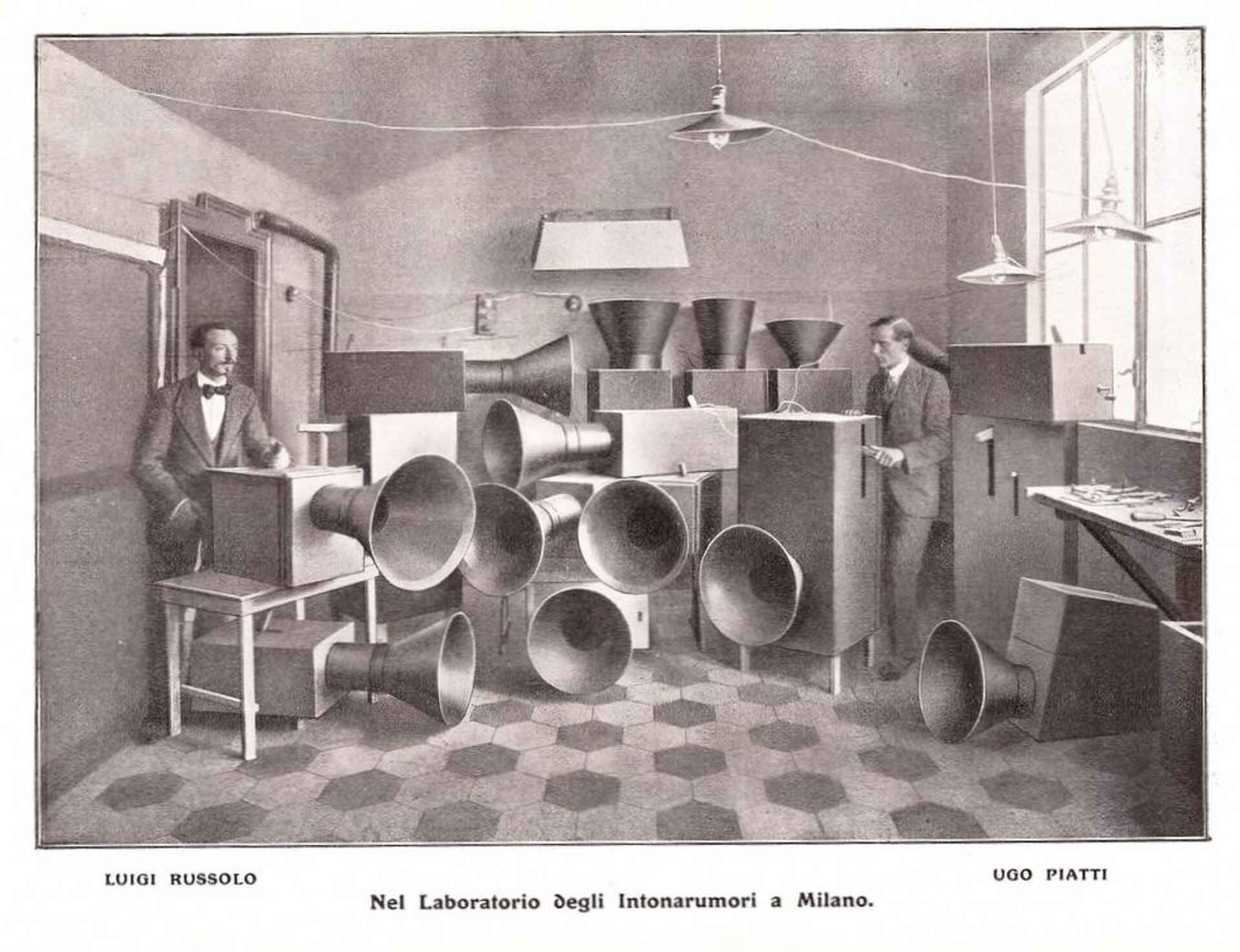
Noise Instruments by Luigi Russolo for brutalist music, 1913

Why?

We are starting our foray into time-based work with sound. This is partly because it is not typical focused on in standard art education, therefore opens up a lot of possibilities without prejudice.

Required

A Brief History of Sound Art, Barnes Foundation

Note: The lecture starts at 03:44 and Q&A begins at 01:29:07. So, the actual lecture is about 01:26. “Philosopher Christoph Cox traces the history of sound art from the invention of audio recording in the late 19th century to the genre-bending compositions of John Cage to the explosion of sound installation in the 1960s. Cox surveys a range of sonic practices, revealing how they resemble and resist approaches in the visual arts.”

Supplementary Readings

History of Sound Art
The Art of Noises: A Futurist Manifesto

The Art of Noises (Italian: L'arte dei Rumori) is a Futurist manifesto written by Luigi Russolo in a 1913 letter to friend and Futurist composer Francesco Balilla Pratella. In it, Russolo argues that the human ear has become accustomed to the speed, energy, and noise of the urban industrial soundscape; furthermore, this new sonic palette requires a new approach to musical instrumentation and composition. He proposes a number of conclusions about how electronics and other technology will allow futurist musicians to ‘substitute for the limited variety of timbres that the orchestra possesses today the infinite variety of timbres in noises, reproduced with appropriate mechanisms’. The Art of Noises is considered by some authors to be one of the most important and influential texts in 20th-century musical aesthetics.” (Text from Wikipedia.)

History of Sound Art: Audio

“An engaging sound collage presenting an unique historical documentation of a century of Sound Art from the early 20th century to 20011.

“The composition weaves through different sound works throughout the century with narratives and ideas from some of the prominent artists in the field. A retrospective into the craft of sound and its development as an artistic practice, from Edison’s first sound film in 1895 to today, including the thoughts and concepts which served the basis for the creation of these works as spoken by the artists themselves.​

T“he ‘Listening’ can be accompanied with the booklet available here that informs of the artists whose work and words are heard according to the timecode on the video.

“Commissioned by Newtoy Ltd in 2011. Created by J Milo Taylor. Mixed by Joel Cahen

“Featuring:
Sleep Research Facility, Cathy Lane, John Cage, Charlie Fox, Ros Bandt, Janet Cardiff, Brandon La Belle, Thomas Edison, Marcel Duschamp, Hugo Ball, Leon Theramin, FW Marinetti, Walter Ruttmann, Kurt Schwitters, Harry Partch, Antonin Artaud, Pierre Schaeffer and Pierre Henry, Iannis Xenakis, Louis and Bebe Barron, Pauline Oliveros, Morton Feldman, George Brecht, Richard Maxfield, Dick Higgins, Group Ongaku, Brion Gysin, Karlheinz Stockhausen, Tod Dockstader, La Monte Young, Luc Ferrari, Alvin Lucier, Bruce Nauman, Bernard Parmegiani, Francoise Bayle, R Murray Schafer, Trevor Wishart, hildegard Westerkamp, Terry Fox, David Dunn, Nam June Paik, Max Neuhaus, Throbbing Gristle, Barry Truax, Limpe Fuchs, John Oswald, Bill Fontana, Warren Burt, David Cunningham, Laurie Anderson, Gregory Whitehead, Lee Renaldo, Christian Marclay, William Burroughs, Denis Smalley, Dan Lander, Gilles Gobeil, Negativland, Trimpin, Jonty Harrison, Kim Cascone, Jodi Rose, Francisco Lopez, Bernard Leitner, Peter Vogel, Steve Roden, Pamela Z, Terre Thaemlitz, Chris Watson, David Toop, Disinformation, Atau tanaka, Dan Lander, Philip Jeck, Carsten Nicolai, Justin Bennett, David Toop, Project Dark, Steve Vitiello, Maryanne Amacher, Christina Kubisch, John Bischoff, Andres Bosshard, Iris Garrelfs, Peter Cusack, Steve Barsotti, Andrea Polli, James Webb, Nic Collins, DJ Spooky, Rainer Linz, Salomé Voegelin, David Lee Myers, David Chesworth and Sonia Leiber, Karlheinz Essl, Dallas Simpson, FM3, Matthew Mullane, Ultra-Red, Tony Herrington, Dan Senn, John Wynne and Susan Philipsz.”

History of Sound Art: Timeline

This timeline accompanies J. Milo Taylor's “engaging sound collage presenting an unique historical documentation of a century of Sound Art from the early 20th century to 2011." You can also see the entire timeline as a scrollable, single-page PDF: https://www.dropbox.com/scl/fi/dkbnw9ej90kltp0kl51j2/taylor_history-of-sound-art-vertical.pdf?rlkey=t60n33yn5nkts7eds0130ql96&st=mbibe8xa&dl=0

Sound Artists
Sound Artists: A List

This is a spreadsheet listing sound artists along with links to help with further research.

Pauline Oliveros
Pauline Oliveros on The Power of Listening | Red Bull Music Academy, Red Bull Music Academy

“Pioneering artist Pauline Oliveros recalled how she created her own instruments and how listening can help change how you hear in her 2016 Red Bull Music Academy lecture.”

The Difference Between Hearing and Listening | Pauline Oliveros | TEDxIndianapolis, TEDx Talks

“Sounds carry intelligence. If you are too narrow in your awareness of sounds, you are likely to be disconnected from your environment. Ears do not listen to sounds; the brain does. Listening is a lifetime practice that depends on accumulated experiences with sound; it can be focused to detail or open to the entire field of sound. Octogenarian composer and sound art pioneer Pauline Oliveros describes the sound experiment that led her to found an institute related to Deep Listening, and develop it as a theory relevant to music, psychology, and our collective quality of life. Pauline is a composer and accordionist who significantly contributed to the development of electronic music. The culmination of her life-long fascination with music and sound is what inspired the practice of Deep Listening, the art of listening and responding to environmental conditions. As a Professor of Practice in the Arts Department at Rensselaer Polytechnic Institute, she produced highly regarded work as a composer and improviser. Pauline’s 1989 recording, Deep Listening, is considered a classic in her field.”

KQED Spark: Pauline Oliveros, KQED

“Spark makes acquaintance with Pauline Oliveros, the internationally renowned pioneer in electronic and improvisational music. Original air date: February 2004.”

Pauline Oliveros, Sonosphere

“This episode of Sonosphere takes a look at the life and work of composer Pauline Oliveros through the eyes and ears of those who worked with her and learned from her. We spoke with Claire Chase, Wu Fei, Monique Buzzarte, Tara Rodgers, and Kerry O'Brien about how Pauline touched their lives personally and professionally, and how her legacy shaped the musical world of today.”

The Sensual Nature of Sound: 4 Composers Laurie Anderson Tania Leon Meredith Monk Pauline Oliveros

The Sensual Nature of Sound portrays these New York based composer/performers in terms of their musical lives. Although all four women are pioneers in American music, each composer pursues a distinct direction of her own. Since the early 1980s, Laurie Anderson has used music and performance as the foundation for her multi-media stage shows which have since become her trademark. Cuban born Tania Leon composes orchestral music that is an intricate weave of Afro-Cuban and Latin jazz elements embedded within a classical Western concerto format. Meredith Monk experiments with new ideas in music theater and has developed a genre of opera very much her own. Pauline Oliveros draws upon the rich resources of ritual, myth, meditation, and improvisation to create a body of work that is truly visionary. Filmed at rehearsals and performances in the United States and abroad, The Sensual Nature of Sound examines the contributions of these diverse composers to contemporary American music.”

Note: Kanopy videos are mercurial—sometimes they are available, and sometimes they are not. If this video is unavailable on Kanopy, just find it elsewhere, or find a different "reading."

Listening
Pauline Oliveros on The Power of Listening | Red Bull Music Academy, Red Bull Music Academy

“Pioneering artist Pauline Oliveros recalled how she created her own instruments and how listening can help change how you hear in her 2016 Red Bull Music Academy lecture.”

The Difference Between Hearing and Listening | Pauline Oliveros | TEDxIndianapolis, TEDx Talks

“Sounds carry intelligence. If you are too narrow in your awareness of sounds, you are likely to be disconnected from your environment. Ears do not listen to sounds; the brain does. Listening is a lifetime practice that depends on accumulated experiences with sound; it can be focused to detail or open to the entire field of sound. Octogenarian composer and sound art pioneer Pauline Oliveros describes the sound experiment that led her to found an institute related to Deep Listening, and develop it as a theory relevant to music, psychology, and our collective quality of life. Pauline is a composer and accordionist who significantly contributed to the development of electronic music. The culmination of her life-long fascination with music and sound is what inspired the practice of Deep Listening, the art of listening and responding to environmental conditions. As a Professor of Practice in the Arts Department at Rensselaer Polytechnic Institute, she produced highly regarded work as a composer and improviser. Pauline’s 1989 recording, Deep Listening, is considered a classic in her field.”

Pauline Oliveros, Sonosphere

“This episode of Sonosphere takes a look at the life and work of composer Pauline Oliveros through the eyes and ears of those who worked with her and learned from her. We spoke with Claire Chase, Wu Fei, Monique Buzzarte, Tara Rodgers, and Kerry O'Brien about how Pauline touched their lives personally and professionally, and how her legacy shaped the musical world of today.”

Acoustic Investigation into the Syrian Regime Prison (ft. Artist Lawrence Abu Hamdan), Art21

“Riding the New York City subway, artist Lawrence Abu Hamdan makes his way to the Museum of Modern Art (MoMA), where his 2023 exhibition ‘Walled Unwalled and Other Monologues’ is underway. Using his unique methods of acoustic investigation, Abu Hamdan explores the potentials and limits of our ability to listen and truly hear. “I’ve dedicated a lot of work to thinking about a politics of listening,” says the artist. “That’s quite different to a politics of speech where everyone should have a voice because where and when those voices are heard is just as important.” At MoMA, museumgoers sit in a darkened room as Abu Hamdan appears projected on a screen, walking to a music stand before delivering the monologue at the heart of Walled Unwalled (2018). The video is one of three works in the exhibition that describe a range of strategies for listening and that make distinct political claims. Rehearsing for the performance After SFX (2018), Abu Hamdan and percussionist Eli Keszler experiment with “playing” different types of doors. In the performance, Keszler’s instrumentation complements a monologue delivered by the artist, both pointing to the nature of sonic experiences and memories as distinct from, and even in excess of, the visual. Lawrence Abu Hamdan was born in 1985 in Amman, Jordan, and currently lives and works in Dubai, UAE.”

Listening as a Shared and Social Practice

“The materials gathered here grew out of a Great Lakes Association for Sound Studies (GLASS) conference in 2022, on the theme of ‘Listening as a Shared and Social Practice.’ Responding to a turn in sound studies that considers the role of listening, the conference call invited presentations, workshops, and performances that considered the co-constitutive nature of listening. This volume contains activities and essays that create starting points for listening and noticing more deeply, through different frameworks and lenses. Several themes run throughout the collection: collective study of/though listening; embodied listening; imagination and place; resonance and response.” Contributing authors: Josh Rios, Fereshteh Toosi, Lorelei d’Andriole, Jami Reimer, Nikki Lindt, Eleni-Ira Panourgia, Lisa Sandlos, Rennie Tang, Steve Stelling, Sean Steele, and Magda Stanová.

Culture of Sound
The Siren of Scrap Metal, 99% Invisible

“Amid the noisy bustle of Mexico City, there is one iconic sound echoing on repeat in the background. A recording that blares from trucks looking to buy old household items and appliances, either to fix and resell or to sell for scrap. The crews inside these trucks are essentially scrap metal haulers and the recording is their pitch to prospective sellers. It lists out all the household castoffs they’re looking to purchase (mattresses, bed frames…) and then crescendos gloriously with this line: “…o algo de fierro viejo que vendan!” which basically means ‘…or any old metal thing you’re selling!’ This last bit has become the recording’s namesake: fierro viejo, literally ‘old iron.’”

Vuvuzela, 99% Invisible

“The vuvuzela is a two foot long injection-molded plastic horn. It only plays one note: a B flat. And it gradually became a regular feature of South African soccer. But prior to the 2010 World Cup, the rest of the world had never heard anything quite like it. Even people in the soccer world didn’t know what they were. But six years later, by the time the first game of the tournament was underway, vuvuzelas were all over. For critics, the vuvuzela was a relatively new, mass produced noisemaker. But supporters ended to think of the vuvuzela as an instrument, producing a loud, attention grabbing sound that grew out of South Africa’s rich footballing tradition.”

Bleep!, 99% Invisible

“Note: This episode contains references to adult language, and might not be suitable for younger listeners. You’ll likely know within the first fifteen seconds if this episode is appropriate for your children. There’s a particular one-kilohertz tone that is universally understood to be covering up inappropriate words on radio and TV. But there are other options, too, like silence—so why did this particular *bleep* sound become ubiquitous?”

The Sound of the Artificial World, 99% Invisible

“Without all the beeps and chimes, without sonic feedback, all of your modern conveniences would be very hard to use. If a device and its sounds are designed correctly, it creates a special “theater of the mind” that users completely buy into. Electronic things are made to feel mechanical. It’s the feeling of movement, texture and articulation where none exists. We talk with Sound Designer Jim McKee of Earwax Productions about the art of designing organic sounds for inorganic things.”

The Los Angeles Leaf Blower Wars, 99% Invisible

“The leaf blower is one of the most hated objects in the modern world. They’re loud, they pollute, and. . . how important is a leafless lawn anyway? In a lot of towns and cities, the gas-powered leaf blower has been banned. In others, there are strict guidelines on where and when they can be used. But in Los Angeles, California, the leaf blower has never gone quiet.”

Sound and Health: Hospitals, 99% Invisible

“Sounds can have serious impacts on our wellbeing, even (or especially) in places focused on health like hospitals. This is the second episode in a two-part series [. . .] about how sound can be designed to reduce harm and even improve wellbeing.”

Sound and Health: Cities, 99% Invisible

“Is our blaring modern soundscape harming our health? Cities are noisy places and while people are pretty good at tuning it out on a day-to-day basis our sonic environments have serious, long-term impacts on our mental and physical health. This is part one in a two-part series supported by the Robert Wood Johnson Foundation about how sound can be designed to reduce harm and even improve wellbeing.Many of the sounds we hear are created with very little thought for how they interact with each other. Some of these are byproducts of modern technologies, like engine sounds or the hums of computers. Others are made intentionally, like alarms or cellphone rings. There are the sounds of overhead planes, air conditioning units, stores pumping out music, sirens and then people talking loudly to be heard over the rest of the noise. Then there are cars, which may be the biggest culprit.”

The Laff Box, 99% Invisible

“What happened to the laugh track? For nearly five decades, it was ubiquitous, simulating in-person audience experiences in home living rooms. But beginning in the early 2000s, it fell out of sitcom fashion. So how did we get from Beverly Hillbillies to 30 Rock?”

Bone Music, 99% Invisible

“In 1950s Soviet Russia, citizens craved Western popular music—everything from jazz to rock & roll. But smuggling vinyl was dangerous, and acquiring the scarce material to make copies of those records that did make it into the country was expensive. An ingenuous solution to this problem began to emerge in the form of ‘bone music.’”

The Sizzle, 99% Invisible

“The first trademark for a sound in the United States was issued in 1978 to NBC for their chimes. MGM has a sound trademark for their roaring lion, as does 20th Century Fox for their trumpet fanfare. Harley Davidson tried to trademark the sound of their motorcycles, but after years of litigation, they finally withdrew their application. Right now there are fewer than two hundred active trademarks for sounds. A surprisingly small number, considering sound has the power make — or break — a brand. Consider, for instance, the fajita. Specifically, the”sizzling fajitas”of the restaurant chain Chili’s.”

Response Questions

Remember to cite specific instances from the text to support your views.

  • Which artists/projects mentioned resonated with you and why?
  • What excites you about or causes you to hesitate when it comes to making your own sound art given what was mentioned in the lecture?