Why?
We are starting our foray into time-based work with sound. This is partly because it is not typical focused on in standard art education, therefore opens up a lot of possibilities without prejudice.
Required
A Brief History of Sound Art, Barnes Foundation
Note: The lecture starts at 03:44 and Q&A begins at 01:29:07. So, the actual lecture is about 01:26. “Philosopher Christoph Cox traces the history of sound art from the invention of audio recording in the late 19th century to the genre-bending compositions of John Cage to the explosion of sound installation in the 1960s. Cox surveys a range of sonic practices, revealing how they resemble and resist approaches in the visual arts.”
Supplementary Readings
- History of Sound Art
-
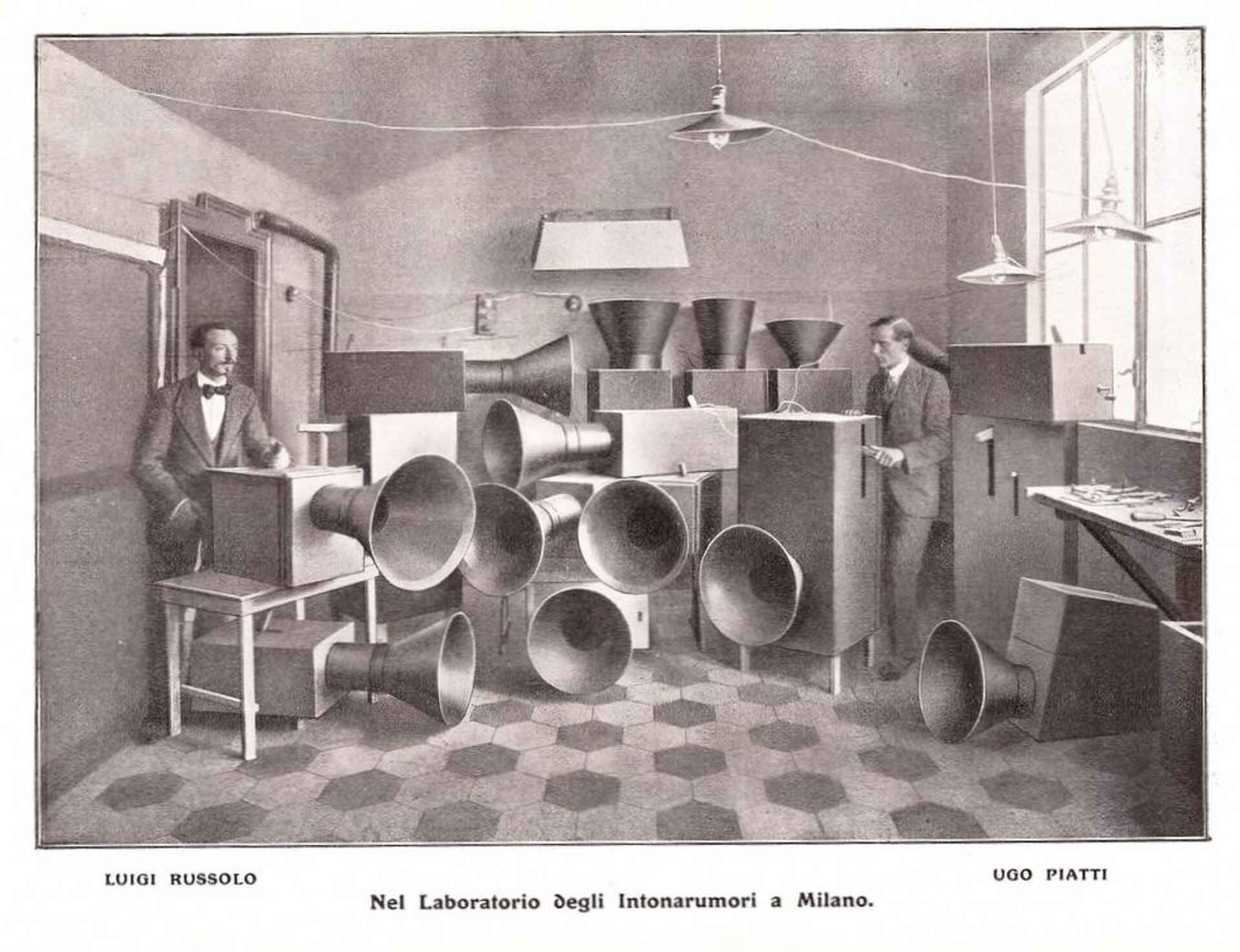
The Art of Noises: A Futurist Manifesto
“The Art of Noises (Italian: L'arte dei Rumori) is a Futurist manifesto written by Luigi Russolo in a 1913 letter to friend and Futurist composer Francesco Balilla Pratella. In it, Russolo argues that the human ear has become accustomed to the speed, energy, and noise of the urban industrial soundscape; furthermore, this new sonic palette requires a new approach to musical instrumentation and composition. He proposes a number of conclusions about how electronics and other technology will allow futurist musicians to ‘substitute for the limited variety of timbres that the orchestra possesses today the infinite variety of timbres in noises, reproduced with appropriate mechanisms’. The Art of Noises is considered by some authors to be one of the most important and influential texts in 20th-century musical aesthetics.” (Text from Wikipedia.)
History of Sound Art: Audio
“An engaging sound collage presenting an unique historical documentation of a century of Sound Art from the early 20th century to 20011.
“The composition weaves through different sound works throughout the century with narratives and ideas from some of the prominent artists in the field. A retrospective into the craft of sound and its development as an artistic practice, from Edison’s first sound film in 1895 to today, including the thoughts and concepts which served the basis for the creation of these works as spoken by the artists themselves.
T“he ‘Listening’ can be accompanied with the booklet available here that informs of the artists whose work and words are heard according to the timecode on the video.
“Commissioned by Newtoy Ltd in 2011. Created by J Milo Taylor. Mixed by Joel Cahen
“Featuring:
Sleep Research Facility, Cathy Lane, John Cage, Charlie Fox, Ros Bandt, Janet Cardiff, Brandon La Belle, Thomas Edison, Marcel Duschamp, Hugo Ball, Leon Theramin, FW Marinetti, Walter Ruttmann, Kurt Schwitters, Harry Partch, Antonin Artaud, Pierre Schaeffer and Pierre Henry, Iannis Xenakis, Louis and Bebe Barron, Pauline Oliveros, Morton Feldman, George Brecht, Richard Maxfield, Dick Higgins, Group Ongaku, Brion Gysin, Karlheinz Stockhausen, Tod Dockstader, La Monte Young, Luc Ferrari, Alvin Lucier, Bruce Nauman, Bernard Parmegiani, Francoise Bayle, R Murray Schafer, Trevor Wishart, hildegard Westerkamp, Terry Fox, David Dunn, Nam June Paik, Max Neuhaus, Throbbing Gristle, Barry Truax, Limpe Fuchs, John Oswald, Bill Fontana, Warren Burt, David Cunningham, Laurie Anderson, Gregory Whitehead, Lee Renaldo, Christian Marclay, William Burroughs, Denis Smalley, Dan Lander, Gilles Gobeil, Negativland, Trimpin, Jonty Harrison, Kim Cascone, Jodi Rose, Francisco Lopez, Bernard Leitner, Peter Vogel, Steve Roden, Pamela Z, Terre Thaemlitz, Chris Watson, David Toop, Disinformation, Atau tanaka, Dan Lander, Philip Jeck, Carsten Nicolai, Justin Bennett, David Toop, Project Dark, Steve Vitiello, Maryanne Amacher, Christina Kubisch, John Bischoff, Andres Bosshard, Iris Garrelfs, Peter Cusack, Steve Barsotti, Andrea Polli, James Webb, Nic Collins, DJ Spooky, Rainer Linz, Salomé Voegelin, David Lee Myers, David Chesworth and Sonia Leiber, Karlheinz Essl, Dallas Simpson, FM3, Matthew Mullane, Ultra-Red, Tony Herrington, Dan Senn, John Wynne and Susan Philipsz.”History of Sound Art: Timeline
This timeline accompanies J. Milo Taylor's “engaging sound collage presenting an unique historical documentation of a century of Sound Art from the early 20th century to 2011." You can also see the entire timeline as a scrollable, single-page PDF: https://www.dropbox.com/scl/fi/dkbnw9ej90kltp0kl51j2/taylor_history-of-sound-art-vertical.pdf?rlkey=t60n33yn5nkts7eds0130ql96&st=mbibe8xa&dl=0
- Sound Artists
-
Sound Artists: A List
This is a spreadsheet listing sound artists along with links to help with further research.
- Pauline Oliveros
-
Pauline Oliveros on The Power of Listening | Red Bull Music Academy, Red Bull Music Academy
“Pioneering artist Pauline Oliveros recalled how she created her own instruments and how listening can help change how you hear in her 2016 Red Bull Music Academy lecture.”
The Difference Between Hearing and Listening | Pauline Oliveros | TEDxIndianapolis, TEDx Talks
“Sounds carry intelligence. If you are too narrow in your awareness of sounds, you are likely to be disconnected from your environment. Ears do not listen to sounds; the brain does. Listening is a lifetime practice that depends on accumulated experiences with sound; it can be focused to detail or open to the entire field of sound. Octogenarian composer and sound art pioneer Pauline Oliveros describes the sound experiment that led her to found an institute related to Deep Listening, and develop it as a theory relevant to music, psychology, and our collective quality of life. Pauline is a composer and accordionist who significantly contributed to the development of electronic music. The culmination of her life-long fascination with music and sound is what inspired the practice of Deep Listening, the art of listening and responding to environmental conditions. As a Professor of Practice in the Arts Department at Rensselaer Polytechnic Institute, she produced highly regarded work as a composer and improviser. Pauline’s 1989 recording, Deep Listening, is considered a classic in her field.”
KQED Spark: Pauline Oliveros, KQED
“Spark makes acquaintance with Pauline Oliveros, the internationally renowned pioneer in electronic and improvisational music. Original air date: February 2004.”
Pauline Oliveros, Sonosphere
“This episode of Sonosphere takes a look at the life and work of composer Pauline Oliveros through the eyes and ears of those who worked with her and learned from her. We spoke with Claire Chase, Wu Fei, Monique Buzzarte, Tara Rodgers, and Kerry O'Brien about how Pauline touched their lives personally and professionally, and how her legacy shaped the musical world of today.”
The Sensual Nature of Sound: 4 Composers Laurie Anderson Tania Leon Meredith Monk Pauline Oliveros
“The Sensual Nature of Sound portrays these New York based composer/performers in terms of their musical lives. Although all four women are pioneers in American music, each composer pursues a distinct direction of her own. Since the early 1980s, Laurie Anderson has used music and performance as the foundation for her multi-media stage shows which have since become her trademark. Cuban born Tania Leon composes orchestral music that is an intricate weave of Afro-Cuban and Latin jazz elements embedded within a classical Western concerto format. Meredith Monk experiments with new ideas in music theater and has developed a genre of opera very much her own. Pauline Oliveros draws upon the rich resources of ritual, myth, meditation, and improvisation to create a body of work that is truly visionary. Filmed at rehearsals and performances in the United States and abroad, The Sensual Nature of Sound examines the contributions of these diverse composers to contemporary American music.”
Note: Kanopy videos are mercurial—sometimes they are available, and sometimes they are not. If this video is unavailable on Kanopy, just find it elsewhere, or find a different "reading."
- Listening
-
Pauline Oliveros on The Power of Listening | Red Bull Music Academy, Red Bull Music Academy
“Pioneering artist Pauline Oliveros recalled how she created her own instruments and how listening can help change how you hear in her 2016 Red Bull Music Academy lecture.”
The Difference Between Hearing and Listening | Pauline Oliveros | TEDxIndianapolis, TEDx Talks
“Sounds carry intelligence. If you are too narrow in your awareness of sounds, you are likely to be disconnected from your environment. Ears do not listen to sounds; the brain does. Listening is a lifetime practice that depends on accumulated experiences with sound; it can be focused to detail or open to the entire field of sound. Octogenarian composer and sound art pioneer Pauline Oliveros describes the sound experiment that led her to found an institute related to Deep Listening, and develop it as a theory relevant to music, psychology, and our collective quality of life. Pauline is a composer and accordionist who significantly contributed to the development of electronic music. The culmination of her life-long fascination with music and sound is what inspired the practice of Deep Listening, the art of listening and responding to environmental conditions. As a Professor of Practice in the Arts Department at Rensselaer Polytechnic Institute, she produced highly regarded work as a composer and improviser. Pauline’s 1989 recording, Deep Listening, is considered a classic in her field.”
Pauline Oliveros, Sonosphere
“This episode of Sonosphere takes a look at the life and work of composer Pauline Oliveros through the eyes and ears of those who worked with her and learned from her. We spoke with Claire Chase, Wu Fei, Monique Buzzarte, Tara Rodgers, and Kerry O'Brien about how Pauline touched their lives personally and professionally, and how her legacy shaped the musical world of today.”
Acoustic Investigation into the Syrian Regime Prison (ft. Artist Lawrence Abu Hamdan), Art21
“Riding the New York City subway, artist Lawrence Abu Hamdan makes his way to the Museum of Modern Art (MoMA), where his 2023 exhibition ‘Walled Unwalled and Other Monologues’ is underway. Using his unique methods of acoustic investigation, Abu Hamdan explores the potentials and limits of our ability to listen and truly hear. “I’ve dedicated a lot of work to thinking about a politics of listening,” says the artist. “That’s quite different to a politics of speech where everyone should have a voice because where and when those voices are heard is just as important.” At MoMA, museumgoers sit in a darkened room as Abu Hamdan appears projected on a screen, walking to a music stand before delivering the monologue at the heart of Walled Unwalled (2018). The video is one of three works in the exhibition that describe a range of strategies for listening and that make distinct political claims. Rehearsing for the performance After SFX (2018), Abu Hamdan and percussionist Eli Keszler experiment with “playing” different types of doors. In the performance, Keszler’s instrumentation complements a monologue delivered by the artist, both pointing to the nature of sonic experiences and memories as distinct from, and even in excess of, the visual. Lawrence Abu Hamdan was born in 1985 in Amman, Jordan, and currently lives and works in Dubai, UAE.”
Listening as a Shared and Social Practice
“The materials gathered here grew out of a Great Lakes Association for Sound Studies (GLASS) conference in 2022, on the theme of ‘Listening as a Shared and Social Practice.’ Responding to a turn in sound studies that considers the role of listening, the conference call invited presentations, workshops, and performances that considered the co-constitutive nature of listening. This volume contains activities and essays that create starting points for listening and noticing more deeply, through different frameworks and lenses. Several themes run throughout the collection: collective study of/though listening; embodied listening; imagination and place; resonance and response.” Contributing authors: Josh Rios, Fereshteh Toosi, Lorelei d’Andriole, Jami Reimer, Nikki Lindt, Eleni-Ira Panourgia, Lisa Sandlos, Rennie Tang, Steve Stelling, Sean Steele, and Magda Stanová.
- Culture of Sound
-
The Siren of Scrap Metal, 99% Invisible
“Amid the noisy bustle of Mexico City, there is one iconic sound echoing on repeat in the background. A recording that blares from trucks looking to buy old household items and appliances, either to fix and resell or to sell for scrap. The crews inside these trucks are essentially scrap metal haulers and the recording is their pitch to prospective sellers. It lists out all the household castoffs they’re looking to purchase (mattresses, bed frames…) and then crescendos gloriously with this line: “…o algo de fierro viejo que vendan!” which basically means ‘…or any old metal thing you’re selling!’ This last bit has become the recording’s namesake: fierro viejo, literally ‘old iron.’”
Vuvuzela, 99% Invisible
“The vuvuzela is a two foot long injection-molded plastic horn. It only plays one note: a B flat. And it gradually became a regular feature of South African soccer. But prior to the 2010 World Cup, the rest of the world had never heard anything quite like it. Even people in the soccer world didn’t know what they were. But six years later, by the time the first game of the tournament was underway, vuvuzelas were all over. For critics, the vuvuzela was a relatively new, mass produced noisemaker. But supporters ended to think of the vuvuzela as an instrument, producing a loud, attention grabbing sound that grew out of South Africa’s rich footballing tradition.”
Bleep!, 99% Invisible
“Note: This episode contains references to adult language, and might not be suitable for younger listeners. You’ll likely know within the first fifteen seconds if this episode is appropriate for your children. There’s a particular one-kilohertz tone that is universally understood to be covering up inappropriate words on radio and TV. But there are other options, too, like silence—so why did this particular *bleep* sound become ubiquitous?”
The Sound of the Artificial World, 99% Invisible
“Without all the beeps and chimes, without sonic feedback, all of your modern conveniences would be very hard to use. If a device and its sounds are designed correctly, it creates a special “theater of the mind” that users completely buy into. Electronic things are made to feel mechanical. It’s the feeling of movement, texture and articulation where none exists. We talk with Sound Designer Jim McKee of Earwax Productions about the art of designing organic sounds for inorganic things.”
The Los Angeles Leaf Blower Wars, 99% Invisible
“The leaf blower is one of the most hated objects in the modern world. They’re loud, they pollute, and. . . how important is a leafless lawn anyway? In a lot of towns and cities, the gas-powered leaf blower has been banned. In others, there are strict guidelines on where and when they can be used. But in Los Angeles, California, the leaf blower has never gone quiet.”
Sound and Health: Hospitals, 99% Invisible
“Sounds can have serious impacts on our wellbeing, even (or especially) in places focused on health like hospitals. This is the second episode in a two-part series [. . .] about how sound can be designed to reduce harm and even improve wellbeing.”
Sound and Health: Cities, 99% Invisible
“Is our blaring modern soundscape harming our health? Cities are noisy places and while people are pretty good at tuning it out on a day-to-day basis our sonic environments have serious, long-term impacts on our mental and physical health. This is part one in a two-part series supported by the Robert Wood Johnson Foundation about how sound can be designed to reduce harm and even improve wellbeing.Many of the sounds we hear are created with very little thought for how they interact with each other. Some of these are byproducts of modern technologies, like engine sounds or the hums of computers. Others are made intentionally, like alarms or cellphone rings. There are the sounds of overhead planes, air conditioning units, stores pumping out music, sirens and then people talking loudly to be heard over the rest of the noise. Then there are cars, which may be the biggest culprit.”
The Laff Box, 99% Invisible
“What happened to the laugh track? For nearly five decades, it was ubiquitous, simulating in-person audience experiences in home living rooms. But beginning in the early 2000s, it fell out of sitcom fashion. So how did we get from Beverly Hillbillies to 30 Rock?”
Bone Music, 99% Invisible
“In 1950s Soviet Russia, citizens craved Western popular music—everything from jazz to rock & roll. But smuggling vinyl was dangerous, and acquiring the scarce material to make copies of those records that did make it into the country was expensive. An ingenuous solution to this problem began to emerge in the form of ‘bone music.’”
The Sizzle, 99% Invisible
“The first trademark for a sound in the United States was issued in 1978 to NBC for their chimes. MGM has a sound trademark for their roaring lion, as does 20th Century Fox for their trumpet fanfare. Harley Davidson tried to trademark the sound of their motorcycles, but after years of litigation, they finally withdrew their application. Right now there are fewer than two hundred active trademarks for sounds. A surprisingly small number, considering sound has the power make — or break — a brand. Consider, for instance, the fajita. Specifically, the”sizzling fajitas”of the restaurant chain Chili’s.”
Response Questions
Remember to cite specific instances from the text to support your views.
- Which artists/projects mentioned resonated with you and why?
- What excites you about or causes you to hesitate when it comes to making your own sound art given what was mentioned in the lecture?