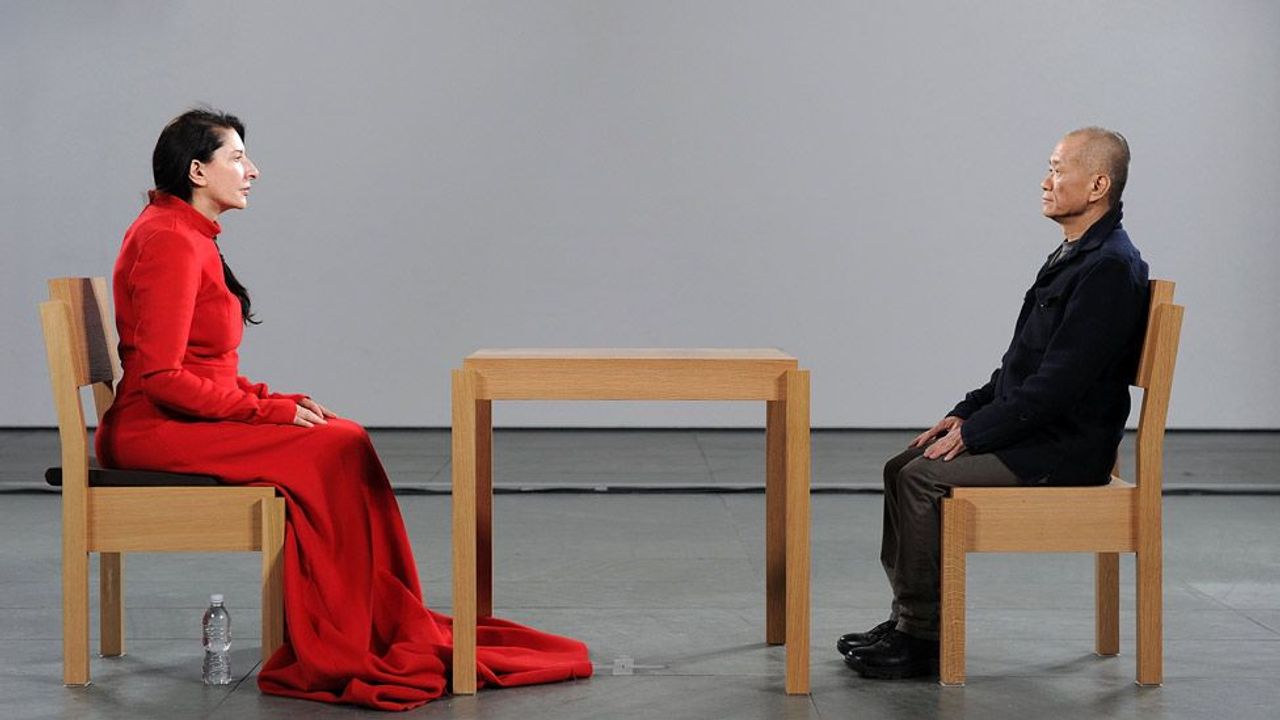
Marina Abramović
The Artist is Present, 2010
MoMA
The artist sat silently facing visitors for over 700 hours
Why?
These readings are to give you a foundation for our future discussions and work with performance art. Keep in mind that these are initial overviews of the genre and future readings will include more particulars and deeper dives into specific artists.
Performance has long been a part of visual art practices and it is difficult to extract it from experimental theater (Hugo Ball, Spalding Gray), film (Howardena Pindell, Martha Rosler), and music (Laurie Anderson, John Cage) as well as hybrid work with the plastic arts (Anne Hamilton, Senga Nengudi), since all may involve performance. Therefore, there will be overlap between performance and a number of other fields which opens up exciting possibilities. Even if you don’t work in performance art in your own practice, consider how it might play a role for you outside of just being an assignment or exercise.
Note: Due to the nature of performance art being an exploration of the body, some material below may be inappropriate for sensitive individuals. If you have concerns, please contact the instructor and they can guide you to material that will be suitable for you.
Required
The Case for Performance Art, The Art Assignment
“Dubious of performance art? Break into a cold sweat when you realize it’s about to begin? There’s a reason. Here we present you with a brief history of performance art and attempt to sway you to its potential charms. Let us know if you buy it.”
Some Thoughts On Teaching Performance Art in Five Parts, Total Art Journal
This is an abridged version. “In the classic understanding of the medium, performance art is the act of doing. It is not representing, not recounting, not re-enacting, but simply doing. It is live and it is real. It is direct action. It is not about rehearsing a text or recreating a narrative, but rather it is an experiment with a portion of one’s life. It is not about entertainment, but about the desire to learn. Ideally, performance artists are always generating new challenges for themselves, never repeating an action. Performance is driven by curiosity, and the quest is discovery, transformation, knowledge.”
Supplementary Readings
- Performance Art
-
Marina Abramović: What is Performance Art?
Abramović defines performance art as she sees it.
- Performance Art and Documentation
-
The Performativity of Performance Documentation, PAJ: A Journal of Performance and Art
“As a point of departure for my analysis here, I propose that performance documentation has been understood to encompass two categories, which I shall call the documentary and the theatrical. The documentary category represents the traditional way in which the relationship between performance art and its documentation is conceived. It is assumed that the documentation of the performance event provides both a record of it through which it can be reconstructed (though, as Kathy O'Dell points out, the reconstruction is bound to be fragmentary and incomplete') and evidence that it actually occurred. The connection between performance and document is thus thought to be ontological, with the event preceding and authorizing its documentation. Burden's performance documentation, as well as most of the documentation of classic performance and body art from the 1960s and 1970s, belongs to this category.”
Documentation Tool: Map of Interactions, Tate Research Publication
This is part of a series published by Tate about collecting and documenting performance art. “The Map of Interactions is a document that aims to provide an understanding of the networks that exist both internally and externally to Tate. These networks are critical in supporting the institution’s ability to activate performance artworks in the collection and have been developed in practice to create a tool that maps a range of interactions.”
Documentation Tool: Activation Report, Tate Research Publication
This is part of a series published by Tate about collecting and documenting performance art. “The activation report has been developed for documenting the material conditions of the activation of a performance artwork within the institution, both at Tate and beyond. This written document reflects the specific conditions of each activation of any given artwork. The activation report, the format of which is similar to the performance specification, captures new information in each instance that the artwork is brought from its dormant state through to its activated state, and seeks to capture institutional and artistic justification for consequent changes that arise from this activation.”
Documentation Tool: Performance Specification, Tate Research Publication
This is part of a series published by Tate about collecting and documenting performance art. “Developed as part of the Documentation and Conservation of Performance project, the Performance Specification is a document designed to capture written information about a performance-based artwork. The Performance Specification consists of a single central written document that captures written information about performance-based artwork. It contains seven overall category headings: ‘Artwork Requirements’, ‘Space’, ‘Time’, ‘Audience/Viewers’, ‘Performer’, ‘Physical Components’, ‘Logistics’, with two further categories: ‘Material Histories’ being captured in a separate document and ‘Activations after Acquisition’ being documented in individual folders for each instantiation of the work, saved in our artwork folder structure under ‘Display History’.”
Documentation Tool: Material History, Tate Research Publication
This is part of a series published by Tate about collecting and documenting performance art. “This tool has been developed for with the intent of mapping the material histories of the performance-based artworks in Tate’s collection. When mapping the material history of artworks, we hope to identify the material conditions of their various activations. This includes understanding, for example, what equipment and materials were used and for what, who has been involved in curating, producing, directing, or performing the work, where the activations have taken place, and the interactions between the social context and the materiality of the work. In other words, writing a material history consists of understanding how artworks evolve, how and why they change, and how those changes are traces of decision-making processes that are both material and social.”
Strategy and Glossary of Terms for the Documentation and Conservation of Performance, Tate Research Publication
This is part of a series published by Tate about collecting and documenting performance art. “Performance has been collected at Tate since 2005, with Good Feelings, Good Times 2003 by Roman Ondak being the first performance work to be acquired. These artworks fall within the remit of the time-based media conservation team, who have worked to document and conserve them. The approach to the conservation of performance was developed in the years following this first acquisition by applying existing conservation practice, working to understand each artwork and considering the short- to long-term needs of each work. At this early stage, existing documentation strategies and templates used for time-based media artworks were adapted.The approach to the documentation and conservation of performance works in the collection was revisited in early 2016, prompted by an increase in the number of performances works being collected and their increasing complexity.”
- Marina Abramović
-
Marina Abramović: What is Performance Art?
Abramović defines performance art as she sees it.
Marina Abramović: The Artist is Present
Note: Nudity, language, and adult themes
“Seductive, fearless, and outrageous, Marina Abramović has been redefining what art is for nearly forty years. Using her own body as a vehicle, pushing herself beyond her physical and mental limits–and at times risking her life in the process–she creates performances that challenge, shock, and move us. Through her and with her, boundaries are crossed, consciousness expanded, and art as we know it is reborn. She is, quite simply, one of the most compelling artists of our time.”Note: Kanopy videos are mercurial—sometimes they are available, and sometimes they are not. If this video is unavailable on Kanopy, just find it elsewhere, or find a different "reading."
- Laurie Anderson
-
The Sensual Nature of Sound: 4 Composers Laurie Anderson Tania Leon Meredith Monk Pauline Oliveros
“The Sensual Nature of Sound portrays these New York based composer/performers in terms of their musical lives. Although all four women are pioneers in American music, each composer pursues a distinct direction of her own. Since the early 1980s, Laurie Anderson has used music and performance as the foundation for her multi-media stage shows which have since become her trademark. Cuban born Tania Leon composes orchestral music that is an intricate weave of Afro-Cuban and Latin jazz elements embedded within a classical Western concerto format. Meredith Monk experiments with new ideas in music theater and has developed a genre of opera very much her own. Pauline Oliveros draws upon the rich resources of ritual, myth, meditation, and improvisation to create a body of work that is truly visionary. Filmed at rehearsals and performances in the United States and abroad, The Sensual Nature of Sound examines the contributions of these diverse composers to contemporary American music.”
Note: Kanopy videos are mercurial—sometimes they are available, and sometimes they are not. If this video is unavailable on Kanopy, just find it elsewhere, or find a different "reading."
Laurie Anderson Interview: A Life of Stories, Louisiana Channel
“Listen to the story of how Laurie Anderson became the iconic multimedia artist she is today, why she prefers to keep things simple, and how she began telling stories as a child – and never stopped: ‘I try to make stories that really engage my mind.’
When Anderson started out as an artist, she was aware that you don’t necessarily need impressive or expensive gear in order to succeed: ‘I was trying to do something on the right scale – something that you can do yourself.’ She began as a painter and sculptor and started playing the instruments she made while making little films, which she would show to a small group of artists. This enticed her to try to get her films out into a wider audience in the mid-1970s by doing ‘these little shows’ at different venues.
Laurie Anderson was interviewed by Christian Lund at the Louisiana Museum of Modern Art, Denmark in May 2016.Laurie Anderson’s Buddhism: Art, Meditation, and Death as Adventure, How to Train a Happy Mind
“Grammy Award winning artist Laurie Anderson, a longtime student of Buddhism and meditation, joined us today to share her personal path with Buddhism, approaching art with a beginner’s mind, staying present with suffering without letting it overwhelm you, and making our lives meaningful. Laurie Anderson is one of our greatest living artists. Her work includes spoken word and performance, top-charting albums and music videos, digital art, film, virtual reality, and the invention of ingenious instruments like the tape bow violin and the talking stick. She’s won the Grammy Award and many other honors, and is currently the subject of a fantastic solo show at the Hirschhorn Museum in Washington, D.C.”
Laurie Anderson: The 60 Minutes Interview, 60 Minutes
“Anderson Cooper speaks with Laurie Anderson about her five-decade career as an artist, singer, composer and storyteller, and visits her largest-ever U.S. exhibit.”
Laurie Anderson – Building an ARK | Starmus VII, Slovakia 2024, Starmus
“In this lecture from Starmus VII, titled ‘Building an ARK,’ Laurie Anderson, an avant-garde artist, composer, and filmmaker, delves into the intersection of art, technology, and storytelling. Anderson explores the concept of creating a modern ark for the 21st century, weaving together themes of artificial intelligence, language, and the human experience. Through her unique lens, Anderson challenges us to reconsider our relationship with technology and the natural world, offering a thought-provoking narrative on the future of humanity and our planet.
“Laurie Anderson is a pioneering figure in electronic music and an acclaimed multimedia artist known for her innovative use of technology in art. Her work spans performance art, pop music, and multimedia projects, often focusing on themes of politics, culture, and the human condition.”
Laurie Anderson discusses ‘Amelia’: a visionary new album inspired by Amelia Earhart, Qobuz
“In an illuminating conversation, the Chicago artist shares her vision of the future and tells the story of ‘Amelia,’ her tenth album dedicated to the aviatrix Amelia Earhart. Along the way, she discusses the album-making process, the AI revolution, and even her cogitations on life and death.”
Laurie Anderson 12-14-85 late night TV interview, BetGems Lost Media
“Laurie Anderson is interviewed for a late night TV show, as broadcast 12-14-85. The BetaGems channel also has "Laurie Anderson & Peter Gabriel video vanguard award.”
- Joseph Beuys
-
Beuys: The Life and Work of a Innovative Artist Joseph Beuys
“Thirty years after his death, Joseph Beuys still feels like a visionary and is widely considered one of the most influential artists of his generation. Known for his contributions to the Fluxus movement and his work across diverse media—from happening and performance to sculpture, installation, and graphic art—Beuys’ expanded concept of the role of the artist places him in the middle of socially relevant discourses on media, community, and capitalism. Using previously untapped visual and audio sources, director Andres Veiel has created a one-of-a-kind chronicle: BEUYS is not a portrait in the traditional sense, but an intimate and in-depth look at a human being, his art and ideas, and the way they have impacted the world.”
Note: Kanopy videos are mercurial—sometimes they are available, and sometimes they are not. If this video is unavailable on Kanopy, just find it elsewhere, or find a different "reading."
Joseph Beuys – English Subtitles – How to Explain Pictures to a Dead Hare 1/2
Joseph Beuys discusses his seminal work How to Explain Pictures to a Dead Hare on the German TV program “Club 2” am on January 27, 1983. Make sure you turn on English subtitles. Part 1.
Joseph Beuys – English Subtitles – How to Explain Pictures to a Dead Hare 2/2
Joseph Beuys discusses his seminal work How to Explain Pictures to a Dead Hare on the German TV program “Club 2” am on January 27, 1983. Make sure you turn on English subtitles. Part 2.
Filz TV (Felt TV), Identifications
“Joseph Beuys «Felt TV: Shown in TV broadcast 'Identifications'» As a contribution to Gerry Schum's 'Identifications', Beuys adapted for television the 'Felt TV' action previously staged for a live audience at a Happening festival in Copenhagen in 1966. It was the only Beuys action executed specifically for the camera. It opens with Beuys seated in front of a TV set showing a programme which is invisible because the screen is covered by felt. The boxing-gloves used later in the action lie at the ready beneath his chair. Beuys turns up the bottom left corner of the felt, revealing a glimpse of the faulty TV picture. The voice of a TV reporter, who is talking about current milk and meat prices, is still audible. Beuys declares he has 'undertaken a gradual elimination' by 'filtering away' the picture first while leaving the sound, 'but when the picture has gone, the sound becomes absurd.'”
- Chris Burden
-
Shot in the Name of Art | Op-Docs | The New York Times, The New York Times
“This short documentary celebrates the late conceptual artist Chris Burden’s landmark work ‘Shoot,’ in which a friend shot him in the arm.”
Burden
“An unprecedented look into the life of conceptual artist and sculptor Chris Burden. Whether he shot himself, squeezed into a 2-foot-square locker for 5 days, or mounted iconic sculptures, Burden rocked the art world.”
- Fluxus and Performance
-
George: The Story of George Maciunas and Fluxus: Story of an Avant-Garde Artist
Note: It gets a bit kinky 01:44:30–01:54:10.
“A feature documentary as mercurial as its subject, George Maciunas, impresario of the international avant-garde art movement Fluxus (1962–78). Fascinatingly contradictory interviews with artists, including Yoko Ono, Jonas Mekas, and Nam June Paik, and inventive sound and screen design, shape this rich portrait of a visionary artist. Dedicated to cooperative methods and expanded processes, everything could be Fluxus: kits, shops, festivals, islands, weddings, food, or Flux Lofts—the first network of artist-owned lofts in SoHo, New York. The iconoclastic Maciunas and the spirit of Fluxus provoke questions still critical to artists working today.”Note: Kanopy videos are mercurial—sometimes they are available, and sometimes they are not. If this video is unavailable on Kanopy, just find it elsewhere, or find a different "reading."
Filz TV (Felt TV), Identifications
“Joseph Beuys «Felt TV: Shown in TV broadcast 'Identifications'» As a contribution to Gerry Schum's 'Identifications', Beuys adapted for television the 'Felt TV' action previously staged for a live audience at a Happening festival in Copenhagen in 1966. It was the only Beuys action executed specifically for the camera. It opens with Beuys seated in front of a TV set showing a programme which is invisible because the screen is covered by felt. The boxing-gloves used later in the action lie at the ready beneath his chair. Beuys turns up the bottom left corner of the felt, revealing a glimpse of the faulty TV picture. The voice of a TV reporter, who is talking about current milk and meat prices, is still audible. Beuys declares he has 'undertaken a gradual elimination' by 'filtering away' the picture first while leaving the sound, 'but when the picture has gone, the sound becomes absurd.'”
- Guillermo Gomez-Peña
-
MANIFESTO — June 1: Guillermo Gomez-Peña: Manifesto
“Guillermo Gomez-Peña is a performance artist, writer, activist, radical pedagogue and director of the performance troupe La Pocha Nostra. Born in Mexico City, he moved to the US in 1978. His performance work and 10 books have contributed to the debates on cultural diversity, border culture and US-Mexico relations. His art work has been presented at over eight hundred venues across the US, Canada, Latin America, Europe, Russia, South Africa and Australia. A MacArthur Fellow, Bessie and American Book Award winner, he is a regular contributor for newspapers and magazines in the US, Mexico, and Europe and a contributing editor to The Drama Review (NYU-MIT). Gómez-Peña is a Senior Fellow of the Hemispheric Institute of Performance and Politics and a Patron for the London-based Live Art Development Agency.”
- Allan Kaprow and Happenings
-
An Interview with Allan Kaprow
“The following interview was videotaped at the Dallas Public Library Cable Access Studio in 1988 while Mr. Kaprow was attending, ‘Proceedings,’ a sympiosium in his honor held at the University of Texas at Arligngton. It was subsequently broadcast on Dallas Cable Access TV.”
The Legacy of Jackson Pollock
“Young artists of today need no longer say, ‘I am a painter’ or ‘a poet’ or ‘a dancer.’ They are simply ‘artists.’ All of life will be open to them. They will discover out of ordinary things the meaning of ordinariness. They will not try to make them extraordinary but will only state their real meaning. But out of nothing they will devise the extraordinary and then maybe nothingness as well. People will be horrified, critics will be confused or amused, but these, I am certain, will be the alchemies of the 1960s.”
How to Make a Happening: Side 1
Note: This has been edited for content. “Allan Kaprow’s How to Make a Happening was released as a LP album in 1966 by Mass Art Inc. It features Kaprow delivering 11 rules on how, and how not, to make a Happening—a movement begun by Kaprow in the late fifties that is known for its unpredictability, open scores, and constantly-evolving form.” You may read the unedited transcript here if you like.
How to Make a Happening: Side 2
Note: This has been edited for content. “On the second track, which is constructed like the first, Kaprow reads the program and notes of three recent Happenings (Soap, Calling, and Raining), which serve as loose instruction, as they involve improvisation and forces beyond human control, such as acts of nature and other uncontrolled environmental forces. These elucidations further provide a clear, if somewhat circumstantial, distinction of what does and does not constitute a Happening.” You may read the unedited transcript here if you like.
18 Happenings in 6 Parts
18 Happenings in 6 Parts
New York City
April, 1988
Reinvented as part of
Precedings
at
The University of Texas at Arlington Center for Research on Contemporary Art organized by Jeff Kelley - Tehching Hsieh
-
Tehching Hsieh – ‘All Art Comes From Life’, TateShots
“In this short film we hear the story of how Taiwanese performance artist Tehching Hsieh's life as an illegal immigrant informed his piece One Year Performance 1980-1981. Hsieh moved from Taiwan to the United States as a stowaway in 1974, living as an illegal immigrant until he was granted amnesty in 1988. For One Year Performance 1980–1981, Hsieh rigorously punched a time clock every hour for 366 days from 11 April 1980 to 11 April 1981. The resulting installation consists of letters, statements, uniforms, photographs, punch clock and a time card. Between 1978 and 1986 Hsieh made five year-long performances, followed by a thirteen-year performance of making art but not publicly showing it.”
Tehching Hsieh: An Interview, Video Data Bank On Art & Artists: Performance
”At the age of twenty-four, Taiwanese artist Tehching Hsieh (b.1950), moved to New York, where he has created and documented time-specific, conceptual art performances since the 1970s. In this interview, Hsieh discusses his formative years and philosophical moorings. This dialogue includes description of the artist's early period of painting, his military service in Taiwan, and the cultural atmosphere of a country then undergoing massive political change. Much of the discussion focuses specifically on Hsieh's understanding of the relationship of art and life, his investment in "free thinking," and the politics of documentation. For Hsieh, the ability to think freely is art's bottom line--he believes the essence of his work lies in human communication. To this end, Hsieh insists that his work, though incredibly personal, is not autobiographical, but philosophical. In this interview, works such as Cage Piece, Rope Piece, and Time Clock Piece receive special attention. Hsieh discusses his decision to stop making art after the year 2000, and how the act of being a ‘believer’ has defined his practice over the years. With reference to the processes of Vincent van Gogh, Paul Cezanne, Marcel Duchamp and Jackson Pollock, Hsieh aims to make clear the importance of painting and action to his development, while avoiding strict art historical categorizations that limit the scope of what he believes his art can achieve."
Note: Kanopy videos are mercurial—sometimes they are available, and sometimes they are not. If this video is unavailable on Kanopy, just find it elsewhere, or find a different "reading."
Tehching Hsieh: One Year Performance 1980-1981, Das Platforms
“The artist and curator Nina Miall discuss the second in Tehching Hsieh's one-year performances, commonly referred to as Time Clock Piece.”
- Senga Nengudi
-
On Art and Collaboration: Artist Talk with Maren Hassinger and Senga Nengudi, Hirshhorn Museum
“Artists Maren Hassinger and Senga Nengudi joined Hirshhorn senior curator Evelyn Hankins for a discussion on their respective cross-disciplinary practices as well as their longstanding collaboration with each other, which dates back to the early 1970s, when they were both living and working in Los Angeles. Hassinger’s practice includes sculptures, videos, and performances that reflect her background in fiber arts, sculpture, and dance. She employs her signature twisted wire rope and other unconventional materials to consider love and unity as a possibility in our common experience. Hassinger believes that issues of vanishing nature, politics, and discrimination among people are related to our inability to see ourselves as one. Hassinger was the director of the Rinehart School of Graduate Sculpture at Maryland Institute College of Art for more than twenty years before retiring in 2017. Nengudi likewise works across a wide range of media, but is particularly well-known for sculptures that combine natural and synthetic materials to explore connections between visual arts, dance, body mechanics, and matters of the spirit. Her work ‘R.S.V.P. X’ (1977/2014) entered the Hirshhorn’s collection in 2015 and was featured in Masterworks from the Hirshhorn Collection the following year. The work is part of a series of sculptures made of worn nylon stockings that are stretched, knotted, and weighed down with sand, rocks, rose petals, and other natural materials before being attached to the surrounding architecture in varying configurations. The decades-long collaboration between Hassinger and Nengudi reflects their shared interest in movement and performance, as exemplified by Hassinger’s activation of Nengudi’s ‘R.S.V.P.’ sculptures.”
How Senga Nengudi’s ‘Performance Objects’ Stretched Sculpture Into New Forms—and How She’s Still Pressing the Limits Today, Artnet News
“As a sculptor, Senga Nengudi (b. 1943) is well-known for one material in particular: nylon pantyhose, variously stretched, tied, and filled with sand, made over into abstracted renditions of the body. Yet this instantly recognizable artistic signature can also mask the depths of her work. Performance has been as fundamental to Nengudi’s practice as her materials. Her just-opened show at Art + Practice in L.A., ‘Head Back and High,’ reveals an artistic process fueled by her associations with a tight community of artists who pushed the boundaries of black contemporary art just as surely as she herself stretched nylon into new and challenging forms.”
- Yoko Ono
-
Yoko Ono: A Kind of Meeting Point, Getty: Recording Artists
“This episode focuses on Yoko Ono (b. 1933). Joining host Helen Molesworth are artists Catherine Lord and Sanford Biggers. In an interview from 1990, Ono reflects on her influences, her years on the international avant-garde scene, and the impact of her marriage on the reception of her work.”
- Martha Wilson
-
Martha Wilson: An Interview, Video Data Bank On Art & Artists: Performance
“Feminist performance artist, Martha Wilson, is director and founder of the alternative New York art space, Franklin Furnace Gallery, in operation since 1976. In this interview, Wilson discusses her Quaker upbringing, the impetus for her move from Nova Scotia to New York, and the founding of Franklin Furnace, as well as her involvement in the feminist punk band collective Disband. She also discusses her collaboration with the Guerrilla Girls, a group established in the mid 1980s to confront the art world's sexism and racism. In the interview, Wilson describes the ‘sculpting of personality’ that mobilized her early investment in art and continued to sustain her later satirical performances parodying the personas of Nancy Reagan, Barbara Bush, and Tipper Gore.”
Note: Kanopy videos are mercurial—sometimes they are available, and sometimes they are not. If this video is unavailable on Kanopy, just find it elsewhere, or find a different "reading."
Response Question
Remember to cite specific instances from the “readings” to support your views.
- What excites you about the prospect of doing performance art? What gives you pause?
- How might things we have discussed up to this point in the semester inform your approach to performance art?
- Where do you stand on the idea of documentation in performance art—is it a necessary evil, necessary good, unnecessary evil, or just plain unnecessary?