Why?
Leading up to your next assignment, these readings will give you some ideas of how sonorous objects are used in sound art—as installations, A/V recordings, or performance objects/instruments.
Required
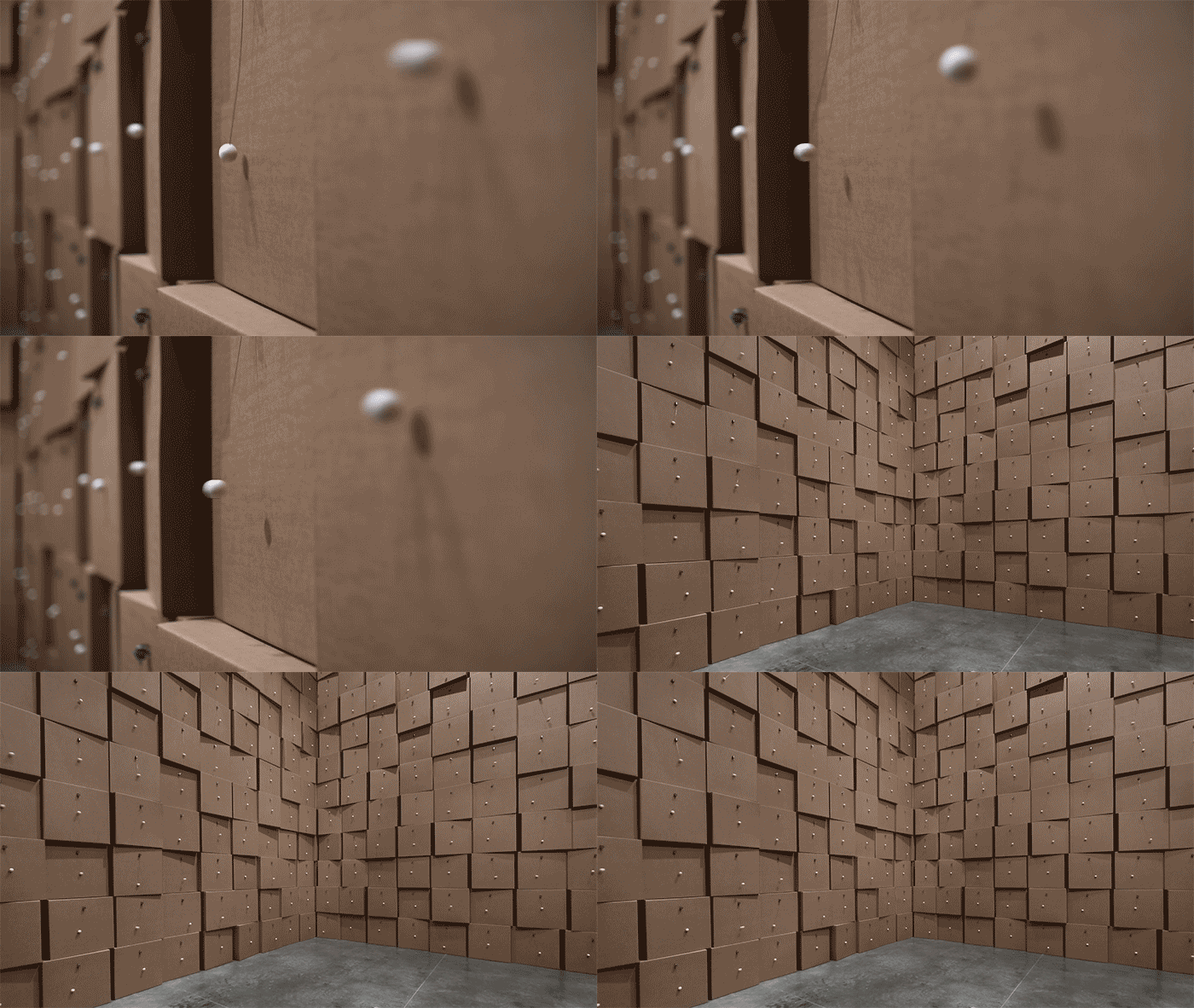
Zimoun : Compilation Video 4.3 (2024) : Sound Sculptures & Installations
You can skip around this video rather than watching it from start to finish. This provides an overview of the sound installation artist Zimoun.
Tarek Atoui, The Whisperers, 2021, Galerie Chantal Crousel
“Galerie Chantal Crousel is pleased to present a new exhibition by Tarek Atoui. The artist shows his new series, The Whisperers (2021), which continues his investigations of sound and the way it can sculpt perceptions. Tarek Atoui’s hybrid compositions create soundscapes where sound morphs through a phenomenon of translation.”
Leonel Vasquez / Canto Rodado
“‘Canto Rodado’ is the story of a river that is composed of stones that I have been collecting in various rivers in Colombia. I started a couple of years ago with the project 'Listening in times of water', for that purpose I traveled across various landscapes in Colombia listening and collecting different materials that allowed me to discover and get closer to the stories of each of the rivers I encountered. We are only seeing appearances and we are not perceiving what sustains the relationships and to understand those connections we have to enter the world of these multisensory expressions, we have to break the retinal logocentrism, so I end up producing art that besides being seen, sounds.”
Destruction Diaries 35
Jan Hakon Erichsen is known for his ridiculous performance contraptions. “Compilation of the latest videos from my Instagram @janerichsen with all new camera angles.”
Supplementary Readings
- Sonorous Objects
-
Aural Obscura, Twenty Thousand Hertz
“All over the world, there are unique and breathtaking sounds that you can only hear in one specific place. In this episode, we travel to two of the most astounding sonic wonders in the United States. The first is a hidden sound installation in Times Square that might be the most visited art exhibit on Earth. The second is an enormous organ built right into the rock of an ancient Virginian cave. These stories originally aired on the Atlas Obscura podcast.”
Making Different Sounds with a Bertoia Sculpture, Allentown Art Museum
“Our Museum Auxiliary visited Bertoia Studio in Bally, PA, on April 7, 2016, and were treated to a tour by Val Bertoia, who keeps the legacy and the sounds of his father Harry's work alive. The Museum's permanent collection includes sounding sculptures from Harry Bertoia.”
Harry Bertoia Sonambient Barn
“Visited the Harry Bertoia Sonambient Barn and studio today. This is his son, Val, as well as me and some other folks on the tour playing with the various sculptures and gongs.”
The Great Stalacpipe Organ (a cave that you play)
The world’s largest musical instrument is located underground in the Luray Caverns near Luray, VA. The interface resembles a standard church organ, but small rubber mallets strike the stalactites of the cave to create resonant tones.
This Musical Instrument Took Eons To Make
“This musical instrument is 400,000+ years old and still growing.”
Canto Rodado Polifónico | Leonel Vásquez
“Canto Rodado Polifónico
Sound Sculpture
120 x 50 x 50 cmSonorous object; wooden acoustic, analog amplification system with resonant membranes; stones from a dried or anthropogenicly intervened river in Colombia; mecanic system; motion gearbox; geared motor”
Canto Rodado Modular | Leonel Vásquez
“Canto Rodado modular
Escultura sonora · Sound sculpture
45 x 45 x 45 cmWooden acoustic, analog amplification system with resonant membranes; stone from a dried or anthropogenicly intervened river in Colombia; mecanic system; motion gearbox; geared motor”
Rafael Lozano-Hemmer in “Borderlands” Extended Segment, Art21
“Known for his large-scale, interactive installations, Rafael Lozano-Hemmer uses contemporary technologies like computerized surveillance, heart-rate sensors, and robotics to create participatory experiences and platforms for public participation and connection. The artist frequently works in and transforms public spaces, creating awe-inspiring, poetic, and critical installations, like Voz Alta: a massive megaphone system erected in a Mexico City plaza to commemorate the infamous Tlatelolco student massacre in 1968. Spurred by his Mexican heritage and the growing nationalism in the United States, Lozano-Hemmer embarks on his most ambitious project to date: Border Tuner, an enormous intercom system at the border between El Paso and Juárez that allows participants from both sides to speak and listen to each other via radio-enabled searchlights. At his studio in Montreal, the artist works with a team of scientists, engineers, programmers, architects, and designers to develop the project; at the El Paso–Juárez border, he invites local artists and performers and members of the public to use Border Tuner to listen to, share, and visualize their voices and stories.”
“The Bell Project” Hiwa K, Art21
“Kurdish-Iraqi artist Hiwa K discusses his desire to make artwork that is understandable to a wide audience. Describing his video and sculpture installation, The Bell Project (2007–2015), the artist explains how he spent years following and filming a Kurdish scrap yard owner named Nazhad, who collected the U.S. and European military waste that was sold to and used in Iraq during the Iran-Iraq and Gulf Wars. Melted down into bricks of raw metal, these weapons of war took on new life and became, as the artist states, ‘possibilities of transformation.’ Inspired by the fact that church bells were often melted down to make cannons during times of war in pre-industrial Europe, Hiwa K explains how he became interested in swapping this process by making a bell out of melted down weapons. The artist had Nazhad’s metal bricks sent to Italy, where a foundry cast the material into a large bell, adorned with Assyrian imagery. The bell, installed at MoMA PS1 in Queens, New York alongside the artist’s videos of Nazhad’s scrap yard and the Italian foundry, becomes a simple but potent depiction of the circulation of materials and how countries are linked through warfare. Expressing his own difficulty with the art often exhibited in museums and his intention to make his work intelligible to all viewers, Hiwa K states, ‘I have an affair with knowledge, I don’t have a relationship with knowledge. I don’t want to overdose my work with philosophy.’”
- Foley Artists
-
Sounds Natural, 99% Invisible
“In most wildlife films, the sounds you hear were not recorded while the cameras were rolling. Most filmmakers use long telephoto lenses to film animals, but there’s no sonic equivalent of a zoom lens. Good audio requires a microphone close to the source of the sound, which can be difficult and dangerous.”
The Magic of Making Sound
“In Hollywood, everything is magic and make-believe, even sounds. When you watch a film that immerses you completely in its world, you’re probably hearing the work of sound artists. If the work is done right, you won’t be able to tell that the “natural” sounds on screen are manufactured with studio props. That's the challenge for Warner Bros. Foley artists Alyson Moore, Chris Moriana and mixer Mary Jo Lang. Theirs is a practice in recreation, one creative element at a time.”
- Unconventional Instruments
-
Playlist: The Baschet Instrumentarium
“This video is part of a 12-part series on the Baschet instrumentarium. Each video features a specific sound sculpture. While the Baschet brothers have designed other instruments intended for performance and music therapy, these particular structures belong to the education line and are intended for sound exploration with children. Or for big children, like me!”
Cristal Baschet (an instrument that needs to be wet)
Dennis James demonstrates the Cristal Baschet that requires the player to wet their fingers before stroking glass stems that vibrate and are amplified by metal cones/resonators.
The Great Stalacpipe Organ (a cave that you play)
The world’s largest musical instrument is located underground in the Luray Caverns near Luray, VA. The interface resembles a standard church organ, but small rubber mallets strike the stalactites of the cave to create resonant tones.
This Musical Instrument Took Eons To Make
“This musical instrument is 400,000+ years old and still growing.”
Close Up Sounds of Everyday Objects
“Close-up sounds of everyday objects.”
3 Floors Instrument, My Tallest One (For Now) – CFMI Selestat
“Back in my school, CFMI de Sélestat, France, formation for ‘Musiciens Intervenants’ to create a giant installation with students”
Extended Turntable Developments Spring 2024
“An collection of clips I've uploaded to instagram over the last few months, collated here with annotations explaining what's happening. These contraptions are components for use in performance and recording with the Mechanical Techno setup and various other experimental music collaborations.”
Graham Dunning | A4 – priestor súčasnej kultúry
“Instrumental innovator Graham Dunning perceives sound as texture, colour or a haptic impulse, his playful approach based in DIY production and found object recycling. In tandem with DJ Food, he wields his record player sequencers – an unusual apparatus built on a turntable platter, which relies on specially adapted discs, optical reflex sensors, active beat coordinates and ping pong balls (!) to generate a frantic mechanical techno. Strictly Kev is another turntable dismantler and recontextualization enthusiast. Kev has been part of DJ Food (formerly the multi-producer collective Coldcut and PC) for nearly three decades. For 25 years, he was the main contributor to the radio show Solid Steel produced by – you guessed it – the Coldcut duo. Teaming up with Graham Dunning, his four-armed record player and so-called locked grooves elevate the DJ set into a performance of ceaselessly morphic sonic surfaces and rhythms.”
Christian Marclay on Night Music
“A piece by ‘turntablist’ Christian Marclay, from the October 29, 1989 episode of the short-lived music television show Night Music. Other guests that night included Todd Rundgren, Taj Mahal, Pat Metheny, and Nanci Griffith.”
Guitar Drag, Christian Marclay (1999)
“This video depicts a pickup truck dragging an amplified, electric guitar tied by a rope across a Texas roadway to its aggressive destruction. The many-layered video work references the practice of smashing guitars during rock concerts and demonstrates Marclay’s interest in inventing new types of sound. The piece was also created in response to the 1998 murder of 49-year-old James Byrd, Jr. of Jasper, Texas by three white supremacists and the tragedy’s widespread repercussions. Guitar Drag not only resonates with our aural and visual senses, but also simultaneously investigates multiple layers of history, race, geography, and timely social issues. Since 2000, Guitar Drag has been shown 24 times in museums and galleries, both nationally and internationally, including the Hayward Gallery in London, Gallery Koyanagi in Tokyo, Museum of Contemporary Art, Chicago, ZKM Center for Art and Media in Karlsruhe, Germany, and the Smithsonian Institution in Washington, DC. Sixteen years after its initial making, Artpace proudly presents the completed version of Marclay’s Guitar Drag for its Texas premiere.”
- Harry Partch
-
A New Note in Music: Harry Partch’s Kooky 1950s Instruments
“Composer and instrument inventor Harry Partch conducts a student music performance on his instruments, built with insights from atomic research and Partch's 30-year obsession to find the elusive tones that exist between the tones of a regular piano, at Oakland's Mills College.”
The Dreamer That Remains
“‘A Study in Loving’ and portrait at a time in Harry's life. 1972 Film by Betty Freeman and Stephen Pouliot, conducted by Jack Logan, music direction Danlee Mitchell, sound recordist Mark Hoffman. Filmed on location at San Diego State University, and Encinitas California.”
Harry Partch – Music Studio
“A documentary about Partch's hand-built microtonal instruments. Film by Madeline Tourtelot 1958. Purchase this on the Innova Enclosure Series at Amazon...so Harry can take everyone out for ice cream sometime soon.”
Harry Partch introducing The Bewitched, WTTW-Chicago, “Imprint”, 1957
“Harry Partch (1901-1974) with ensemble members: Danlee Mitchell, Jack McKenzie, Thomas Gauger, Michael Donzella. WTTW-Chicago, Art Director, Bob Kostka; Producer, Richard Mansfield.
“Danlee Mitchell writes (in 2022):
“The studio that the 1957 WTTW-Chicago program was held was at the WTTW TV studios located (as I recall) in the Chicago Museum of Science (or adjacent to), just south of downtown Chicago. This was after the 1957 THE BEWITCHED being performed on the UI campus (rehearsals in the Fall of 56), with an immediate runout to St. Louis. Bob Kostka, the producer of the WTTW show, was somehow acquainted with Harry, but I forget how their connection began.“Why Harry agreed to this WTTW appearance also escapes me. It only involved the Diamond Marimba, the Surrogate Kithara, and the Boo I, playing a pared-down version of a scene from BW, plus a few dancers rendering some abstract choreography. This production was but a minor foray involving Harry and a scaled down version of a scene from BW. But it did give Harry an opportunity to explain himself verbally.
“As far a traveling up to WTTW-Chicago from Champaign-Urbana, as I recall it was accomplished all in one day——drive up, unload, rehearse, shoot, load up, and drive back. I recall Tom Gauger and myself driving the instruments used up and back in a university truck. Most probably Jack McKenzie drove himself, Harry, and Mike Donzella up in a university car. In the end—yes—it was ‘rinky-dink,’ and presents a very incorrect impression concerning BW, and Harry’s vision of it.”
The Outsider: The Story of Harry Partch
“A documentary about avant-garde composer Harry Partch. Broadcast on the BBC.”
Response Question
Remember to cite specific instances from the “readings” to support your views.
- What sparked something in your thinking that may impact your project?