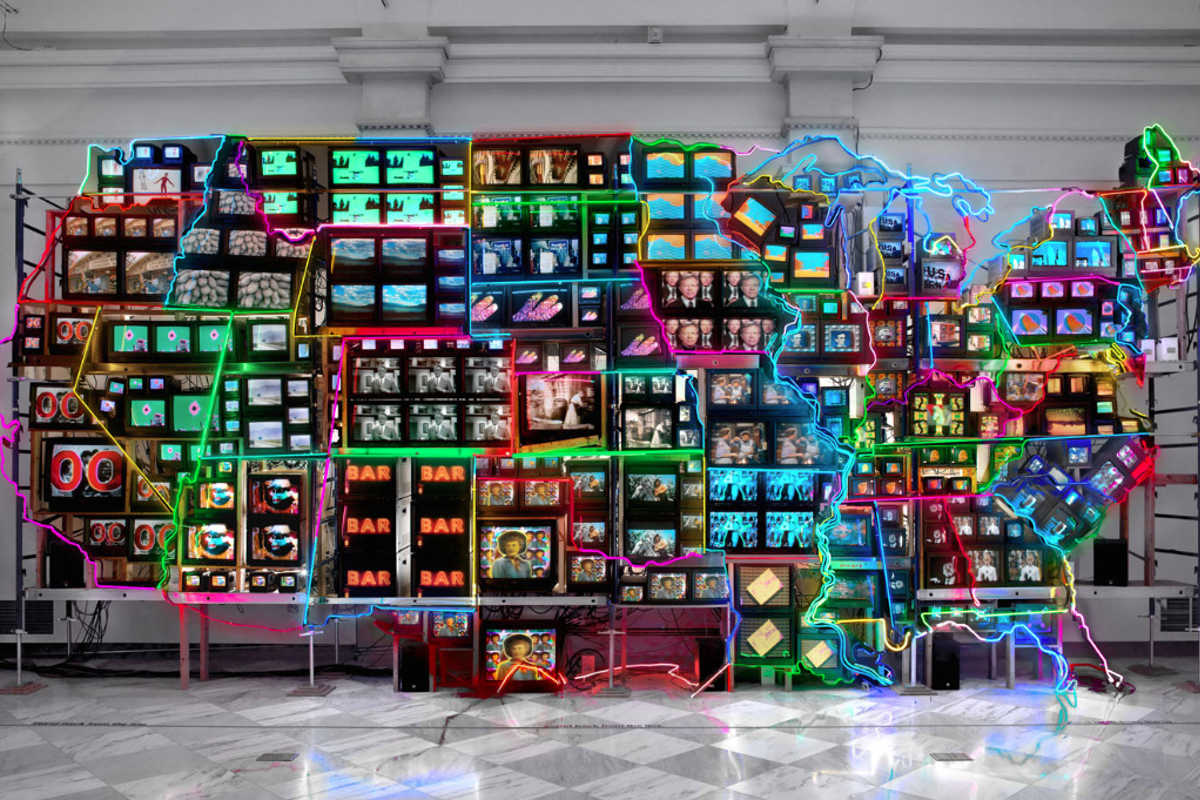
Nam June Paik (1932–2006)
Electronic Superhighway: Continental U.S., Alaska, Hawaii, 1995
Fifty-one channel video installation (including one closed-circuit television feed), custom electronics, neon lighting, steel and wood; color, sound
approx. 15 x 40 x 4 ft.
Smithsonian American Art Museum, Gift of the artist, 2002.23, © Nam June Paik Estate
Why?
Video Art emerged from the fields of experimental film and performance art and has grown in the digital age. To understand how it is practiced now and its potential for the future, it is important to understand where it came from and how it has developed.
Note: Due to the nature of video art including aspects of performance art, some material below may be inappropriate for sensitive individuals. If you have concerns, please contact the instructor and they can guide you to material that will be suitable for you.
Required
The Case for Video Art, The Art Assignment
“What is video art? How is it any different from all the other moving pictures that are apparently not-art? Let's explore its history and present.”
The Case for Video Art—Where Does It Stand Today?, Widewalls
“Ok, you say, so you have a person, that makes ‘moving pictures’ in one way or another. How does his work separates from the work of, say, movie directors who, as well, are creating ‘moving pictures’? The biggest difference between video art and movies is the disrespect of the aforementioned one to all of the latter's conventions and rules. Usually, there's got to exist at least one of three following things in a motion picture: story, actors and screenplay. Video art is not interested in that, but rather in exploring the maximum possibilities of the media, and/or to challenge viewer's ideas about the world that surrounds him/her. It usually has many forms - broadcasted recordings, projections, performances with TV sets, online streams, but today, video installation is the most common form of video art. Installation could be seen at museums and galleries, but it is often a part of some wider work, associated with design, sculpture, and architecture.”
Video Art, Explained | Neus Miró, CIFRAWORLD
“Why is this video 7 hours long? Why doesn’t it have a plot? Is TikTok secretly the future of art? Did Andy Warhol invent video art, or was he just a branding genius? And what do medieval churches have to do with our idea of beauty? We threw 8 naive questions about video art at Neus Miró—curator, art critic, professor, and certified cinephile. Her superpower is decoding the deeper story behind the screen or the white cube of the gallery. But one of her true passions is movies. The line for tickets. The flicker of the projector. That silver screen glow. For Neus, the magic of film and video art never fades. She walked us through the history of video art, breaking down the biggest milestones and revealing what makes this medium so impactful.”
Supplementary Readings
- Video Art History
-
Video Art: The First Fifty Years
“The curator who founded MoMA's video program recounts the artists and events that defined the medium's first 50 years. Since the introduction of portable consumer electronics nearly a half century ago, artists throughout the world have adapted their latest technologies to art-making. In this book, curator Barbara London traces the history of video art as it transformed into the broader field of media art - from analog to digital, small TV monitors to wall-scale projections, and clunky hardware to user-friendly software. In doing so, she reveals how video evolved from fringe status to be seen as one of the foremost art forms of today.”
Video Art
“In this overview of a still relatively new art form, Rush (director, Palm Beach Inst. of Contemporary Art) asserts that video art emerged as an important medium just as artists embraced conceptual and performance-based art. The popularity of video art marked a shift within contemporary art toward ideas and away from an interest in any specific medium. A key strength of Rush's analysis is his explanation of the link among performance, conceptual art, and video. Rather than exploring the technical qualities of film, artists stage performances on film to communicate ideas. Rush organizes this history around three major themes: the use of video cameras as an extension of artists' own bodies, the time-based qualities of video making way for new kinds of stories, and the combination of video with electronic, digital media to form new hybrid installations.”
Encounters in Video art in Latin America
“The emergence of video art in Latin America is marked by multiple points of development, across more than a dozen artistic centers, over a period of more than twenty-five years. When it was first introduced during the 1960s, video was seen as empowering: the portability of early equipment and the possibility of instant playback allowed artists to challenge and at times subvert the mainstream media. Video art in Latin America was—and still is—closely related to the desire for social change. Themes related to gender, ethnic, and racial identity as well as the consequences of social inequality and ecological disasters have been fundamental to many artists’ practices. This compendium explores the history and current state of artistic experimentation with video throughout Latin America. Departing from the relatively small body of existing scholarship in English, much of which focuses on individual countries, this volume approaches the topic thematically, positioning video artworks from different periods and regions throughout Latin America in dialogue with each other. Organized in four broad sections—Encounters, Networks and Archives, Memory and Crisis, and Indigenous Perspectives—the book’s essays and interviews encourage readers to examine the medium of video across varied chronologies and geographies.”
- Interviews with Video Artists
-
Art21: Video Art
This is the Art21 database of segments concerning video art and artists. Be aware that not all content may be suitable for a BYU audience. Proceed with caution.
“The Last Post”: Shahzia Sikander, Art21
“Artist Shahzia Sikander, filmed in her Manhattan studio, discusses her animated video work The Last Post (2010). Sikander also describes how beginning to create animations was a natural evolution in her studio process because she had already been working with narrative and layering in her paintings and large-scale installations.”
Programming: Jenny Holzer, Art21
“Jenny Holzer’s history as a typesetter feels obvious, once you’re acquainted with her signature text-based artworks. From PROTECT PROTECT at the Museum of Contemporary Art, Chicago, Holzer recounts her fondness for programming the LED electronics that display her statements. Within the programming process, Holzer curates the speed of the revolving message, and orchestrates the pauses and flashes of the phrase. The emission of light by the LEDs is affected by each of these variables, simultaneously influencing the mood and energy of the exhibition space.”
Writing & Difficulty: Jenny Holzer, Art21
“Jenny Holzer discusses her difficult relationship to writing during the installation of the exhibition PROTECT PROTECT at the Museum of Contemporary Art, Chicago. ‘I have no idea whether I’ll write again,’ says Holzer. ‘One reason why I left it is because I tend to write about the most ghastly subjects. So it’s not just the difficulty in having something turn out right, it’s the difficulty of staying with the material long enough to complete it.’While multiple factors have contributed to Holzer’s writing hiatus, her body of work remains as poignant and provocative as ever. Whether questioning capitalist impulses, or describing torture, Holzer’s art expresses concepts and questions through subversive lightworks which present her queries through projections or streamlined LED marquis. ‘My work might be like theater in that I hope there’s an audience,’ says the artist.”
Conversations with Noise John Akomfrah, Art21
“Known for his visually stunning, multichannel video installations, artist and filmmaker John Akomfrah shares a lesser acknowledged, but equally vital component of his work: sound. From his London studio, the artist discusses the transformative and essential role that sound has played in both his artwork and his experience of the world. Between sessions editing recently-shot footage, Akomfrah recalls his early experiences with sound. The artist witnessed the ways that music fostered the social connection at the nightclubs of his youth and co-founded the artist group Black Audio Film Collective, which saw itself primarily as an experimental auditory outfit. His seminal experience with sound came as a university student, when Akomfrah heard the music of Estonian composer Arvo Pärt for the first time. Pärt’s music reconfigured Akomfrah’s understanding of time and of himself within it, motivating his filmic work which weaves together footage from divergent time periods, histories, and themes. While aware that early critics of his work found his use of sound and music “vulgar,” Akomfrah retorts, ‘I like the vulgarity of it.’ ‘That’s the point,’ he adds. ‘The new comes into being via the pathway of vulgarity.’”
“Anlee” Pierre Huyghe, Art21
“French artist Pierre Huyghe discusses his use of Anlee, a Japanese manga character whose copyrights he purchased and loans out to other artists. ‘Normally this kind of sign [Anlee] is bought by people to make advertising or cartoon. It’s a support for narrative,’ says the artist. ‘We give this character to different artists. Different authors speak through this character, in a certain way.’ Anlee has been featured in Huyghe’s One Million Kingdoms (2001), Two Minutes Out of Time (2000), and as part of No Ghost Just a Shell (1999–2003), a collaboration with artist Philippe Parreno.”
Pierre Huyghe in “Romance”, Art21
“‘As I start a project, I always need to create a world. Then I want to enter this world, and my walk through this world is the work,’ says Pierre Huyghe, who lives in both Paris and New York. Huyghe’s films, installations, and public events range from a small-town parade to a puppet theater, from a model amusement park to an expedition in Antarctica. ‘I’m trying to be less narrative, it’s more an emotional landscape that I’m trying to reach here,’ he explains. Huyghe describes how, through the documentation of his scripted realities, he is ‘building a kind of mythology.’ Huyghe believes that his exhibitions are not the endpoint, but rather ‘the starting point to go somewhere else.’”
Response Question
Remember to cite specific instances from the “readings” to support your views.
- What excites you about the prospect of doing video art? What gives you pause?
- How might things we have discussed up to this point in the semester inform your approach to video art?